Sennacherib Summary
STEPBible TIPNR
Sennacherib and Sargon were Assyrian kings who led military campaigns against Judah during the reigns of King Hezekiah and King Ahaz, respectively.
King of Assyria (2KI 18:13)
Loading book references…
Sennacherib and Sargon were Assyrian kings who led military campaigns against Judah during the reigns of King Hezekiah and King Ahaz, respectively.
Sennacherib and Sargon were powerful Assyrian kings who significantly impacted the kingdom of Judah. Sargon II, mentioned in Isa 20:1, was the king of Assyria who conquered Ashdod, a Philistine city. This event occurred during the reign of King Ahaz of Judah and served as a warning of the impending Assyrian threat. Sennacherib, Sargon's son and successor, is more prominently featured in the biblical narrative (2Kings 18-19; 2Chronicles 32; Isaiah 36-37). He invaded Judah during the reign of King Hezekiah and besieged Jerusalem. Sennacherib demanded tribute from Hezekiah and threatened to destroy the city. Hezekiah prayed to God for deliverance, and the prophet Isaiah prophesied that God would defend Jerusalem. As a result, the Assyrian army was miraculously defeated, and Sennacherib returned to Nineveh, where he was later assassinated by his own sons. These accounts demonstrate God's power to protect His people and the fulfillment of prophetic words.
Sin (the god) sends many brothers, son of Sargon, whom he succeeded on the throne of Assyria (B.C. 705), in the 23rd year of Hezekiah. “Like the Persian Xerxes, he was weak and vainglorious, cowardly under reverse, and cruel and boastful in success.” He first set himself to break up the powerful combination of princes who were in league against him. Among these was Hezekiah, who had entered into an alliance with Egypt against Assyria. He accordingly led a very powerful army of at least 200,000 men into Judea, and devastated the land on every side, taking and destroying many cities (2 Kings 18:13-16; comp. Isa. 22, 24, 29, and 2 Chr. 32:1-8). His own account of this invasion, as given in the Assyrian annals, is in these words: “Because Hezekiah, king of Judah, would not submit to my yoke, I came up against him, and by force of arms and by the might of my power I took forty-six of his strong fenced cities; and of the smaller towns which were scattered about, I took and plundered a countless number. From these places I took and carried off 200,156 persons, old and young, male and female, together with horses and mules, asses and camels, oxen and sheep, a countless multitude; and Hezekiah himself I shut up in Jerusalem, his capital city, like a bird in a cage, building towers round the city to hem him in, and raising banks of earth against the gates, so as to prevent escape...Then upon Hezekiah there fell the fear of the power of my arms, and he sent out to me the chiefs and the elders of Jerusalem with 30 talents of gold and 800 talents of silver, and divers treasures, a rich and immense booty...All these things were brought to me at Nineveh, the seat of my government.” (Comp. Isa. 22:1-13 for description of the feelings of the inhabitants of Jerusalem at such a crisis.)
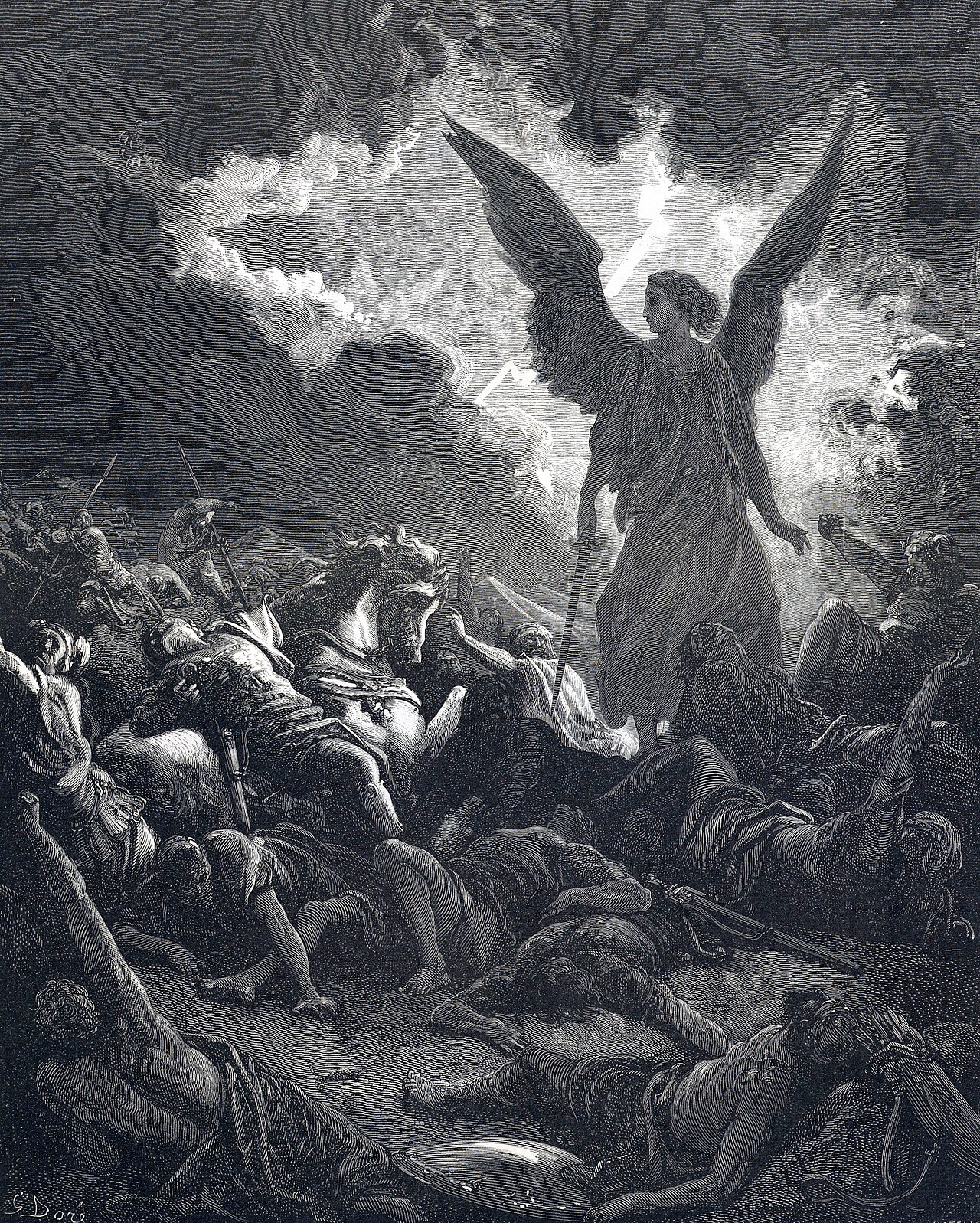
Hezekiah was not disposed to become an Assyrian feudatory. He accordingly at once sought help from Egypt (2 Kings 18:20-24). Sennacherib, hearing of this, marched a second time into Palestine (2 Kings 18:17, 37; 19; 2 Chr. 32:9-23; Isa. 36:2-22. Isa. 37:25 should be rendered “dried up all the Nile-arms of Matsor,” i.e., of Egypt, so called from the “Matsor” or great fortification across the isthmus of Suez, which protected it from invasions from the east). Sennacherib sent envoys to try to persuade Hezekiah to surrender, but in vain. He next sent a threatening letter (2 Kings 19:10-14), which Hezekiah carried into the temple and spread before the Lord. Isaiah again brought an encouraging message to the pious king (2 Kings 19:20-34). “In that night” the angel of the Lord went forth and smote the camp of the Assyrians. In the morning, “behold, they were all dead corpses.” The Assyrian army was annihilated.
This great disaster is not, as was to be expected, taken notice of in the Assyrian annals.
Though Sennacherib survived this disaster some twenty years, he never again renewed his attempt against Jerusalem. He was murdered by two of his own sons (Adrammelech and Sharezer), and was succeeded by another son, Esarhaddon (B.C. 681), after a reign of twenty-four years.
Sources: BibleData (CC BY 4.0, Sennacherib_1) · STEPBible TIPNR (CC BY 4.0, Sennacherib@2Ki.18.13-Isa) · Theographic Bible Metadata (CC BY-SA 4.0, sennacherib_2489)