Assyria Summary
STEPBible TIPNR
Assyria, a major Mesopotamian empire, frequently mentioned in the Old Testament as an adversary of Israel and Judah.
A powerful ancient empire, often in conflict with Israel.
Loading book references…
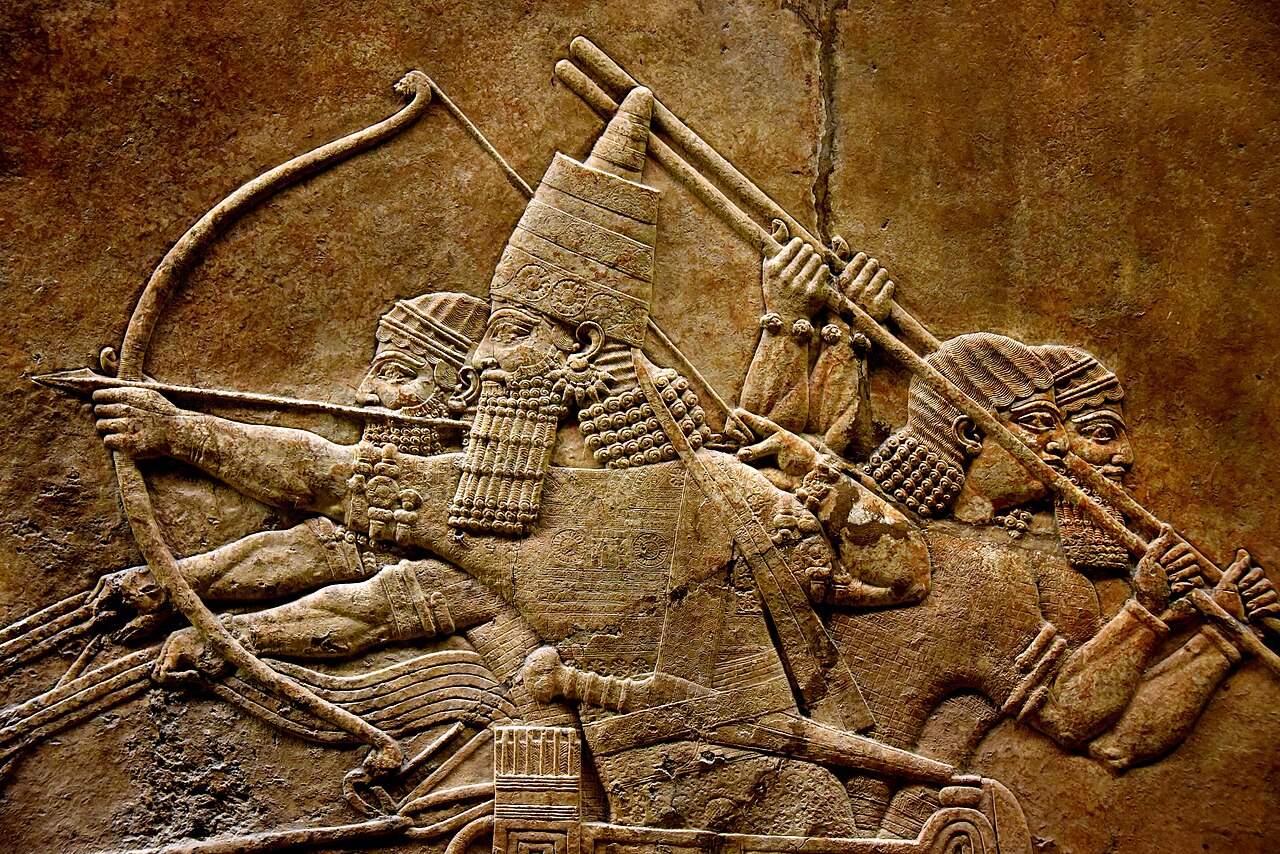
Assyria, a major Mesopotamian empire, frequently mentioned in the Old Testament as an adversary of Israel and Judah.
Assyria, also known as Asshur, was a powerful ancient empire centered in Mesopotamia, in what is now modern-day Iraq. The Assyrians are mentioned extensively throughout the Old Testament, often in the context of their military conquests and their interactions with the kingdoms of Israel and Judah.
The name "Asshur" first appears in Genesis 10:11, where it is associated with Nimrod, who is said to have built several cities, including Nineveh, the capital of Assyria. In Genesis 25:18, the descendants of Ishmael are described as living in the region from Havilah to Shur, near the border of Egypt, as one goes toward Assyria.
Assyria began to emerge as a significant power in the 9th century BC, and its kings are mentioned in the books of Kings and Chronicles. The Assyrian king Shalmaneser III is recorded as receiving tribute from Jehu, king of Israel (2Ki.15.19-20). Later, Tiglath-Pileser III, also known as Pul, conquered parts of Israel and deported some of its inhabitants (2Ki.15.29; 1Ch.5.6, 26).
The Assyrian Empire reached its zenith during the reign of Sennacherib, who is known for his military campaigns against Judah and his siege of Jerusalem during the reign of King Hezekiah (2Kings 18-19; 2Chronicles 32; Isaiah 36-37). The prophet Isaiah played a significant role in encouraging Hezekiah to trust in God and resist the Assyrian threat.
Other Assyrian kings, such as Esarhaddon and Ashurbanipal, are also mentioned in the Bible (Ezra 4:2; 2Ch.33.11). The fall of the Assyrian Empire is alluded to in the prophetic books, particularly in Nahum, which foretells the destruction of Nineveh (Nam.3.18-19).
The name derived from the city Asshur on the Tigris, the original capital of the country, was originally a colony from Babylonia, and was ruled by viceroys from that kingdom. It was a mountainous region lying to the north of Babylonia, extending along the Tigris as far as to the high mountain range of Armenia, the Gordiaean or Carduchian mountains. It was founded in B.C. 1700 under Bel-kap-kapu, and became an independent and a conquering power, and shook off the yoke of its Babylonian masters. It subdued the whole of Northern Asia. The Assyrians were Semites (Gen. 10:22), but in process of time non-Semite tribes mingled with the inhabitants. They were a military people, the “Romans of the East.”
Of the early history of the kingdom of Assyria little is positively known. In B.C. 1120 Tiglath-pileser I., the greatest of the Assyrian kings, “crossed the Euphrates, defeated the kings of the Hittites, captured the city of Carchemish, and advanced as far as the shores of the Mediterranean.” He may be regarded as the founder of the first Assyrian empire. After this the Assyrians gradually extended their power, subjugating the states of Northern Syria. In the reign of Ahab, king of Israel, Shalmaneser II. marched an army against the Syrian states, whose allied army he encountered and vanquished at Karkar. This led to Ahab’s casting off the yoke of Damascus and allying himself with Judah. Some years after this the Assyrian king marched an army against Hazael, king of Damascus. He besieged and took that city. He also brought under tribute Jehu, and the cities of Tyre and Sidon.
About a hundred years after this (B.C. 745) the crown was seized by a military adventurer called Pul, who assumed the name of Tiglath-pileser III. He directed his armies into Syria, which had by this time regained its independence, and took (B.C. 740) Arpad, near Aleppo, after a siege of three years, and reduced Hamath. Azariah (Uzziah) was an ally of the king of Hamath, and thus was compelled by Tiglath-pileser to do him homage and pay a yearly tribute.
In B.C. 738, in the reign of Menahem, king of Israel, Pul invaded Israel, and imposed on it a heavy tribute (2 Kings 15:19). Ahaz, the king of Judah, when engaged in a war against Israel and Syria, appealed for help to this Assyrian king by means of a present of gold and silver (2 Kings 16:8); who accordingly “marched against Damascus, defeated and put Rezin to death, and besieged the city itself.” Leaving a portion of his army to continue the siege, “he advanced through the province east of Jordan, spreading fire and sword,” and became master of Philistia, and took Samaria and Damascus. He died B.C. 727, and was succeeded by Shalmanezer IV., who ruled till B.C. 722. He also invaded Syria (2 Kings 17:5), but was deposed in favour of Sargon (q.v.) the Tartan, or commander-in-chief of the army, who took Samaria (q.v.) after a siege of three years, and so put an end to the kingdom of Israel, carrying the people away into captivity, B.C. 722 (2 Kings 17:1-6, 24; 18:7, 9). He also overran the land of Judah, and took the city of Jerusalem (Isa. 10:6, 12, 22, 24, 34). Mention is next made of Sennacherib (B.C. 705), the son and successor of Sargon (2 Kings 18:13; 19:37; Isa. 7:17, 18); and then of Esar-haddon, his son and successor, who took Manasseh, king of Judah, captive, and kept him for some time a prisoner at Babylon, which he alone of all the Assyrian kings made the seat of his government (2 Kings 19:37; Isa. 37:38).
Assur-bani-pal, the son of Esarhaddon, became king, and in Ezra 4:10 is referred to as Asnapper. From an early period Assyria had entered on a conquering career, and having absorbed Babylon, the kingdoms of Hamath, Damascus, and Samaria, it conquered Phoenicia, and made Judea feudatory, and subjected Philistia and Idumea. At length, however, its power declined. In B.C. 727 the Babylonians threw off the rule of the Assyrians, under the leadership of the powerful Chaldean prince Merodach-baladan (2 Kings 20:12), who, after twelve years, was subdued by Sargon, who now reunited the kingdom, and ruled over a vast empire. But on his death the smouldering flames of rebellion again burst forth, and the Babylonians and Medes successfully asserted their independence (B.C. 625), and Assyria fell according to the prophecies of Isaiah (10:5-19), Nahum (3:19), and Zephaniah (3:13), and the many separate kingdoms of which it was composed ceased to recognize the “great king” (2 Kings 18:19; Isa. 36:4). Ezekiel (31) attests (about B.C. 586) how completely Assyria was overthrown. It ceases to be a nation.
Sources: OpenBible.info Bible Geocoding Data (CC BY 4.0, a3d1321) · STEPBible TIPNR (CC BY 4.0, Assyria@Gen.2.14-Zec) · Theographic Bible Metadata (CC BY-SA 4.0, assyria_111) · Wikidata (CC0 1.0, Q856544)