Corinth Summary
STEPBible TIPNR
Corinth, an important city in ancient Greece, was the location of a Christian church to which Paul wrote two epistles.
Ancient Greek city; recipient of Paul's epistles
Remove a false statement about Romans 16:27; preserve the independently correct 2 Timothy 4:20 link to Corinth.
Corinth
Corinth was a prominent city in ancient Greece, located on the Isthmus of Corinth, which connects the Peloponnese to the mainland. It was known for its strategic location, controlling trade routes between the Aegean and Adriatic seas. The city was famous for its wealth, luxury, and immorality.
In the New Testament, Corinth plays a significant role as the location of a Christian church founded by the apostle Paul during his second missionary journey (Act.18.1-18). Paul spent 18 months in Corinth, working as a tentmaker and preaching the gospel. Many Corinthians, including Crispus, the ruler of the synagogue, believed and were baptized (Act.18.8).
After leaving Corinth, Paul wrote two epistles to the church, known as 1 and 2 Corinthians. These letters address various issues faced by the Corinthian believers, including divisions, immorality, lawsuits, and questions about spiritual gifts, resurrection, and Christian conduct.
In Romans 16:27, Paul sends greetings to the Corinthians, indicating that he wrote the epistle to the Romans while in Corinth. In 2Ti.4.20, Paul mentions that he left Erastus in Corinth, suggesting that the city continued to have a Christian presence.
Throughout the epistles, Paul refers to the Corinthian believers with affection, calling them "saints" (1Co.1.2; 2Co.1.1) and expressing his love for them (2Co.6.11; 13:13-14). The correspondence between Paul and the Corinthian church provides valuable insights into the challenges and growth of the early Christian community in a significant Gentile city.
Loading book references…
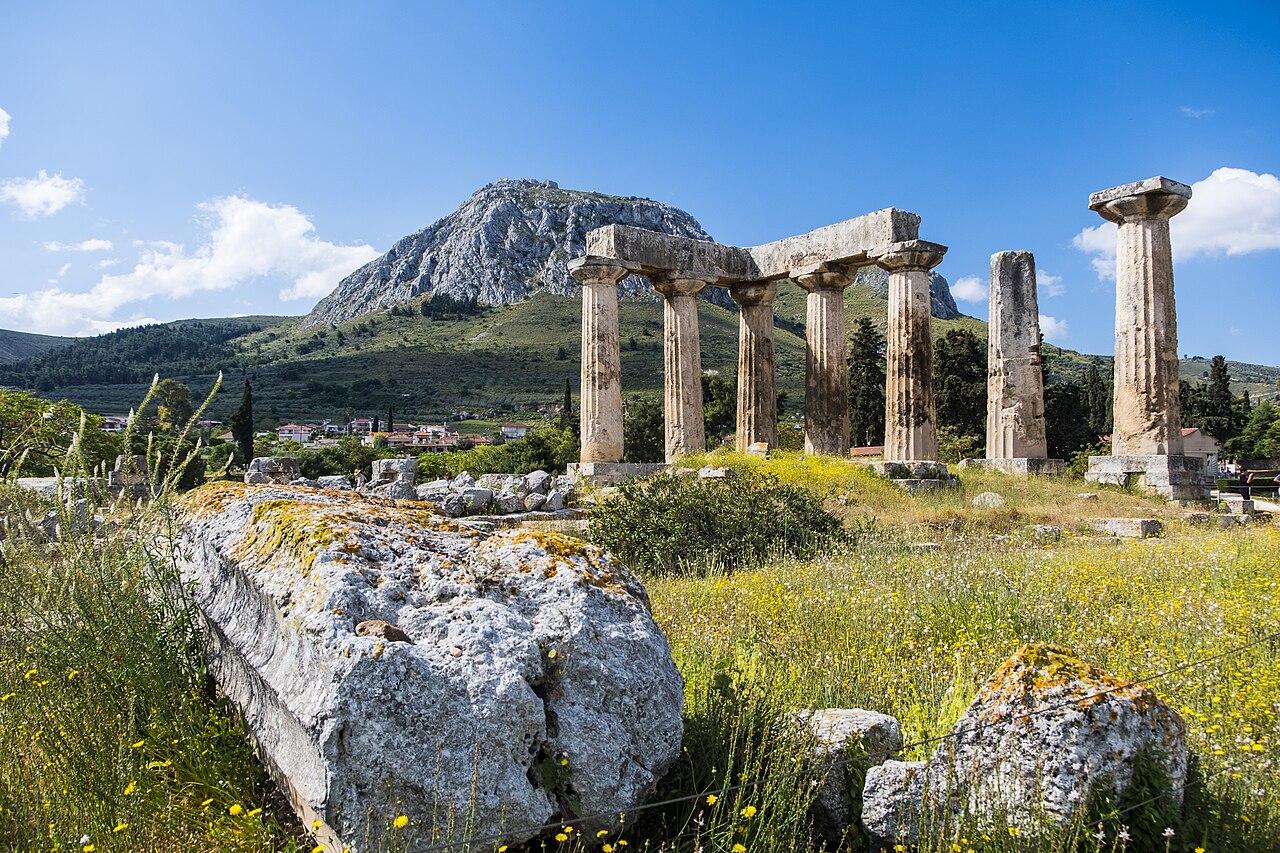
Corinth, an important city in ancient Greece, was the location of a Christian church to which Paul wrote two epistles.
Corinth was a prominent city in ancient Greece, located on the Isthmus of Corinth, which connects the Peloponnese to the mainland. It was known for its strategic location, controlling trade routes between the Aegean and Adriatic seas. The city was famous for its wealth, luxury, and immorality.
In the New Testament, Corinth plays a significant role as the location of a Christian church founded by the apostle Paul during his second missionary journey (Act.18.1-18). Paul spent 18 months in Corinth, working as a tentmaker and preaching the gospel. Many Corinthians, including Crispus, the ruler of the synagogue, believed and were baptized (Act.18.8).
After leaving Corinth, Paul wrote two epistles to the church, known as 1 and 2 Corinthians. These letters address various issues faced by the Corinthian believers, including divisions, immorality, lawsuits, and questions about spiritual gifts, resurrection, and Christian conduct.
In 2Ti.4.20, Paul mentions that he left Erastus in Corinth, suggesting that the city continued to have a Christian presence.
Throughout the epistles, Paul refers to the Corinthian believers with affection, calling them "saints" (1Co.1.2; 2Co.1.1) and expressing his love for them (2Co.6.11; 13:13-14). The correspondence between Paul and the Corinthian church provides valuable insights into the challenges and growth of the early Christian community in a significant Gentile city.
A Grecian city, on the isthmus which joins the Peloponnesus to the mainland of Greece. It is about 48 miles west of Athens. The ancient city was destroyed by the Romans (B.C. 146), and that mentioned in the New Testament was quite a new city, having been rebuilt about a century afterwards and peopled by a colony of freedmen from Rome. It became under the Romans the seat of government for Southern Greece or Achaia (Acts 18:12-16). It was noted for its wealth, and for the luxurious and immoral and vicious habits of the people. It had a large mixed population of Romans, Greeks, and Jews. When Paul first visited the city (A.D. 51 or 52), Gallio, the brother of Seneca, was proconsul. Here Paul resided for eighteen months (18:1-18). Here he first became aquainted with Aquila and Priscilla, and soon after his departure Apollos came to it from Ephesus. After an interval he visited it a second time, and remained for three months (20:3). During this second visit his Epistle to the Romans was written (probably A.D. 55). Although there were many Jewish converts at Corinth, yet the Gentile element prevailed in the church there.
Some have argued from 2 Cor. 12:14; 13:1, that Paul visited Corinth a third time (i.e., that on some unrecorded occasion he visited the city between what are usually called the first and second visits). But the passages referred to only indicate Paul’s intention to visit Corinth (comp. 1 Cor. 16:5, where the Greek present tense denotes an intention), an intention which was in some way frustrated. We can hardly suppose that such a visit could have been made by the apostle without more distinct reference to it.
Sources: OpenBible.info Bible Geocoding Data (CC BY 4.0, a6f437a) · STEPBible TIPNR (CC BY 4.0, Corinth@Act.18.1-2Ti) · Theographic Bible Metadata (CC BY-SA 4.0, corinth_306) · Wikidata (CC0 1.0, Q1363688)