The Euphrates, a major river in the ancient Near East, often served as a boundary marker for the Promised Land and was the site of significant events in biblical history.
Euphrates
PlaceMajor river in ancient Near East; boundary of Promised Land
-
en
Euphrates
that makes fruitful
- en Perath · Also called
- en Shibolet · Also called
- en River · Also called
- en Euphrates River · Also called
- en Great River · Also called
- en River Euphrates · Also called
- he פְּרָת · H6578
- he שִׁבֹּ֫לֶת · H7641G
- he נָהָר · H5104G
- he נְהַר · H5103G
- el Εὐφράτης · G2166
- bg Ефрат
SDA Books
Awaiting permission to publishLoading book references…
The Euphrates is one of the most significant rivers mentioned in the Bible, playing a crucial role in the geography, history, and prophecy of the ancient Near East. It is often referred to simply as "the River" or "Shibolet" (meaning "ear of grain") in Hebrew.
In the Garden of Eden narrative, the Euphrates is one of the four rivers that flowed from the garden (Genesis 2:14). Later, it is mentioned as part of the boundary of the Promised Land, as God promised Abraham that his descendants would inherit the land from the river of Egypt to the Euphrates (Genesis 15:18; Deu.1.7; 11:24; Joshua 1:4).
The Euphrates served as a natural boundary between the Assyrian and Babylonian empires and the kingdoms of Israel and Judah. It was the site of several significant events, such as the battle of Carchemish, where the Babylonians defeated the Egyptians (Jeremiah 46:2), and the place where Jeremiah hid a linen belt as a symbol of God's judgment on Judah (Jeremiah 13:4-7).
In the book of Revelation, the Euphrates is mentioned in connection with the sixth trumpet judgment (Revelation 9:14) and the sixth bowl judgment (Revelation 16:12), where the river is dried up to prepare the way for the kings from the east.
Throughout the Bible, the Euphrates is used as a symbol of the extent of God's promised blessings (Psalm 72:8), the reach of Israel's enemies (Isaiah 7:20; 8:7), and the future restoration of Israel (Isaiah 11:15; 27:12; Micah 7:12; Zechariah 9:10).
The Euphrates played a significant role in the history and commerce of the ancient Near East, with many important cities and civilizations situated along its banks, such as Babylon, Ur, and Carchemish. It was a vital source of water for irrigation and transportation, and its fertile floodplains supported agriculture and trade.
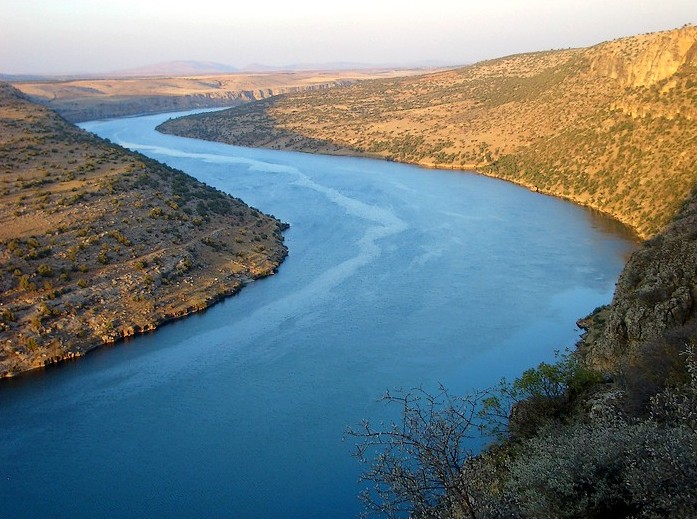
Hebrew, Perath; Assyrian, Purat; Persian cuneiform, Ufratush, whence Greek Euphrates, meaning “sweet water.” The Assyrian name means “the stream,” or “the great stream.” It is generally called in the Bible simply “the river” (Ex. 23:31), or “the great river” (Deut. 1:7).
The Euphrates is first mentioned in Gen. 2:14 as one of the rivers of Paradise. It is next mentioned in connection with the covenant which God entered into with Abraham (15:18), when he promised to his descendants the land from the river of Egypt to the river Euphrates (comp. Deut. 11:24; Josh. 1:4), a covenant promise afterwards fulfilled in the extended conquests of David (2 Sam. 8:2-14; 1 Chr. 18:3; 1 Kings 4:24). It was then the boundary of the kingdom to the north-east. In the ancient history of Assyria, and Babylon, and Egypt many events are recorded in which mention is made of the “great river.” Just as the Nile represented in prophecy the power of Egypt, so the Euphrates represented the Assyrian power (Isa. 8:7; Jer. 2:18).
It is by far the largest and most important of all the rivers of Western Asia. From its source in the Armenian mountains to the Persian Gulf, into which it empties itself, it has a course of about 1,700 miles. It has two sources, (1) the Frat or Kara-su (i.e., “the black river”), which rises 25 miles north-east of Erzeroum; and (2) the Muradchai (i.e., “the river of desire”), which rises near Ararat, on the northern slope of Ala-tagh. At Kebban Maden, 400 miles from the source of the former, and 270 from that of the latter, they meet and form the majestic stream, which is at length joined by the Tigris at Koornah, after which it is called Shat-el-Arab, which runs in a deep and broad stream for above 140 miles to the sea. It is estimated that the alluvium brought down by these rivers encroaches on the sea at the rate of about one mile in thirty years.
Sources: OpenBible.info Bible Geocoding Data (CC BY 4.0, a62dec4) · STEPBible TIPNR (CC BY 4.0, Euphrates@Gen.2.14-Rev) · Theographic Bible Metadata (CC BY-SA 4.0, euphrates_421) · Wikidata (CC0 1.0, Q34589)