Sinai, also called Mount Sinai, Horeb, or Mount Horeb, was the mountain where God gave Moses the Ten Commandments and other laws (Exod. 19-40; Lev. 7:38; 25:1; 26:46; 27:34; Num. 3:1; 28:6; Deut. 33:2; Judg. 5:5; Ps. 68:8, 17; Neh. 9:13; Mal. 4:4; Act.7.30, 38; Gal. 4:24-25).
Mount Sinai
PlaceMountain where Moses received the Ten Commandments
- en Mount Sinai
- en Sinai
- en mount Sinai · Also called
-
en
Horeb
· Also called desert; solitude; destruction
- en Mount Horeb · Also called
- en Sinai Mount · Also called
- en Sina · Also called
- he סִינַי · H5514G
- he חֹרֵב · H2722
- el Σινᾶ · G4614
- bg планината Синай
SDA Books
Awaiting permission to publishLoading book references…
Sinai, also known as Mount Sinai, Horeb, or Mount Horeb, is one of the most significant locations in the Bible. It is the mountain where God revealed Himself to Moses and gave him the Ten Commandments, as well as other laws and instructions for the Israelites.
After the Exodus from Egypt, the Israelites camped at the base of Mount Sinai for about a year (Exod. 19:1-2). During this time, God called Moses to the top of the mountain and spoke to him, giving him the Ten Commandments and other laws (Exod. 19-31). The mountain was filled with smoke, fire, and thunder, symbolizing the awesome presence of God (Exod. 19:16-19).
Moses spent forty days and forty nights on the mountain, receiving instructions from God and writing down the laws (Exod. 24:18; 34:28). He also received the two stone tablets inscribed with the Ten Commandments (Exod. 31:18; 34:1, 4, 28-29).
The location of Mount Sinai is not specified in the Bible, but tradition has identified it with Jebel Musa (Mountain of Moses) in the southern part of the Sinai Peninsula. However, some scholars have proposed alternative locations, such as Jebel al-Lawz in Saudi Arabia, based on various geographical and archaeological considerations.
Throughout the Bible, Sinai is mentioned as a symbol of God's revelation, covenant, and law (Deut. 33:2; Judg. 5:5; Ps. 68:8, 17; Neh. 9:13; Mal. 4:4). In the New Testament, Paul uses Sinai as an allegory for the old covenant, in contrast to the new covenant represented by the heavenly Jerusalem (Gal. 4:24-25).
The events at Sinai, including the giving of the Ten Commandments and the establishment of the Mosaic covenant, were pivotal moments in the history of Israel and laid the foundation for their identity as God's chosen people.
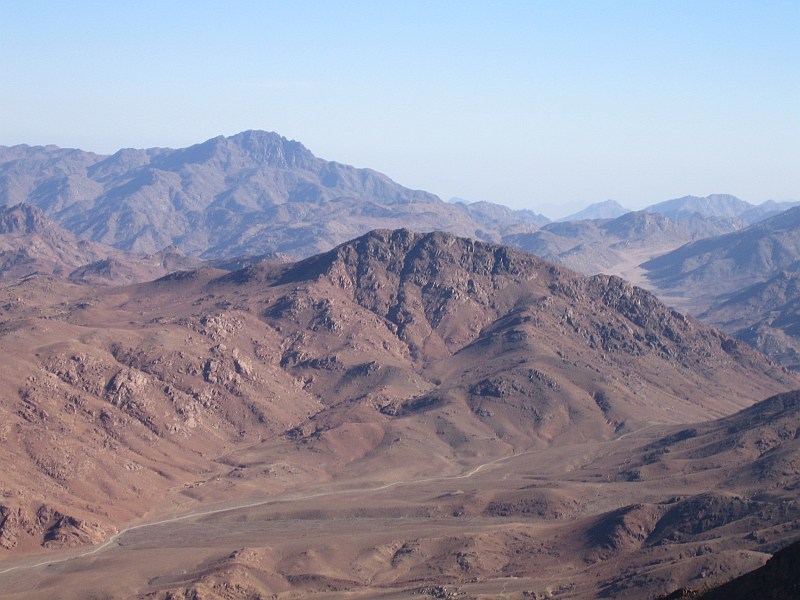
Of Sin (the moon god), called also Horeb, the name of the mountain district which was reached by the Hebrews in the third month after the Exodus. Here they remained encamped for about a whole year. Their journey from the Red Sea to this encampment, including all the windings of the route, was about 150 miles. The last twenty-two chapters of Exodus, together with the whole of Leviticus and Num. ch. 1-11, contain a record of all the transactions which occurred while they were here. From Rephidim (Ex. 17:8-13) the Israelites journeyed forward through the Wady Solaf and Wady esh-Sheikh into the plain of er-Rahah, “the desert of Sinai,” about 2 miles long and half a mile broad, and encamped there “before the mountain.” The part of the mountain range, a protruding lower bluff, known as the Ras Sasafeh (Sufsafeh), rises almost perpendicularly from this plain, and is in all probability the Sinai of history. Dean Stanley thus describes the scene:, “The plain itself is not broken and uneven and narrowly shut in, like almost all others in the range, but presents a long retiring sweep, within which the people could remove and stand afar off. The cliff, rising like a huge altar in front of the whole congregation, and visible against the sky in lonely grandeur from end to end of the whole plain, is the very image of the ‘mount that might be touched,’ and from which the voice of God might be heard far and wide over the plain below.” This was the scene of the giving of the law. From the Ras Sufsafeh the law was proclaimed to the people encamped below in the plain of er-Rahah. During the lengthened period of their encampment here the Israelites passed through a very memorable experience. An immense change passed over them. They are now an organized nation, bound by covenant engagement to serve the Lord their God, their ever-present divine Leader and Protector. At length, in the second month of the second year of the Exodus, they move their camp and march forward according to a prescribed order. After three days they reach the “wilderness of Paran,” the “et-Tih”, i.e., “the desert”, and here they make their first encampment. At this time a spirit of discontent broke out amongst them, and the Lord manifested his displeasure by a fire which fell on the encampment and inflicted injury on them. Moses called the place Taberah (q.v.), Num. 11:1-3. The journey between Sinai and the southern boundary of the Promised Land (about 150 miles) at Kadesh was accomplished in about a year.
Sources: OpenBible.info Bible Geocoding Data (CC BY 4.0, abfba2a) · STEPBible TIPNR (CC BY 4.0, Sinai@Exo.3.1-Gal) · Theographic Bible Metadata (CC BY-SA 4.0, mount_sinai_855)