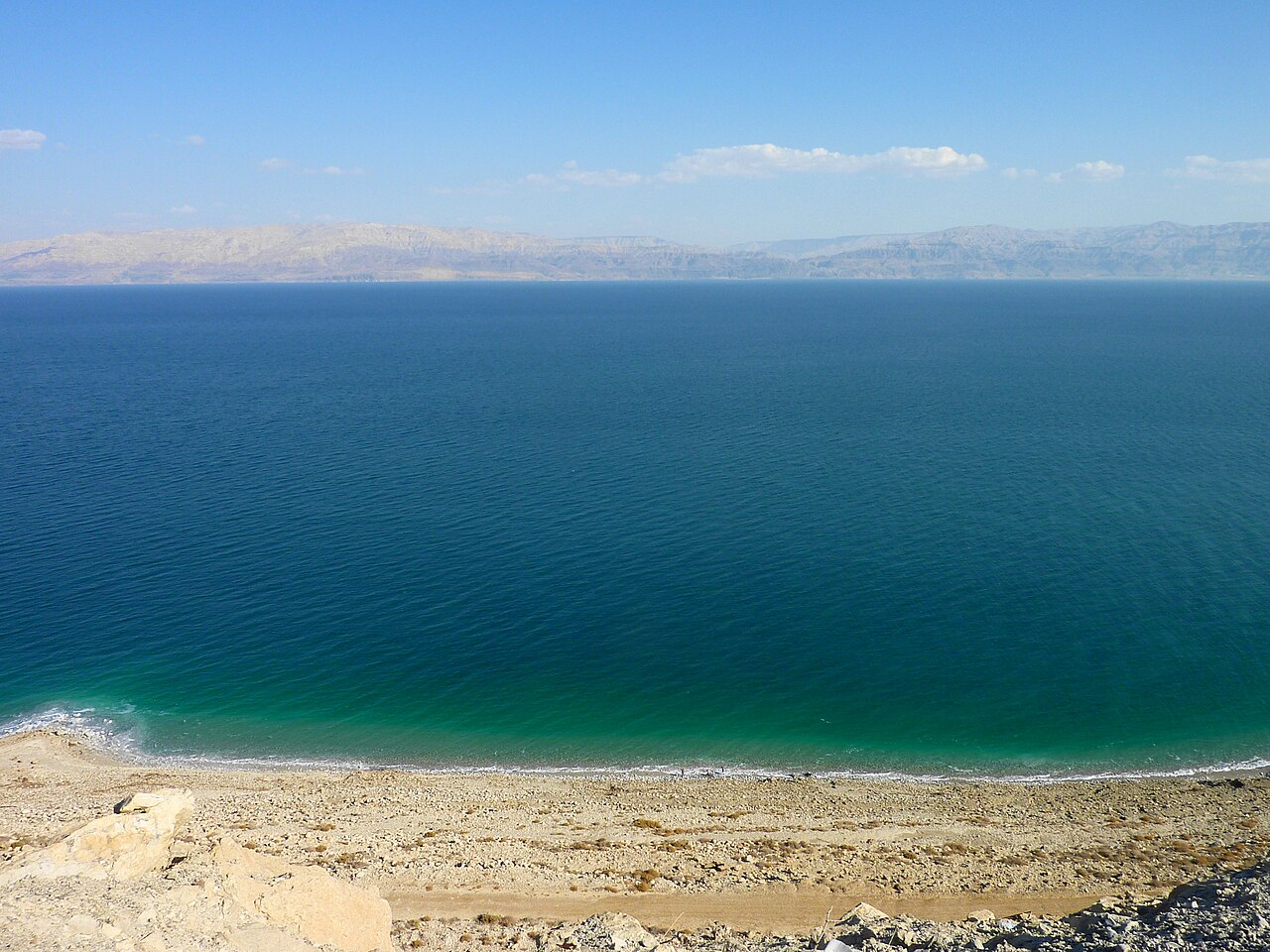
The name given by Greek writers of the second century to that inland sea called in Scripture the “salt sea” (Gen. 14:3; Num. 34:12), the “sea of the plain” (Deut. 3:17), the “east sea” (Ezek. 47:18; Joel 2:20), and simply “the sea” (Ezek. 47:8). The Arabs call it Bahr Lut, i.e., the Sea of Lot. It lies about 16 miles in a straight line to the east of Jerusalem. Its surface is 1,292 feet below the surface of the Mediterranean Sea. It covers an area of about 300 square miles. Its depth varies from 1,310 to 11 feet. From various phenomena that have been observed, its bottom appears to be still subsiding. It is about 53 miles long, and of an average breadth of 10 miles. It has no outlet, the great heat of that region causing such rapid evaporation that its average depth, notwithstanding the rivers that run into it, is maintained with little variation. The Jordan alone discharges into it no less than six million tons of water every twenty-four hours.
The waters of the Dead Sea contain 24.6 per cent. of mineral salts, about seven times as much as in ordinary sea-water; thus they are unusually buoyant. Chloride of magnesium is most abundant; next to that chloride of sodium (common salt). But terraces of alluvial deposits in the deep valley of the Jordan show that formerly one great lake extended from the Waters of Merom to the foot of the watershed in the Arabah. The waters were then about 1,400 feet above the present level of the Dead Sea, or slightly above that of the Mediterranean, and at that time were much less salt.
Nothing living can exist in this sea. “The fish carried down by the Jordan at once die, nor can even mussels or corals live in it; but it is a fable that no bird can fly over it, or that there are no living creatures on its banks. Dr. Tristram found on the shores three kinds of kingfishers, gulls, ducks, and grebes, which he says live on the fish which enter the sea in shoals, and presently die. He collected one hundred and eighteen species of birds, some new to science, on the shores, or swimming or flying over the waters. The cane-brakes which fringe it at some parts are the homes of about forty species of mammalia, several of them animals unknown in England; and innumerable tropical or semi-tropical plants perfume the atmosphere wherever fresh water can reach. The climate is perfect and most delicious, and indeed there is perhaps no place in the world where a sanatorium could be established with so much prospect of benefit as at Ain Jidi (Engedi).”, Geikie’s Hours, etc.