Chinnereth Summary
STEPBible TIPNR
Chinnereth, also known as the Sea of Galilee or the Sea of Tiberias, is a freshwater lake in northern Israel where Jesus conducted much of his ministry.
Freshwater lake in northern Israel; location of Jesus' ministry
Loading book references…
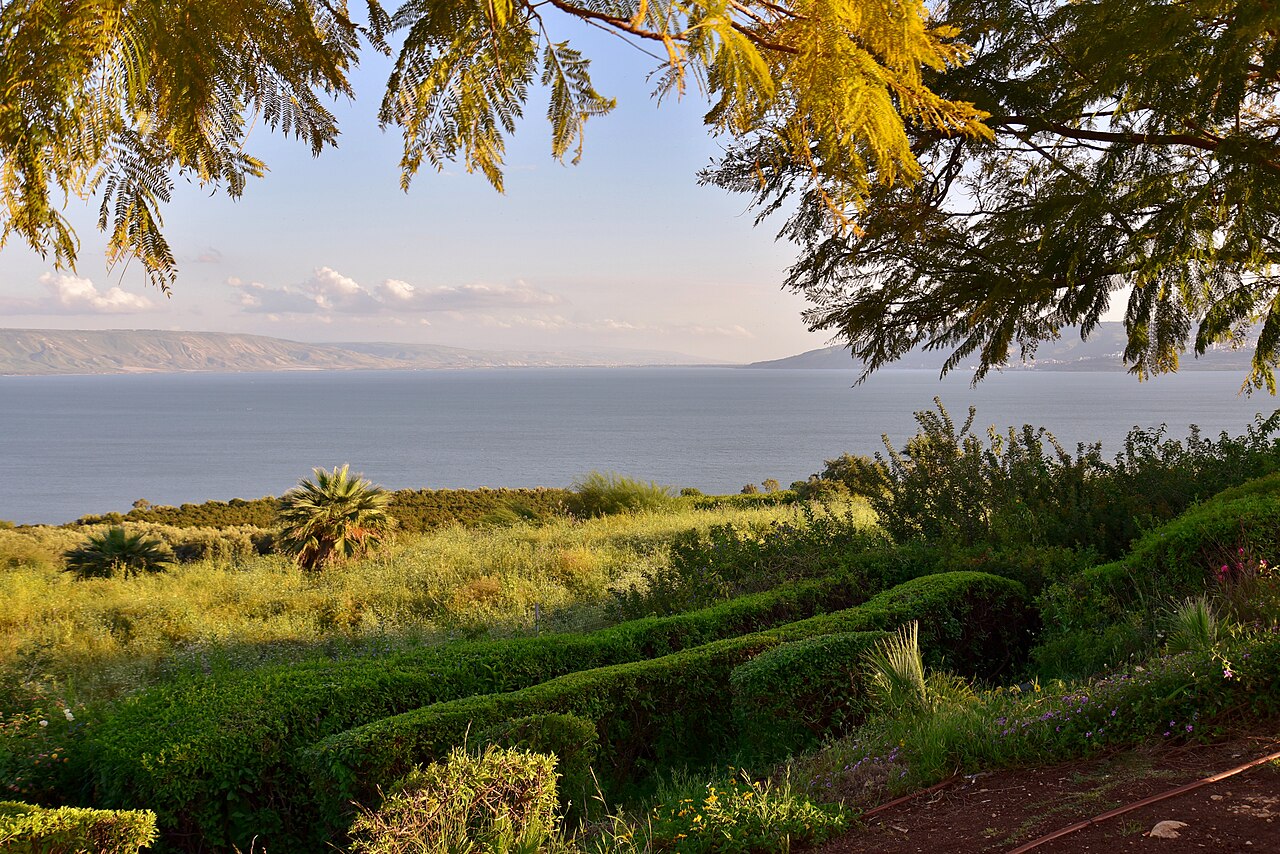
Chinnereth, also known as the Sea of Galilee or the Sea of Tiberias, is a freshwater lake in northern Israel where Jesus conducted much of his ministry.
Chinnereth, Chinneroth, the Sea of Galilee, and the Sea of Tiberias are different names used in the Bible to refer to the largest freshwater lake in Israel. The lake is located in the Jordan Rift Valley, fed by the Jordan River, and is approximately 13 miles (21 kilometers) long and 8 miles (13 kilometers) wide.
In the Old Testament, the lake is referred to as the Sea of Chinnereth (Numbers 34:11; Joshua 13:27) or Chinneroth (Joshua 12:3), likely named after a nearby town. The name "Chinnereth" may be derived from the Hebrew word for "harp," possibly referring to the shape of the lake.
In the New Testament, the lake is most commonly known as the Sea of Galilee (Matthew 4:18; Mrk.1.16; Jhn.6.1) and is the setting for many events in Jesus' life and ministry. Jesus called his first disciples, Simon Peter and his brother Andrew, while they were fishing on the Sea of Galilee (Matthew 4:18-22). He also calmed a storm on the lake (Mrk.4.35-41), walked on its waters (Jhn.6.16-21), and appeared to his disciples on its shores after his resurrection (Jhn.21.1-14).
The lake is also referred to as the Sea of Tiberias (Jhn.6.1; 21:1), named after the city of Tiberias, which was founded on its western shore during the reign of Herod Antipas (circa 20 CE). The city was named in honor of the Roman Emperor Tiberius.
The Sea of Galilee was an important source of livelihood for the people in the region, with fishing being a major industry. Several of Jesus' disciples, including Peter, Andrew, James, and John, were fishermen on the lake (Luke 5:1-11). The lake's shores were also dotted with numerous towns and villages, such as Capernaum, Bethsaida, and Magdala, which feature prominently in the Gospels.
John (6:1; 21:1) calls it the “sea of Tiberias” (q.v.). The modern Arabs retain this name, Bahr Tabariyeh.
This lake is 12 1/2 miles long, and from 4 to 7 1/2 broad. Its surface is 682 feet below the level of the Mediterranean. Its depth is from 80 to 160 feet. The Jordan enters it 10 1/2 miles below the southern extremity of the Huleh Lake, or about 26 1/2 miles from its source. In this distance of 26 1/2 miles there is a fall in the river of 1,682 feet, or of more than 60 feet to the mile. It is 27 miles east of the Mediterranean, and about 60 miles north-east of Jerusalem. It is of an oval shape, and abounds in fish.
Its present appearance is thus described: “The utter loneliness and absolute stillness of the scene are exceedingly impressive. It seems as if all nature had gone to rest, languishing under the scorching heat. How different it was in the days of our Lord! Then all was life and bustle along the shores; the cities and villages that thickly studded them resounded with the hum of a busy population; while from hill-side and corn-field came the cheerful cry of shepherd and ploughman. The lake, too, was dotted with dark fishing-boats and spangled with white sails. Now a mournful, solitary silence reigns over sea and shore. The cities are in ruins!”
This sea is chiefly of interest as associated with the public ministry of our Lord. Capernaum, “his own city” (Matt. 9:1), stood on its shores. From among the fishermen who plied their calling on its waters he chose Peter and his brother Andrew, and James and John, to be disciples, and sent them forth to be “fishers of men” (Matt. 4:18, 22; Mark 1:16-20; Luke 5: 1-11). He stilled its tempest, saying to the storm that swept over it, “Peace, be still” (Matt. 8:23-27; Mark 7:31-35); and here also he showed himself after his resurrection to his disciples (John 21).
“The Sea of Galilee is indeed the cradle of the gospel. The subterranean fires of nature prepared a lake basin, through which a river afterwards ran, keeping its waters always fresh. In this basin a vast quantity of shell-fish swarmed, and multiplied to such an extent that they formed the food of an extraordinary profusion of fish. The great variety and abundance of the fish in the lake attracted to its shores a larger and more varied population than existed elsewhere in Palestine, whereby this secluded district was brought into contact with all parts of the world. And this large and varied population, with access to all nations and countries, attracted the Lord Jesus, and induced him to make this spot the centre of his public ministry.”
Sources: OpenBible.info Bible Geocoding Data (CC BY 4.0, a562fcc) · STEPBible TIPNR (CC BY 4.0, Chinnereth@Num.34.11-Jhn) · Theographic Bible Metadata (CC BY-SA 4.0, sea_of_galilee_1032) · Wikidata (CC0 1.0, Q126982)