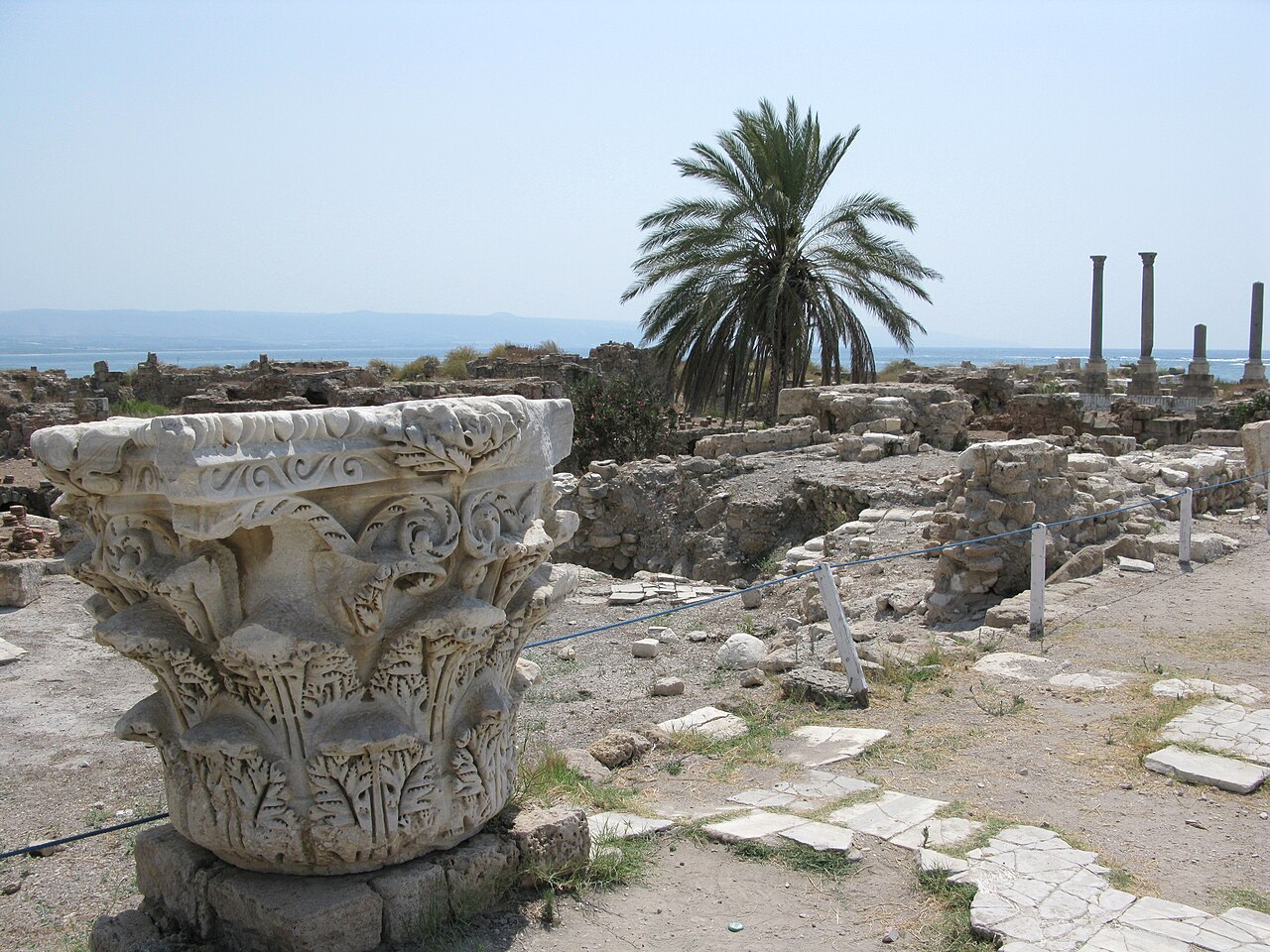
A rock, now es-Sur; an ancient Phoenician city, about 23 miles, in a direct line, north of Acre, and 20 south of Sidon. Sidon was the oldest Phoenician city, but Tyre had a longer and more illustrious history. The commerce of the whole world was gathered into the warehouses of Tyre. “Tyrian merchants were the first who ventured to navigate the Mediterranean waters; and they founded their colonies on the coasts and neighbouring islands of the AEgean Sea, in Greece, on the northern coast of Africa, at Carthage and other places, in Sicily and Corsica, in Spain at Tartessus, and even beyond the pillars of Hercules at Gadeira (Cadiz)” (Driver’s Isaiah). In the time of David a friendly alliance was entered into between the Hebrews and the Tyrians, who were long ruled over by their native kings (2 Sam. 5:11; 1 Kings 5:1; 2 Chr. 2:3).
Tyre consisted of two distinct parts, a rocky fortress on the mainland, called “Old Tyre,” and the city, built on a small, rocky island about half-a-mile distant from the shore. It was a place of great strength. It was besieged by Shalmaneser, who was assisted by the Phoenicians of the mainland, for five years, and by Nebuchadnezzar (B.C. 586-573) for thirteen years, apparently without success. It afterwards fell under the power of Alexander the Great, after a siege of seven months, but continued to maintain much of its commercial importance till the Christian era. It is referred to in Matt. 11:21 and Acts 12:20. In A.D. 1291 it was taken by the Saracens, and has remained a desolate ruin ever since.
“The purple dye of Tyre had a worldwide celebrity on account of the durability of its beautiful tints, and its manufacture proved a source of abundant wealth to the inhabitants of that city.”
Both Tyre and Sidon “were crowded with glass-shops, dyeing and weaving establishments; and among their cunning workmen not the least important class were those who were celebrated for the engraving of precious stones.” (2 Chr. 2:7, 14).
The wickedness and idolatry of this city are frequently denounced by the prophets, and its final destruction predicted (Isa. 23:1; Jer. 25:22; Ezek. 26; 28:1-19; Amos 1:9, 10; Zech. 9:2-4).
Here a church was founded soon after the death of Stephen, and Paul, on his return from his third missionary journey spent a week in intercourse with the disciples there (Acts 21:4). Here the scene at Miletus was repeated on his leaving them. They all, with their wives and children, accompanied him to the sea-shore. The sea-voyage of the apostle terminated at Ptolemais, about 38 miles from Tyre. Thence he proceeded to Caesarea (Acts 21:5-8).
“It is noticed on monuments as early as B.C. 1500, and claiming, according to Herodotus, to have been founded about B.C. 2700. It had two ports still existing, and was of commercial importance in all ages, with colonies at Carthage (about B.C. 850) and all over the Mediterranean. It was often attacked by Egypt and Assyria, and taken by Alexander the Great after a terrible siege in B.C. 332. It is now a town of 3,000 inhabitants, with ancient tombs and a ruined cathedral. A short Phoenician text of the fourth century B.C. is the only monument yet recovered.”