Bethlehem Summary
STEPBible TIPNR
Bethlehem, also called Ephrath or Ephrathah, was the city where David and Jesus were born, located in Judah. (Multiple references, see article for details)
City of David's birth and Jesus' birth.
Loading book references…
Bethlehem, also called Ephrath or Ephrathah, was the city where David and Jesus were born, located in Judah. (Multiple references, see article for details)
Bethlehem, also known as Ephrath or Ephrathah, is a city located in the hill country of Judah, approximately 5 miles south of Jerusalem. The name Bethlehem means "house of bread," while Ephrath or Ephrathah means "fruitful."
Bethlehem is first mentioned in the Bible as the burial place of Rachel, Jacob's wife (Genesis 35:19; 48:7). It was also the hometown of Ibzan, one of the judges of Israel (Judges 12:8, 10).
During the period of the judges, a Levite from Bethlehem became a priest for Micah's idolatrous shrine (Judges 17:7-9). Later, a Levite from Bethlehem traveled to Gibeah, where his concubine was mistreated, leading to a war between the Israelites and the Benjamites (Judges 19:1-2, 18).
The book of Ruth is set primarily in Bethlehem, where Naomi and her family were from (Ruth 1:1-2, 19, 22). Boaz, who married Ruth, was also from Bethlehem (Ruth 2:4; 4:11).
Bethlehem is most famously known as the hometown of King David (1Sa.16.1, 18; 17:12, 15; 20:6, 28). It was in Bethlehem that Samuel anointed David as the future king of Israel (1Sa.16.4). During David's reign, the city was referred to as the "city of David" (Luke 2:4, 11).
Several of David's mighty men, including Abishai and Elhanan, were from Bethlehem (2Sa.23.24; 1Ch.11.26; 2Sa.21.19).
In the New Testament, Bethlehem is celebrated as the birthplace of Jesus Christ (Matthew 2:1, 5-6, 8, 16; Luke 2:4, 15; Jhn.7.42). The Magi visited Jesus in Bethlehem, and King Herod ordered the massacre of the innocents there in an attempt to kill the newborn king (Matthew 2:16).
The prophet Micah foretold that the Messiah would come from Bethlehem (Micah 5:2), and this prophecy is cited in Matthew 2:5-6.
A city in the “hill country” of Judah. It was originally called Ephrath (Gen. 35:16, 19; 48:7; Ruth 4:11). It was also called Beth-lehem Ephratah (Micah 5:2), Beth-lehem-judah (1 Sam. 17:12), and “the city of David” (Luke 2:4). It is first noticed in Scripture as the place where Rachel died and was buried “by the wayside,” directly to the north of the city (Gen. 48:7). The valley to the east was the scene of the story of Ruth the Moabitess. There are the fields in which she gleaned, and the path by which she and Naomi returned to the town. Here was David’s birth-place, and here also, in after years, he was anointed as king by Samuel (1 Sam. 16:4-13); and it was from the well of Bethlehem that three of his heroes brought water for him at the risk of their lives when he was in the cave of Adullam (2 Sam. 23:13-17). But it was distinguished above every other city as the birth-place of “Him whose goings forth have been of old” (Matt. 2:6; comp. Micah 5:2). Afterwards Herod, “when he saw that he was mocked of the wise men,” sent and slew “all the children that were in Bethlehem, and in all the coasts thereof, from two years old and under” (Matt. 2:16, 18; Jer. 31:15).
Bethlehem bears the modern name of Beit-Lahm, i.e., “house of flesh.” It is about 5 miles south of Jerusalem, standing at an elevation of about 2,550 feet above the sea, thus 100 feet higher than Jerusalem.
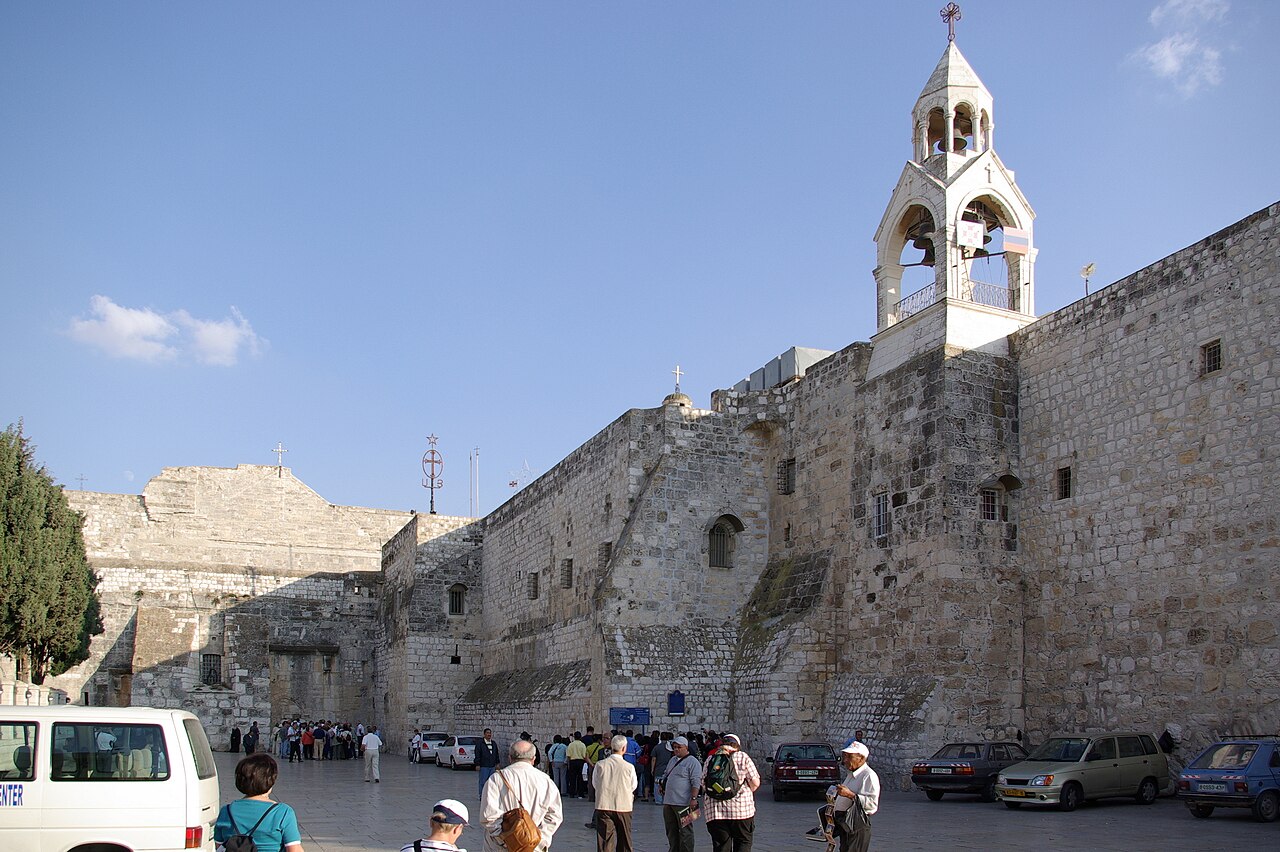
There is a church still existing, built by Constantine the Great (A.D. 330), called the “Church of the Nativity,” over a grotto or cave called the “holy crypt,” and said to be the “stable” in which Jesus was born. This is perhaps the oldest existing Christian church in the world. Close to it is another grotto, where Jerome the Latin father is said to have spent thirty years of his life in translating the Scriptures into Latin.
Sources: OpenBible.info Bible Geocoding Data (CC BY 4.0, a112427) · OpenBible.info Bible Geocoding Data (CC BY 4.0, af4e985) · STEPBible TIPNR (CC BY 4.0, Bethlehem@Gen.35.16-Jhn) · Theographic Bible Metadata (CC BY-SA 4.0, ephrath_403) · Theographic Bible Metadata (CC BY-SA 4.0, bethlehem_218)