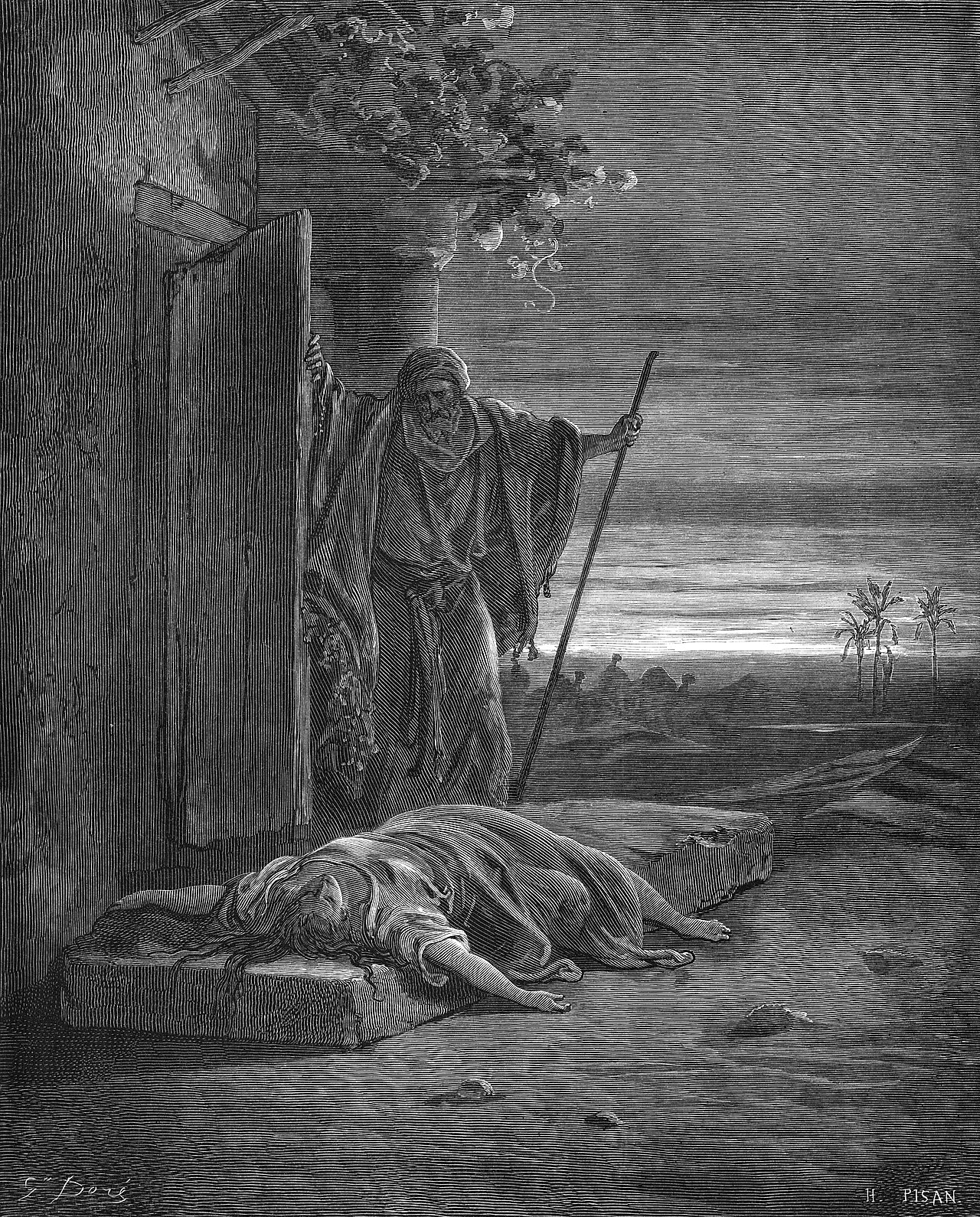
The woman at the threshold in Gibeah
The threshold scene concerns an unnamed woman and the unnamed Levite whose concubine she is. Its location is Gibeah, identified explicitly in the man’s later testimony. The immediate evidence is confined to her arrival at the house at daybreak, her position at the entrance and the discovery when the man opens the door. The setting belongs to the period described as lacking a king in Israel; no calendar date is supplied. Judg 19:26-28 Judg 19:1 Judg 20:4-6
The precise threshold description preserves material details rather than an account from the woman herself: she lies at the door, with her hands on the threshold, while her companion has been inside the house. The preceding verses establish a night of violence, but the selected scene contains no words, decision or explanation from her. Her arrival at the entrance does not establish an intention or feeling beyond what the text states. Judg 19:22-28 (Civil War study)
The man’s instruction that she rise receives no answer. He places her on a donkey and leaves for his own place. These actions and her unresponsiveness are explicit; the selected verses do not identify the exact moment of her death. The later testimony describes her as dead and identifies the violence against her as the cause. Reading the two witnesses together establishes the death without turning the silence at the threshold into a medically precise statement of when it occurred. Judg 19:26-28 Judg 20:4-6