Saul Summary
STEPBible TIPNR
Saul was the first king of Israel, anointed by the prophet Samuel, who initially followed God but later disobeyed and was rejected as king.
son of Kish (1SA 9:2), King of Israel (1SA 11:15)
Lineage: Aphiah › Bechorath › Zeror › Abiel › Kish › Saul
Loading book references…
Chronological estimate · Estimate from the BibleData chronology. The age is not stated directly; see the source assumptions.
2951 − 2891 (AH) = 60
The year of Saul_1's birth is the year his son, Jonathan_2, was born (2911) - 20 years (estimated) = 2891
The year of Saul_1's death is the year David began to reign = 2951
Absolute years are conditional chronological estimates. A biblical passage may state an age or event, but does not by itself establish a BCE year. Different calendar systems are preserved separately.
1071 → ≈ 1071 BC
Birth_Saul_1 · bce_yearbibledata/BibleData-Event.csv · record 19650f0974d87a5d81b81423519cd3e5c2c02fcd28534cb1032dbad26d6b6d9c4b32891 → ≈ 1114 BC
Birth_Saul_1 · event_year_ahbibledata/BibleData-Event.csv · record 19650f0974d87a5d81b81423519cd3e5c2c02fcd28534cb1032dbad26d6b6d9c4b32891 → ≈ 1114 BC
Life_of_Saul_1 · start_year_ahbibledata/BibleData-Epoch.csv · record 6793cfa415dcce8aa3828570f8e2b32441fb8a57d2f416c3c2ea4f7a0b45aa49ac-1054 · Calendar interpretation is unverified; the raw value is shown.
Six children are selected as born before Saul; Jonathan’s death differs from his by 50 years despite the same battle. Sources use different chronological estimates; no replacement is selected without one coherent chronology.
1SA 14:491SA 31:2-42SA 2:10saul_2478 · birthYeartheographic/People.csv · record 2463bcf0b3921b3659e99727fff0888bc89ba41d8ff25b2254882d57fcfec60fdeec1011 → ≈ 1011 BC
Death_Saul_1 · bce_yearbibledata/BibleData-Event.csv · record 2231493d1c670b7c5ae6d5611411427edb69df16a68321fbb54c7aad656d0b34cc72951 → ≈ 1054 BC
Death_Saul_1 · event_year_ahbibledata/BibleData-Event.csv · record 2231493d1c670b7c5ae6d5611411427edb69df16a68321fbb54c7aad656d0b34cc72884 · No established conversion to a BCE/CE year.
Death_Saul_1 · shulman_am_yearbibledata/BibleData-Event.csv · record 2231493d1c670b7c5ae6d5611411427edb69df16a68321fbb54c7aad656d0b34cc72949 · No established conversion to a BCE/CE year.
Death_Saul_1 · ussher_am_yearbibledata/BibleData-Event.csv · record 2231493d1c670b7c5ae6d5611411427edb69df16a68321fbb54c7aad656d0b34cc71055 → ≈ 1055 BC
Death_Saul_1 · ussher_bce_yearbibledata/BibleData-Event.csv · record 2231493d1c670b7c5ae6d5611411427edb69df16a68321fbb54c7aad656d0b34cc72951 → ≈ 1054 BC
Life_of_Saul_1 · end_year_ahbibledata/BibleData-Epoch.csv · record 6793cfa415dcce8aa3828570f8e2b32441fb8a57d2f416c3c2ea4f7a0b45aa49ac-1004 · Calendar interpretation is unverified; the raw value is shown.
Six children are selected as born before Saul; Jonathan’s death differs from his by 50 years despite the same battle. Sources use different chronological estimates; no replacement is selected without one coherent chronology.
1SA 14:491SA 31:2-42SA 2:10saul_2478 · deathYeartheographic/People.csv · record 2463bcf0b3921b3659e99727fff0888bc89ba41d8ff25b2254882d57fcfec60fdeecConditional birth bounds under generation assumptions; not attested parental ages, biological limits or a lifespan.
Below are relatives with a selected birth year, the generations separating them, and the interval allowed by each anchor. Each relative’s page shows available dates and sources. The overall estimate uses the intersection of the allowed intervals.
| Relative / anchor year | Generations | Conditional interval |
|---|---|---|
| Abinadab · 1093 BC Descendant |
1 20–45 years per generation |
c. 1138 BC – 1113 BC |
| Ish-bosheth · 1089 BC Descendant |
1 20–45 years per generation |
c. 1134 BC – 1109 BC |
| Jonathan · 1094 BC Descendant |
1 20–45 years per generation |
c. 1139 BC – 1114 BC |
| Malchi-shua · 1092 BC Descendant |
1 20–45 years per generation |
c. 1137 BC – 1112 BC |
| Merab · 1091 BC Descendant |
1 20–45 years per generation |
c. 1136 BC – 1111 BC |
| Michal · 1090 BC Descendant |
1 20–45 years per generation |
c. 1135 BC – 1110 BC |
| Mephibosheth · 1060 BC Descendant |
2 20–45 years per generation |
c. 1150 BC – 1100 BC |
Saul was the first king of Israel, anointed by the prophet Samuel, who initially followed God but later disobeyed and was rejected as king.
Saul was the first king of Israel, anointed by the prophet Samuel in response to the people's request for a king (1Samuel 8-10). He was a tall and handsome Benjamite who initially showed humility and potential as a leader (1Sa.9.2, 21; 10.6-7, 9-10). However, Saul's reign was marked by disobedience and rebellion against God. He offered an unlawful sacrifice before a battle against the Philistines (1Sa 13:8-14) and later disobeyed God's command to completely destroy the Amalekites and their possessions (1Samuel 15). As a result, God rejected Saul as king and chose David to replace him (1Sa.15.23, 28; 16.1, 13). Saul became jealous of David's success and popularity, leading him to pursue David and attempt to kill him on multiple occasions (1Samuel 18-26). Saul also massacred the priests of Nob for assisting David (1Sa 22:6-23). In a battle against the Philistines, Saul was critically wounded and took his own life to avoid capture (1Sa 31:1-6). His body was later recovered by the men of Jabesh-gilead and buried (1Sa 31:11-13). Despite his tragic end, Saul's reign united the tribes of Israel and laid the foundation for the Israelite monarchy. His life serves as a warning against disobedience and the consequences of turning away from God.
The son of Kish (probably his only son, and a child of prayer, “asked for”), of the tribe of Benjamin, the first king of the Jewish nation. The singular providential circumstances connected with his election as king are recorded in 1 Sam. 8-10. His father’s she-asses had strayed, and Saul was sent with a servant to seek for them. Leaving his home at Gibeah (10:5, “the hill of God,” A.V.; lit., as in R.V. marg., “Gibeah of God”), Saul and his servant went toward the north-west over Mount Ephraim, and then turning north-east they came to “the land of Shalisha,” and thence eastward to the land of Shalim, and at length came to the district of Zuph, near Samuel’s home at Ramah (9:5-10). At this point Saul proposed to return from the three days’ fruitless search, but his servant suggested that they should first consult the “seer.” Hearing that he was about to offer sacrifice, the two hastened into Ramah, and “behold, Samuel came out against them,” on his way to the “bamah”, i.e., the “height”, where sacrifice was to be offered; and in answer to Saul’s question, “Tell me, I pray thee, where the seer’s house is,” Samuel made himself known to him. Samuel had been divinely prepared for his coming (9:15-17), and received Saul as his guest. He took him with him to the sacrifice, and then after the feast “communed with Saul upon the top of the house” of all that was in his heart. On the morrow Samuel “took a vial of oil and poured it on his head,” and anointed Saul as king over Israel (9:25-10:8), giving him three signs in confirmation of his call to be king. When Saul reached his home in Gibeah the last of these signs was fulfilled, and the Sprit of God came upon him, and “he was turned into another man.” The simple countryman was transformed into the king of Israel, a remarkable change suddenly took place in his whole demeanour, and the people said in their astonishment, as they looked on the stalwart son of Kish, “Is Saul also among the prophets?”, a saying which passed into a “proverb.” (Comp. 19:24.)
The intercourse between Saul and Samuel was as yet unknown to the people. The “anointing” had been in secret. But now the time had come when the transaction must be confirmed by the nation. Samuel accordingly summoned the people to a solemn assembly “before the Lord” at Mizpeh. Here the lot was drawn (10:17-27), and it fell upon Saul, and when he was presented before them, the stateliest man in all Israel, the air was rent for the first time in Israel by the loud cry, “God save the king!” He now returned to his home in Gibeah, attended by a kind of bodyguard, “a band of men whose hearts God had touched.” On reaching his home he dismissed them, and resumed the quiet toils of his former life.
Soon after this, on hearing of the conduct of Nahash the Ammonite at Jabeshgilead (q.v.), an army out of all the tribes of Israel rallied at his summons to the trysting-place at Bezek, and he led them forth a great army to battle, gaining a complete victory over the Ammonite invaders at Jabesh (11:1-11). Amid the universal joy occasioned by this victory he was now fully recognized as the king of Israel. At the invitation of Samuel “all the people went to Gilgal, and there they made Saul king before the Lord in Gilgal.” Samuel now officially anointed him as king (11:15). Although Samuel never ceased to be a judge in Israel, yet now his work in that capacity practically came to an end.
Saul now undertook the great and difficult enterprise of freeing the land from its hereditary enemies the Philistines, and for this end he gathered together an army of 3,000 men (1 Sam. 13:1, 2). The Philistines were encamped at Geba. Saul, with 2,000 men, occupied Michmash and Mount Bethel; while his son Jonathan, with 1,000 men, occupied Gibeah, to the south of Geba, and seemingly without any direction from his father “smote” the Philistines in Geba. Thus roused, the Philistines, who gathered an army of 30,000 chariots and 6,000 horsemen, and “people as the sand which is on the sea-shore in multitude,” encamped in Michmash, which Saul had evacuated for Gilgal. Saul now tarried for seven days in Gilgal before making any movement, as Samuel had appointed (10:8); but becoming impatient on the seventh day, as it was drawing to a close, when he had made an end of offering the burnt offering, Samuel appeared and warned him of the fatal consequences of his act of disobedience, for he had not waited long enough (13:13, 14).
When Saul, after Samuel’s departure, went out from Gilgal with his 600 men, his followers having decreased to that number (13:15), against the Philistines at Michmash (q.v.), he had his head-quarters under a pomegrante tree at Migron, over against Michmash, the Wady esSuweinit alone intervening. Here at Gibeah-Geba Saul and his army rested, uncertain what to do. Jonathan became impatient, and with his armour-bearer planned an assault against the Philistines, unknown to Saul and the army (14:1-15). Jonathan and his armour-bearer went down into the wady, and on their hands and knees climbed to the top of the narrow rocky ridge called Bozez, where was the outpost of the Philistine army. They surprised and then slew twenty of the Philistines, and immediately the whole host of the Philistines was thrown into disorder and fled in great terror. “It was a very great trembling;” a supernatural panic seized the host. Saul and his 600 men, a band which speedily increased to 10,000, perceiving the confusion, pursued the army of the Philistines, and the tide of battle rolled on as far as to Bethaven, halfway between Michmash and Bethel. The Philistines were totally routed. “So the Lord saved Israel that day.” While pursuing the Philistines, Saul rashly adjured the people, saying, “Cursed be the man that eateth any food until evening.” But though faint and weary, the Israelites “smote the Philistines that day from Michmash to Aijalon” (a distance of from 15 to 20 miles). Jonathan had, while passing through the wood in pursuit of the Philistines, tasted a little of the honeycomb which was abundant there (14:27). This was afterwards discovered by Saul (ver. 42), and he threatened to put his son to death. The people, however, interposed, saying, “There shall not one hair of his head fall to the ground.” He whom God had so signally owned, who had “wrought this great salvation in Israel,” must not die. “Then Saul went up from following the Philistines: and the Philistines went to their own place” (1 Sam. 14:24-46); and thus the campaign against the Philistines came to an end. This was Saul’s second great military success.
Saul’s reign, however, continued to be one of almost constant war against his enemies round about (14:47, 48), in all of which he proved victorious. The war against the Amalekites is the only one which is recorded at length (1 Sam. 15). These oldest and hereditary (Ex. 17:8; Num. 14:43-45) enemies of Israel occupied the territory to the south and south-west of Palestine. Samuel summoned Saul to execute the “ban” which God had pronounced (Deut. 25:17-19) on this cruel and relentless foe of Israel. The cup of their iniquity was now full. This command was “the test of his moral qualification for being king.” Saul proceeded to execute the divine command; and gathering the people together, marched from Telaim (1 Sam. 15:4) against the Amalekites, whom he smote “from Havilah until thou comest to Shur,” utterly destroying “all the people with the edge of the sword”, i.e., all that fell into his hands. He was, however, guilty of rebellion and disobedience in sparing Agag their king, and in conniving at his soldiers’ sparing the best of the sheep and cattle; and Samuel, following Saul to Gilgal, in the Jordan valley, said unto him, “Because thou hast rejected the word of the Lord, he also hath rejected thee from being king” (15:23). The kingdom was rent from Saul and was given to another, even to David, whom the Lord chose to be Saul’s successor, and whom Samuel anointed (16:1-13). From that day “the spirit of the Lord departed from Saul, and an evil spirit from the Lord troubled him.” He and Samuel parted only to meet once again at one of the schools of the prophets.
David was now sent for as a “cunning player on an harp” (1 Sam. 16:16, 18), to play before Saul when the evil spirit troubled him, and thus was introduced to the court of Saul. He became a great favourite with the king. At length David returned to his father’s house and to his wonted avocation as a shepherd for perhaps some three years. The Philistines once more invaded the land, and gathered their army between Shochoh and Azekah, in Ephes-dammim, on the southern slope of the valley of Elah. Saul and the men of Israel went forth to meet them, and encamped on the northern slope of the same valley which lay between the two armies. It was here that David slew Goliath of Gath, the champion of the Philistines (17:4-54), an exploit which led to the flight and utter defeat of the Philistine army. Saul now took David permanently into his service (18:2); but he became jealous of him (ver. 9), and on many occasions showed his enmity toward him (ver. 10, 11), his enmity ripening into a purpose of murder which at different times he tried in vain to carry out.
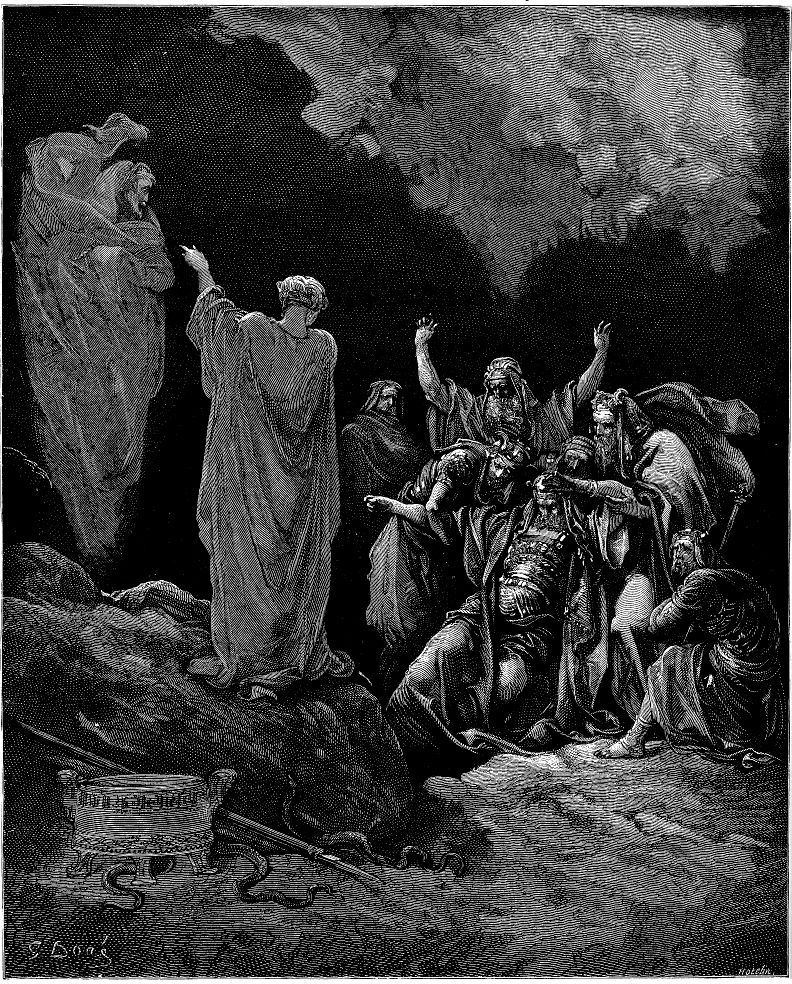
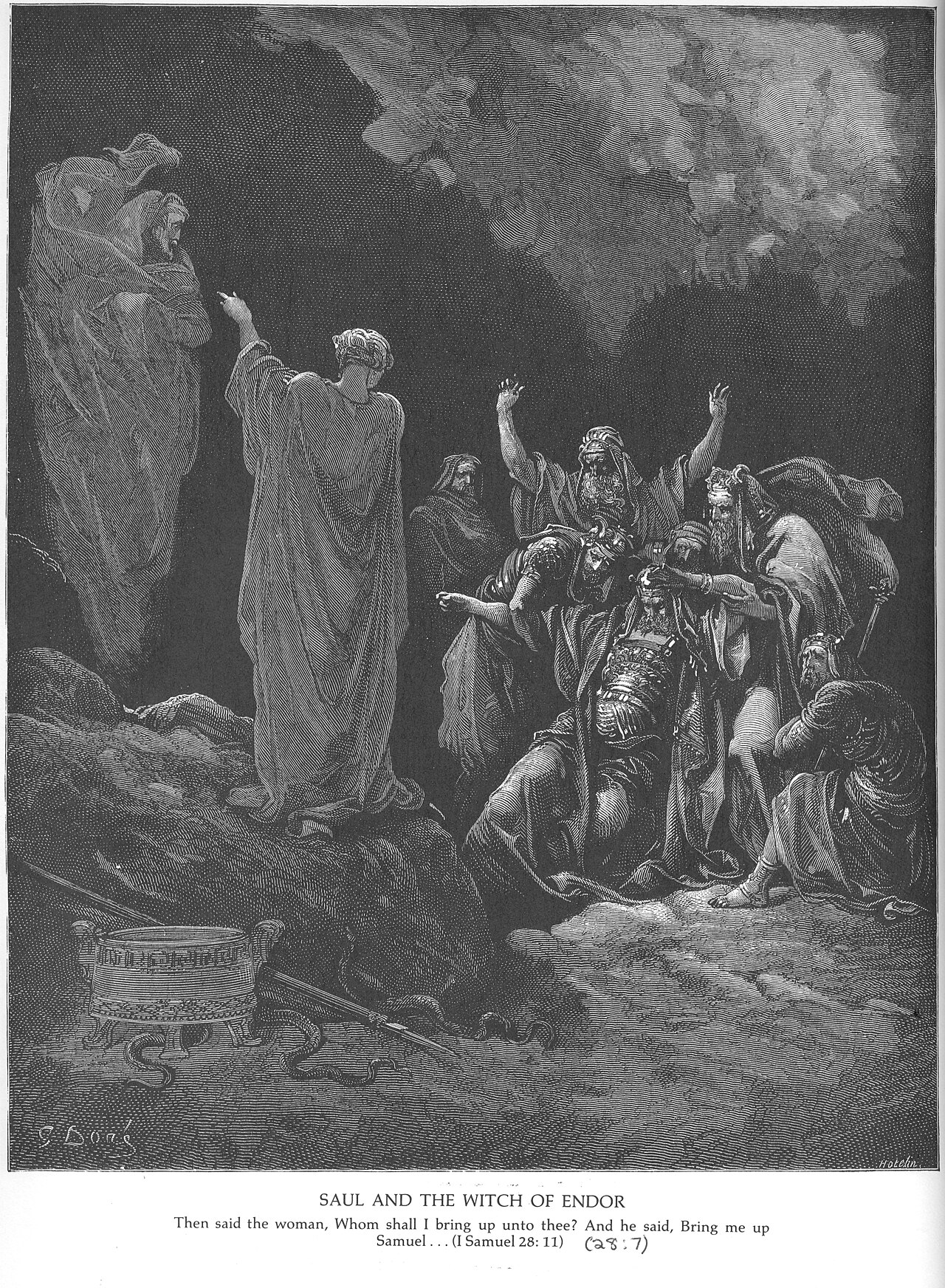
After some time the Philistines “gathered themselves together” in the plain of Esdraelon, and pitched their camp at Shunem, on the slope of Little Hermon; and Saul “gathered all Israel together,” and “pitched in Gilboa” (1 Sam. 28:3-14). Being unable to discover the mind of the Lord, Saul, accompanied by two of his retinue, betook himself to the “witch of Endor,” some 7 or 8 miles distant. Here he was overwhelmed by the startling communication that was mysteriously made to him by Samuel (ver. 16-19), who appeared to him. “He fell straightway all along on the earth, and was sore afraid, because of the words of Samuel” (ver. 20). The Philistine host “fought against Israel: and the men of Israel fled before the Philistines, and fell down slain in Mount Gilboa” (31:1). In his despair at the disaster that had befallen his army, Saul “took a sword and fell upon it.” And the Philistines on the morrow “found Saul and his three sons fallen in Mount Gilboa.” Having cut off his head, they sent it with his weapons to Philistia, and hung up the skull in the temple of Dagon at Ashdod. They suspended his headless body, with that of Jonathan, from the walls of Bethshan. The men of Jabesh-gilead afterwards removed the bodies from this position; and having burnt the flesh, they buried the bodies under a tree at Jabesh. The remains were, however, afterwards removed to the family sepulchre at Zelah (2 Sam. 21:13, 14).
Sources: BibleData (CC BY 4.0, Saul_1) · STEPBible TIPNR (CC BY 4.0, Saul@1Sa.9.2-Act) · Theographic Bible Metadata (CC BY-SA 4.0, saul_2478)