Michal
Michal is the younger of the two daughters of Saul, listed after Merab, the firstborn (BG1940: „по-младата“). Easton takes her to be Saul’s daughter by his wife Ahinoam, whom the next verse names. 1 Sam 14:49-50.
The text says that “Michal Saul’s daughter loved David”, and that the thing pleased Saul when he was told; he resolves to give her to David “that she may be a snare to him”. Instead of a dowry the king asks for an hundred foreskins of the Philistines; David brings two hundred, and Saul gives him Michal his daughter to wife. Saul then sees that the LORD is with David and that Michal loves him. Ellen G. White, Patriarchs and Prophets, chapter 64, calls her “Saul’s youngest daughter” and says that her attachment for David “afforded the king another opportunity to plot against his rival”, and that the enraged monarch saw “that his plots had resulted in the elevation of him whom he sought to destroy.” 1 Sam 18:20-21; 1 Sam 18:25; 1 Sam 18:27-28.
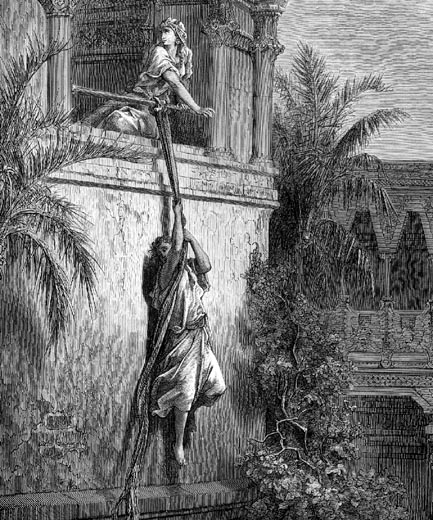
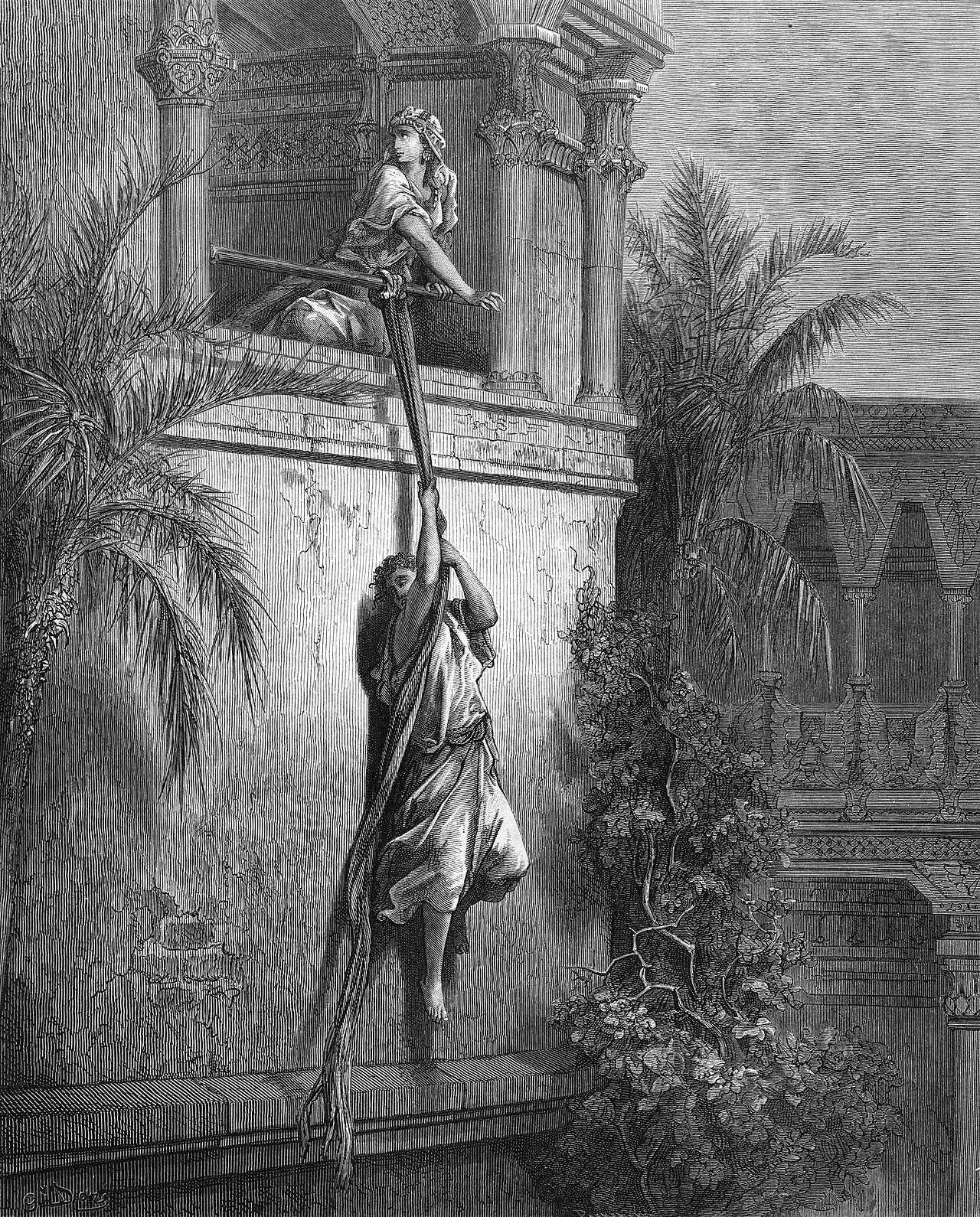
When Saul sends messengers to watch David’s house and slay him in the morning, “Michal David’s wife” warns him: “If thou save not thy life to night, to morrow thou shalt be slain.” She lets him down through a window, lays an image in the bed with a pillow of goats’ hair for his bolster (BG1940: „домашен идол“, a household idol), and tells the messengers that he is sick. To Saul’s reproach that she has deceived him she answers that David said to her, “Let me go; why should I kill thee?” In the same chapter Ellen G. White writes that Michal “urged him to flee for his life, and let him down from the window, thus enabling him to make his escape.” Easton sees here her affection for David in promoting his escape to Naioth, and compares Psalm 59. 1 Sam 19:11-17.
While David is a fugitive, Saul gives “Michal his daughter, David’s wife” to Phalti the son of Laish, which was of Gallim (BG1940: Фалтий). 1 Sam 25:44.
When Abner offers him a league, David makes it a condition that Michal be brought to him first, and he sends to Ish-bosheth for “my wife Michal, which I espoused to me for an hundred foreskins of the Philistines”. Ish-bosheth takes her from her husband, called Phaltiel here (BG1940: Фалатиил), who goes with her weeping as far as Bahurim until Abner sends him back. Smith says that David compelled her new husband to surrender her. 2 Sam 3:13-16.
As the ark of the LORD comes into the city of David, Michal looks through a window, sees king David leaping and dancing before the LORD, and despises him in her heart; Chronicles tells the same moment with “dancing and playing”. She meets him with the words “How glorious was the king of Israel to day”, and David answers that it was before the LORD, who chose him before her father. The account of the ark brought to Jerusalem closes: “Therefore Michal the daughter of Saul had no child unto the day of her death.” Easton says that in David’s conduct she saw nothing but a needless humiliation of the royal dignity, and that she remained childless, so that the races of David and Saul were not mixed; Smith, that all intercourse between her and David ceased from that date; Nave, that she ridicules David on account of his religious zeal. 2 Sam 6:16; 2 Sam 6:20-21; 2 Sam 6:23; 1 Chr 15:29.
Her name occurs once more, in the list of those handed over to the Gibeonites: KJV reads “the five sons of Michal the daughter of Saul, whom she brought up for Adriel”, BG1940 that she bore them to Adriel. Easton holds that the name Merab should probably stand here instead (comparing 1 Sam 18:19), while Smith’s entry on Michal takes the verse as naming her the mother of five of the grandchildren of Saul, although his entry on Merab gives the five sons to Merab. 2 Sam 21:8.