Jezebel Summary
STEPBible TIPNR
Queen Jezebel, the Phoenician wife of King Ahab, promoted Baal worship and persecuted the prophets of God.
wife of Ahab (1KI 16:31)
Lineage: Ethbaal › Jezebel
Loading book references…
Conditional birth bounds under generation assumptions; not attested parental ages, biological limits or a lifespan.
Below are relatives with a selected birth year, the generations separating them, and the interval allowed by each anchor. Each relative’s page shows available dates and sources. The overall estimate uses the intersection of the allowed intervals.
| Relative / anchor year | Generations | Conditional interval |
|---|---|---|
| Joash · 845 BC Descendant |
3 20–45 years per generation |
c. 980 BC – 905 BC |
| Amaziah · 826 BC Descendant |
4 20–45 years per generation |
c. 1006 BC – 906 BC |
| Hezekiah · 742 BC Descendant |
8 20–45 years per generation |
c. 1102 BC – 902 BC |
| Josiah · 649 BC Descendant |
11 20–45 years per generation |
c. 1144 BC – 869 BC |
| Jehoahaz · 633 BC Descendant |
12 20–45 years per generation |
c. 1173 BC – 873 BC |
| Jehoiakim · 635 BC Descendant |
12 20–45 years per generation |
c. 1175 BC – 875 BC |
| Zedekiah · 629 BC Descendant |
12 20–45 years per generation |
c. 1169 BC – 869 BC |
| Jehoiachin · 617 BC Descendant |
13 20–45 years per generation |
c. 1202 BC – 877 BC |
| Jesus Christ · 5 BC Descendant |
26 20–45 years per generation |
c. 1175 BC – 525 BC |
Queen Jezebel, the Phoenician wife of King Ahab, promoted Baal worship and persecuted the prophets of God.
Jezebel was the Phoenician princess who became the wife of King Ahab of Israel (1Ki 16:31). She zealously promoted the worship of the Canaanite god Baal and persecuted the prophets of the Lord (1Ki.18.4,13,19). Her conflict with the prophet Elijah is notably recorded in 1Kings 18-19, where Elijah confronts the prophets of Baal and Jezebel threatens Elijah's life.
Jezebel's wickedness is further demonstrated in her plot to have Naboth killed so that Ahab could seize his vineyard (1Ki.21). Her actions led to divine judgment, as pronounced by Elijah (1Ki 21:23).
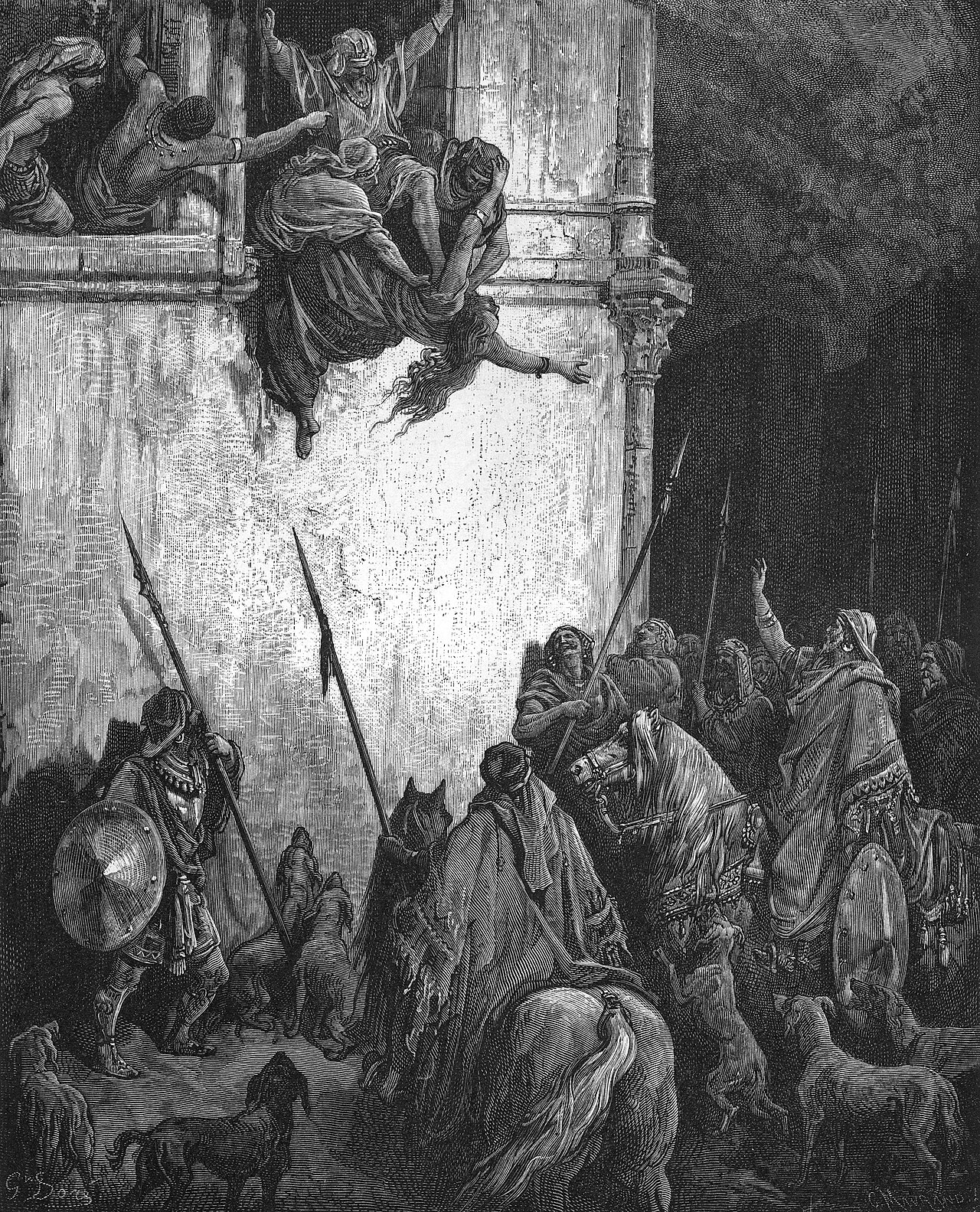
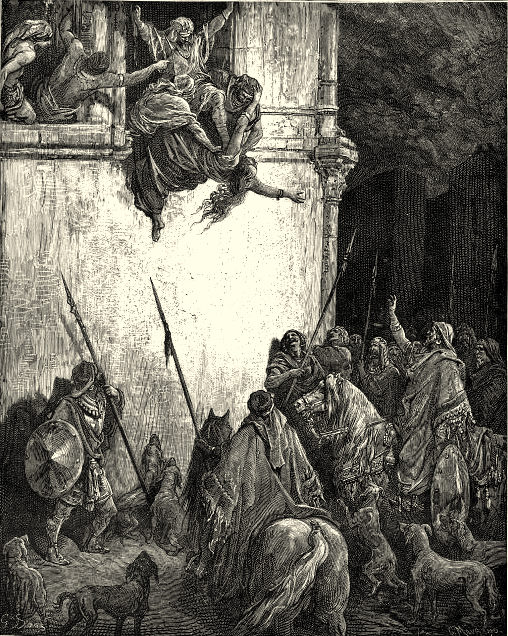
Years later, during the reign of Ahab's son Joram, Jezebel met her demise as prophesied. Jehu, anointed as king of Israel, had her thrown from a window, and her body was consumed by dogs, fulfilling Elijah's prophecy (2Ki 9:30-37).
In Rev 2:20, the name "Jezebel" is used symbolically to describe a false prophetess who led people astray in the church of Thyatira, drawing a parallel to the idolatry and immorality promoted by Ahab's queen.
Chaste, the daughter of Ethbaal, the king of the Zidonians, and the wife of Ahab, the king of Israel (1 Kings 16:31). This was the “first time that a king of Israel had allied himself by marriage with a heathen princess; and the alliance was in this case of a peculiarly disastrous kind. Jezebel has stamped her name on history as the representative of all that is designing, crafty, malicious, revengeful, and cruel. She is the first great instigator of persecution against the saints of God. Guided by no principle, restrained by no fear of either God or man, passionate in her attachment to her heathen worship, she spared no pains to maintain idolatry around her in all its splendour. Four hundred and fifty prophets ministered under her care to Baal, besides four hundred prophets of the groves [R.V., ’prophets of the Asherah’], which ate at her table (1 Kings 18:19). The idolatry, too, was of the most debased and sensual kind.” Her conduct was in many respects very disastrous to the kingdom both of Israel and Judah (21:1-29). At length she came to an untimely end. As Jehu rode into the gates of Jezreel, she looked out at the window of the palace, and said, “Had Zimri peace, who slew his master?” He looked up and called to her chamberlains, who instantly threw her from the window, so that she was dashed in pieces on the street, and his horses trod her under their feet. She was immediately consumed by the dogs of the street (2 Kings 9:7-37), according to the word of Elijah the Tishbite (1 Kings 21:19).
Her name afterwards came to be used as the synonym for a wicked woman (Rev. 2: 20).
It may be noted that she is said to have been the grand-aunt of Dido, the founder of Carthage.
Sources: BibleData (CC BY 4.0, Jezebel_1) · STEPBible TIPNR (CC BY 4.0, Jezebel@1Ki.16.31-Rev) · Theographic Bible Metadata (CC BY-SA 4.0, jezebel_1605)