Egypt Summary
STEPBible TIPNR
Egypt, a powerful nation where the Israelites were enslaved until God delivered them in the Exodus.
Ancient nation; Israelites enslaved there; plagues and Exodus
Loading book references…
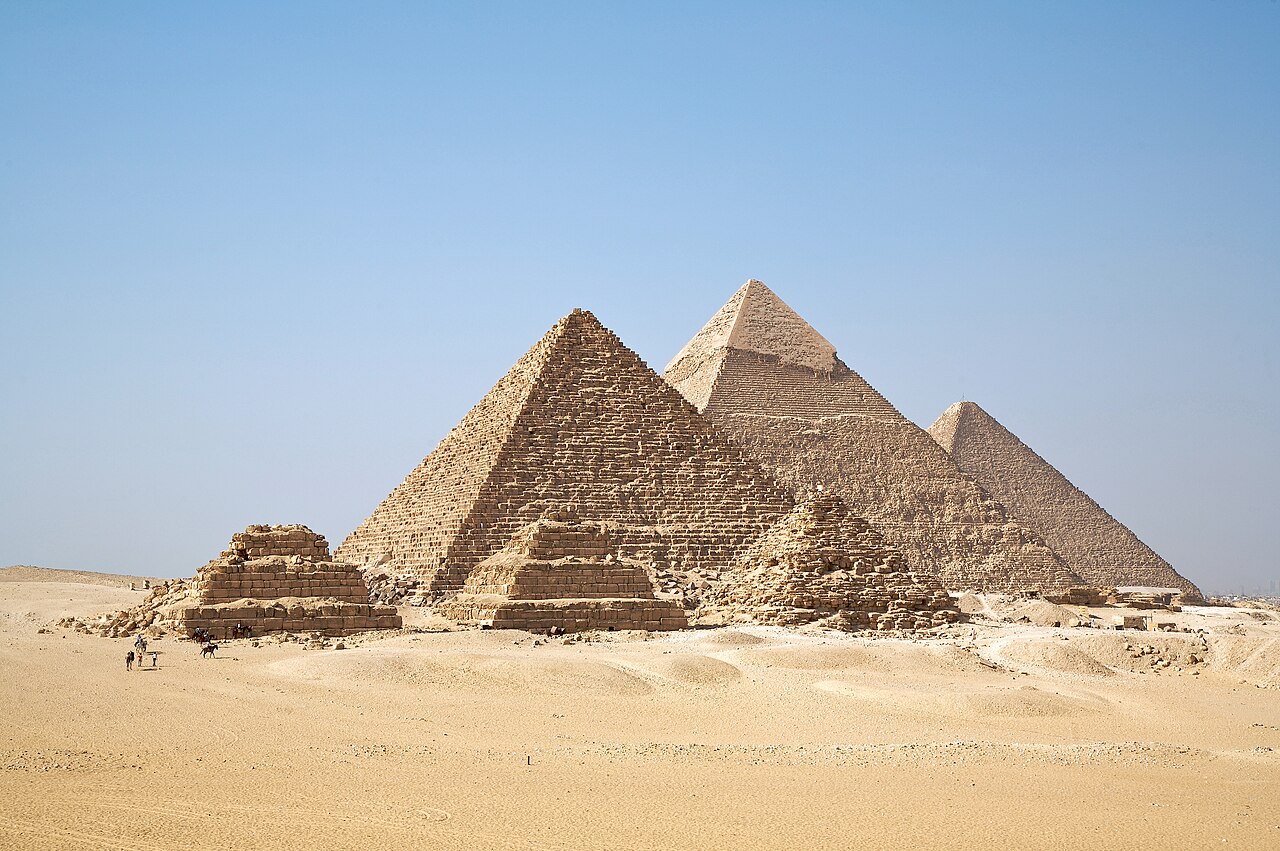
Egypt, a powerful nation where the Israelites were enslaved until God delivered them in the Exodus.
Egypt was a prominent ancient civilization in northeastern Africa, concentrated along the lower reaches of the Nile River. In the Bible, Egypt is first mentioned as the place Abraham journeyed during a famine in Canaan (Genesis 12:10). Later, Joseph was sold into slavery in Egypt but rose to power as a trusted official of Pharaoh. During a famine, Israel (or 'Jacob') and his family settled in Egypt with Joseph.
After generations passed, the Israelites were enslaved by the Egyptians (Exodus 1:8-14). God called Moses to deliver His people from bondage. After Pharaoh refused to free the Israelites, God sent ten plagues upon Egypt (Exodus 7-12). Finally, Pharaoh relented and the Israelites left in the Exodus. At the Red Sea, God miraculously allowed the Israelites to cross on dry ground but destroyed the pursuing Egyptian army (Exodus 14).
Egypt is often used in the Bible as a symbol of bondage and oppression. The prophets warned against trusting in Egypt's power instead of God (Isaiah 30:1-3, 31:1). Yet Egypt was also a place of refuge, as when Mary, Joseph and Jesus fled there to escape Herod (Matthew 2:13-15).
The land of the Nile and the pyramids, the oldest kingdom of which we have any record, holds a place of great significance in Scripture.
The Egyptians belonged to the white race, and their original home is still a matter of dispute. Many scholars believe that it was in Southern Arabia, and recent excavations have shown that the valley of the Nile was originally inhabited by a low-class population, perhaps belonging to the Nigritian stock, before the Egyptians of history entered it. The ancient Egyptian language, of which the latest form is Coptic, is distantly connected with the Semitic family of speech.
Egypt consists geographically of two halves, the northern being the Delta, and the southern Upper Egypt, between Cairo and the First Cataract. In the Old Testament, Northern or Lower Egypt is called Mazor, “the fortified land” (Isa. 19:6; 37: 25, where the A.V. mistranslates “defence” and “besieged places”); while Southern or Upper Egypt is Pathros, the Egyptian Pa-to-Res, or “the land of the south” (Isa. 11:11). But the whole country is generally mentioned under the dual name of Mizraim, “the two Mazors.”
The civilization of Egypt goes back to a very remote antiquity. The two kingdoms of the north and south were united by Menes, the founder of the first historical dynasty of kings. The first six dynasties constitute what is known as the Old Empire, which had its capital at Memphis, south of Cairo, called in the Old Testament Moph (Hos. 9:6) and Noph. The native name was Mennofer, “the good place.”
The Pyramids were tombs of the monarchs of the Old Empire, those of Gizeh being erected in the time of the Fourth Dynasty. After the fall of the Old Empire came a period of decline and obscurity. This was followed by the Middle Empire, the most powerful dynasty of which was the Twelfth. The Fayyum was rescued for agriculture by the kings of the Twelfth Dynasty; and two obelisks were erected in front of the temple of the sun-god at On or Heliopolis (near Cairo), one of which is still standing. The capital of the Middle Empire was Thebes, in Upper Egypt.
The Middle Empire was overthrown by the invasion of the Hyksos, or shepherd princes from Asia, who ruled over Egypt, more especially in the north, for several centuries, and of whom there were three dynasties of kings. They had their capital at Zoan or Tanis (now San), in the north-eastern part of the Delta. It was in the time of the Hyksos that Abraham, Jacob, and Joseph entered Egypt. The Hyksos were finally expelled about B.C. 1600, by the hereditary princes of Thebes, who founded the Eighteenth Dynasty, and carried the war into Asia. Canaan and Syria were subdued, as well as Cyprus, and the boundaries of the Egyptian Empire were fixed at the Euphrates. The Soudan, which had been conquered by the kings of the Twelfth Dynasty, was again annexed to Egypt, and the eldest son of the Pharaoh took the title of “Prince of Cush.”
One of the later kings of the dynasty, Amenophis IV., or Khu-n-Aten, endeavoured to supplant the ancient state religion of Egypt by a new faith derived from Asia, which was a sort of pantheistic monotheism, the one supreme god being adored under the image of the solar disk. The attempt led to religious and civil war, and the Pharaoh retreated from Thebes to Central Egypt, where he built a new capital, on the site of the present Tell-el-Amarna. The cuneiform tablets that have been found there represent his foreign correspondence (about B.C. 1400). He surrounded himself with officials and courtiers of Asiatic, and more especially Canaanitish, extraction; but the native party succeeded eventually in overthrowing the government, the capital of Khu-n-Aten was destroyed, and the foreigners were driven out of the country, those that remained being reduced to serfdom.
The national triumph was marked by the rise of the Nineteenth Dynasty, in the founder of which, Rameses I., we must see the “new king, who knew not Joseph.” His grandson, Rameses II., reigned sixty-seven years (B.C. 1348-1281), and was an indefatigable builder. As Pithom, excavated by Dr. Naville in 1883, was one of the cities he built, he must have been the Pharaoh of the Oppression. The Pharaoh of the Exodus may have been one of his immediate successors, whose reigns were short. Under them Egypt lost its empire in Asia, and was itself attacked by barbarians from Libya and the north.
The Nineteenth Dynasty soon afterwards came to an end; Egypt was distracted by civil war; and for a short time a Canaanite, Arisu, ruled over it.
Then came the Twentieth Dynasty, the second Pharaoh of which, Rameses III., restored the power of his country. In one of his campaigns he overran the southern part of Palestine, where the Israelites had not yet settled. They must at the time have been still in the wilderness. But it was during the reign of Rameses III. that Egypt finally lost Gaza and the adjoining cities, which were seized by the Pulista, or Philistines.
After Rameses III., Egypt fell into decay. Solomon married the daughter of one of the last kings of the Twenty-first Dynasty, which was overthrown by Shishak I., the general of the Libyan mercenaries, who founded the Twenty-second Dynasty (1 Kings 11:40; 14:25, 26). A list of the places he captured in Palestine is engraved on the outside of the south wall of the temple of Karnak.
In the time of Hezekiah, Egypt was conquered by Ethiopians from the Soudan, who constituted the Twenty-fifth Dynasty. The third of them was Tirhakah (2 Kings 19:9). In B.C. 674 it was conquered by the Assyrians, who divided it into twenty satrapies, and Tirhakah was driven back to his ancestral dominions. Fourteen years later it successfully revolted under Psammetichus I. of Sais, the founder of the Twenty-sixth Dynasty. Among his successors were Necho (2 Kings 23:29) and Hophra, or Apries (Jer. 37:5, 7, 11). The dynasty came to an end in B.C. 525, when the country was subjugated by Cambyses. Soon afterwards it was organized into a Persian satrapy.
The title of Pharaoh, given to the Egyptian kings, is the Egyptian Per-aa, or “Great House,” which may be compared to that of “Sublime Porte.” It is found in very early Egyptian texts.
The Egyptian religion was a strange mixture of pantheism and animal worship, the gods being adored in the form of animals. While the educated classes resolved their manifold deities into manifestations of one omnipresent and omnipotent divine power, the lower classes regarded the animals as incarnations of the gods.
Under the Old Empire, Ptah, the Creator, the god of Memphis, was at the head of the Pantheon; afterwards Amon, the god of Thebes, took his place. Amon, like most of the other gods, was identified with Ra, the sun-god of Heliopolis.
The Egyptians believed in a resurrection and future life, as well as in a state of rewards and punishments dependent on our conduct in this world. The judge of the dead was Osiris, who had been slain by Set, the representative of evil, and afterwards restored to life. His death was avenged by his son Horus, whom the Egyptians invoked as their “Redeemer.” Osiris and Horus, along with Isis, formed a trinity, who were regarded as representing the sun-god under different forms.
Even in the time of Abraham, Egypt was a flourishing and settled monarchy. Its oldest capital, within the historic period, was Memphis, the ruins of which may still be seen near the Pyramids and the Sphinx. When the Old Empire of Menes came to an end, the seat of empire was shifted to Thebes, some 300 miles farther up the Nile. A short time after that, the Delta was conquered by the Hyksos, or shepherd kings, who fixed their capital at Zoan, the Greek Tanis, now San, on the Tanic arm of the Nile. All this occurred before the time of the new king “which knew not Joseph” (Ex. 1:8). In later times Egypt was conquered by the Persians (B.C. 525), and by the Greeks under Alexander the Great (B.C. 332), after whom the Ptolemies ruled the country for three centuries. Subsequently it was for a time a province of the Roman Empire; and at last, in A.D. 1517, it fell into the hands of the Turks, of whose empire it still forms nominally a part. Abraham and Sarah went to Egypt in the time of the shepherd kings. The exile of Joseph and the migration of Jacob to “the land of Goshen” occurred about 200 years later. On the death of Solomon, Shishak, king of Egypt, invaded Palestine (1 Kings 14:25). He left a list of the cities he conquered.
A number of remarkable clay tablets, discovered at Tell-el-Amarna in Upper Egypt, are the most important historical records ever found in connection with the Bible. They most fully confirm the historical statements of the Book of Joshua, and prove the antiquity of civilization in Syria and Palestine. As the clay in different parts of Palestine differs, it has been found possible by the clay alone to decide where the tablets come from when the name of the writer is lost. The inscriptions are cuneiform, and in the Aramaic language, resembling Assyrian. The writers are Phoenicians, Amorites, and Philistines, but in no instance Hittites, though Hittites are mentioned. The tablets consist of official dispatches and letters, dating from B.C. 1480, addressed to the two Pharaohs, Amenophis III. and IV., the last of this dynasty, from the kings and governors of Phoenicia and Palestine. There occur the names of three kings killed by Joshua, Adoni-zedec, king of Jerusalem, Japhia, king of Lachish (Josh. 10:3), and Jabin, king of Hazor (11:1); also the Hebrews (Abiri) are said to have come from the desert.
The principal prophecies of Scripture regarding Egypt are these, Isa. 19; Jer. 43: 8-13; 44:30; 46; Ezek. 29-32; and it might be easily shown that they have all been remarkably fulfilled. For example, the singular disappearance of Noph (i.e., Memphis) is a fulfilment of Jer. 46:19, Ezek. 30:13.
Sources: OpenBible.info Bible Geocoding Data (CC BY 4.0, af301ca) · STEPBible TIPNR (CC BY 4.0, Egypt@Gen.12.10-Rev) · Theographic Bible Metadata (CC BY-SA 4.0, egypt_362)