Joseph Summary
STEPBible TIPNR
Joseph, Jacob's son, rose to power in Egypt and saved his family during a famine.
eleventh-born son of Jacob and Rachel (GEN 30:24)
Lineage: God › Adam › Seth › Enos › Cainan › Mahalaleel › Jared › Enoch › Methuselah › Lamech › Noah › Shem › Arphaxad › Cainan › Salah › Eber › Peleg › Reu › Serug › Nahor › Terah › Abraham › Isaac › Jacob › Joseph
Loading book references…
Explicitly stated · Age explicitly stated in the Bible text.
The year of Joseph_1's birth is the year his father, Jacob_1, was born (2170) + the age of his father at Joseph_1's birth (91) = 2261
The year of Joseph_1's death is the year he was born (2261) + his age at death (110) = 2371
Now Joseph was thirty years old when he stood before Pharaoh, king of Egypt. And Joseph went out from the presence of Pharaoh and went through all the land of Egypt. (GEN 41:46) [Joseph is made Pharaoh at age 30 and would have been 37 at the end of the seven years of plenty. (math)] For the famine has been in the land these two years, and there are still five years in which there will be neither plowing nor harvesting. (GEN 45:6) [Jacob goes to Egypt two years into the seven years of famine and Joseph would have been 39 (math).] So Jacob said to Pharaoh, “The years of my sojourning are one hundred and thirty; few and unpleasant have been the years of my life, nor have they attained the years that my fathers lived during the days of their sojourning.” (GEN 47:9) [Jacob was 130 when he entered the land and Joseph was 39. Therefore, Jacob was 91 when Joseph was born. (math)]
Absolute years are conditional chronological estimates. A biblical passage may state an age or event, but does not by itself establish a BCE year. Different calendar systems are preserved separately.
2261 → ≈ 1744 BC
Birth_Joseph_1 · event_year_ahbibledata/BibleData-Event.csv · record 8854a77bd990bc2a6ea4a69e3a09b182e61479349bdb0947836e540945a503bdba2261 → ≈ 1744 BC
Life_of_Joseph_1 · start_year_ahbibledata/BibleData-Epoch.csv · record 3341efdf46a44922add0d58b02c4f4d3fc0ddc3e0204dc6ef19bf1971ef6960d9e1701 → ≈ 1701 BC
Birth_Joseph_1 · bce_yearbibledata/BibleData-Event.csv · record 8854a77bd990bc2a6ea4a69e3a09b182e61479349bdb0947836e540945a503bdba2199 · No established conversion to a BCE/CE year.
Birth_Joseph_1 · shulman_am_yearbibledata/BibleData-Event.csv · record 8854a77bd990bc2a6ea4a69e3a09b182e61479349bdb0947836e540945a503bdba2259 · No established conversion to a BCE/CE year.
Birth_Joseph_1 · ussher_am_yearbibledata/BibleData-Event.csv · record 8854a77bd990bc2a6ea4a69e3a09b182e61479349bdb0947836e540945a503bdba1745 → ≈ 1745 BC
Birth_Joseph_1 · ussher_bce_yearbibledata/BibleData-Event.csv · record 8854a77bd990bc2a6ea4a69e3a09b182e61479349bdb0947836e540945a503bdba-1745 · Calendar interpretation is unverified; the raw value is shown.
joseph_1710 · birthYeartheographic/People.csv · record 1699e4d6f1791cad5d678ece514ad6cc4c59c9de7f37a5864e0ecb497b4a47c01e9c2371 → ≈ 1634 BC
Death_Joseph_1 · event_year_ahbibledata/BibleData-Event.csv · record 1077e8129b42da7a0bc849046589bf14c070eb0995c924839599de3b15c6f6162352371 → ≈ 1634 BC
Life_of_Joseph_1 · end_year_ahbibledata/BibleData-Epoch.csv · record 3341efdf46a44922add0d58b02c4f4d3fc0ddc3e0204dc6ef19bf1971ef6960d9ebiblical-age:Joseph_1 · derived_end_yeardatabase:person_age_evidence · record 277247dc272cc0397fdf242c88b1f3ba2a0ce141f7cf304c82f1668c6669943c431591 → ≈ 1591 BC
Death_Joseph_1 · bce_yearbibledata/BibleData-Event.csv · record 1077e8129b42da7a0bc849046589bf14c070eb0995c924839599de3b15c6f6162352309 · No established conversion to a BCE/CE year.
Death_Joseph_1 · shulman_am_yearbibledata/BibleData-Event.csv · record 1077e8129b42da7a0bc849046589bf14c070eb0995c924839599de3b15c6f6162352369 · No established conversion to a BCE/CE year.
Death_Joseph_1 · ussher_am_yearbibledata/BibleData-Event.csv · record 1077e8129b42da7a0bc849046589bf14c070eb0995c924839599de3b15c6f6162351635 → ≈ 1635 BC
Death_Joseph_1 · ussher_bce_yearbibledata/BibleData-Event.csv · record 1077e8129b42da7a0bc849046589bf14c070eb0995c924839599de3b15c6f616235-1635 · Calendar interpretation is unverified; the raw value is shown.
joseph_1710 · deathYeartheographic/People.csv · record 1699e4d6f1791cad5d678ece514ad6cc4c59c9de7f37a5864e0ecb497b4a47c01e9c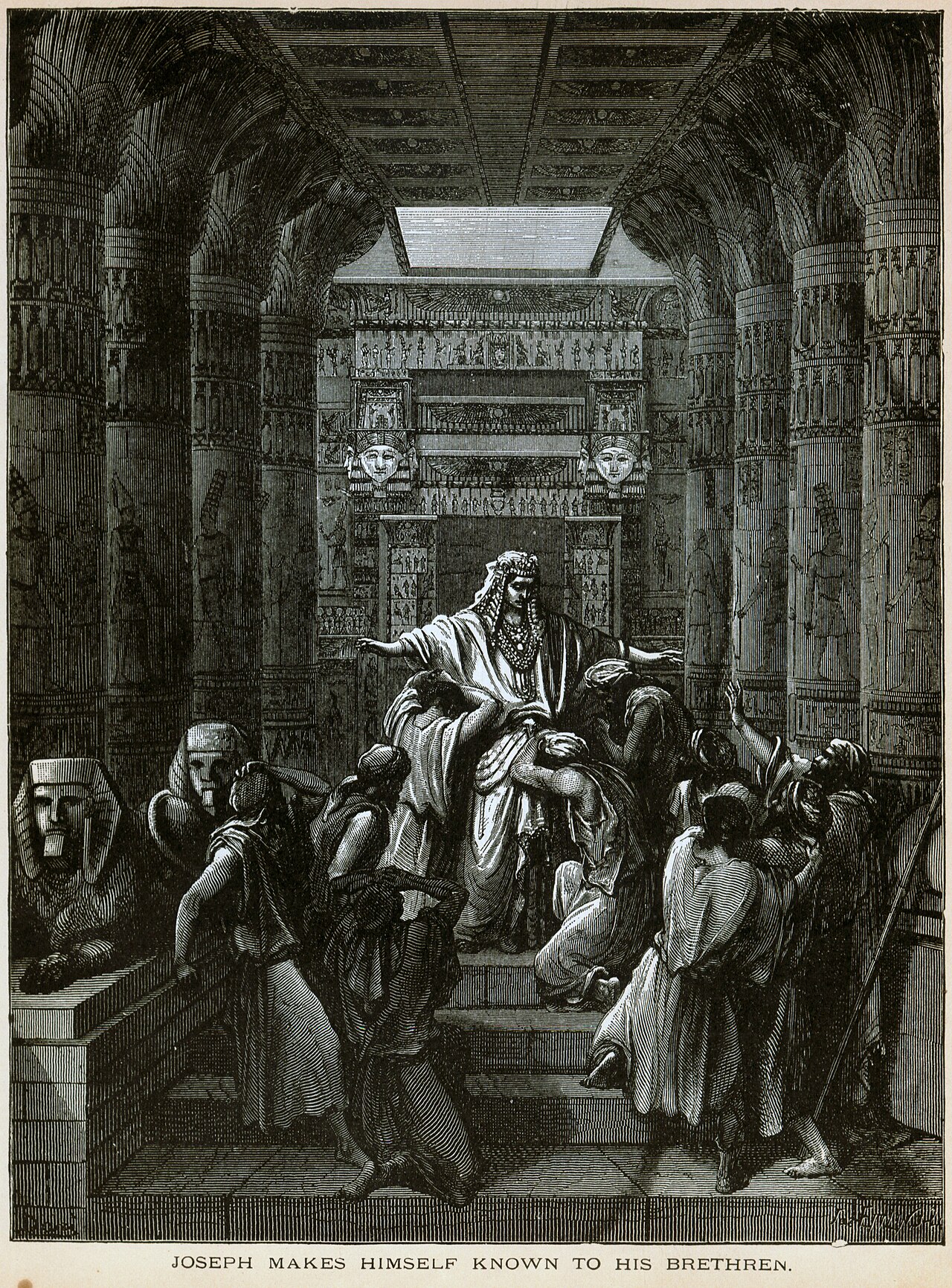
Joseph, Jacob's son, rose to power in Egypt and saved his family during a famine.
Joseph was the eleventh son of Israel (or 'Jacob') and the firstborn of Rachel (Gen 30:22-24). He was favored by his father, causing jealousy among his brothers (Gen 37:3-4). Joseph had dreams of his family bowing down to him, further straining the relationships (Gen 37:5-11). His brothers sold him into slavery, and he was taken to Egypt (Gen 37:12-36). In Egypt, Joseph served in Potiphar's house, where he was falsely accused and imprisoned (Genesis 39). While in prison, Joseph interpreted the dreams of Pharaoh's cupbearer and baker (Genesis 40). Later, he interpreted Pharaoh's dreams and was appointed as second-in-command over Egypt (Gen 41:1-45). During this time, he was given the name Zaphenath-paneah by Pharaoh (Gen 41:45). Joseph managed Egypt's resources wisely during the years of plenty and famine (Gen 41:46-57). His brothers came to Egypt for food, and after testing them, Joseph revealed his identity and reconciled with them (Genesis 42-45). Joseph brought his father, Jacob, and his entire family to Egypt, where they settled in the land of Goshen (Genesis 46-47). Before his death, Jacob blessed Joseph's sons, Ephraim and Manasseh, and prophesied about Joseph's descendants (Genesis 48-49). Joseph died at the age of 110 and was embalmed and placed in a coffin in Egypt (Gen 50:22-26). His bones were later carried out of Egypt by the Israelites during the Exodus and buried at Shechem (Exo 13:19; Jos 24:32). Joseph's life exemplified faith, forgiveness, and God's providence in the midst of hardship.
The elder of the two sons of Jacob by Rachel (Gen. 30:23, 24), who, on the occasion of his birth, said, “God hath taken away [Heb. ‘asaph] my reproach.” “The Lord shall add [Heb. yoseph] to me another son” (Gen. 30:24). He was a child of probably six years of age when his father returned from Haran to Canaan and took up his residence in the old patriarchal town of Hebron. “Now Israel loved Joseph more than all his children, because he was the son of his old age,” and he “made him a long garment with sleeves” (Gen. 37:3, R.V. marg.), i.e., a garment long and full, such as was worn by the children of nobles. This seems to be the correct rendering of the words. The phrase, however, may also be rendered, “a coat of many pieces”, i.e., a patchwork of many small pieces of divers colours.
When he was about seventeen years old Joseph incurred the jealous hatred of his brothers (Gen. 37:4). They “hated him, and could not speak peaceably unto him.” Their anger was increased when he told them his dreams (37:11).
Jacob desiring to hear tidings of his sons, who had gone to Shechem with their flocks, some 60 miles from Hebron, sent Joseph as his messenger to make inquiry regarding them. Joseph found that they had left Shechem for Dothan, whither he followed them. As soon as they saw him coming they began to plot against him, and would have killed him had not Reuben interposed. They ultimately sold him to a company of Ishmaelite merchants for twenty pieces (shekels) of silver (about $2, 10s.), ten pieces less than the current value of a slave, for “they cared little what they had for him, if so be they were rid of him.” These merchants were going down with a varied assortment of merchandise to the Egyptian market, and thither they conveyed him, and ultimately sold him as a slave to Potiphar, an “officer of Pharaoh’s, and captain of the guard” (Gen. 37:36). “The Lord blessed the Egyptian’s house for Joseph’s sake,” and Potiphar made him overseer over his house. At length a false charge having been brought against him by Potiphar’s wife, he was at once cast into the state prison (39; 40), where he remained for at least two years. After a while the “chief of the cupbearers” and the “chief of the bakers” of Pharaoh’s household were cast into the same prison (40:2). Each of these new prisoners dreamed a dream in the same night, which Joseph interpreted, the event occurring as he had said.
This led to Joseph’s being remembered subsequently by the chief butler when Pharaoh also dreamed. At his suggestion Joseph was brought from prison to interpret the king’s dreams. Pharaoh was well pleased with Joseph’s wisdom in interpreting his dreams, and with his counsel with reference to the events then predicted; and he set him over all the land of Egypt (Gen. 41:46), and gave him the name of Zaphnath-paaneah. He was married to Asenath, the daughter of the priest of On, and thus became a member of the priestly class. Joseph was now about thirty years of age.
As Joseph had interpreted, seven years of plenty came, during which he stored up great abundance of corn in granaries built for the purpose. These years were followed by seven years of famine “over all the face of the earth,” when “all countries came into Egypt to Joseph to buy corn” (Gen. 41:56, 57; 47:13, 14). Thus “Joseph gathered up all the money that was in the land of Egypt, and in the land of Canaan, for the corn which they bought.” Afterwards all the cattle and all the land, and at last the Egyptians themselves, became the property of Pharaoh.
During this period of famine Joseph’s brethren also came down to Egypt to buy corn. The history of his dealings with them, and of the manner in which he at length made himself known to them, is one of the most interesting narratives that can be read (Gen. 42-45). Joseph directed his brethren to return and bring Jacob and his family to the land of Egypt, saying, “I will give you the good of the land of Egypt, and ye shall eat the fat of the land. Regard not your stuff; for the good of all the land is yours.” Accordingly Jacob and his family, to the number of threescore and ten souls, together with “all that they had,” went down to Egypt. They were settled in the land of Goshen, where Joseph met his father, and “fell on his neck, and wept on his neck a good while” (Gen. 46:29).
The excavations of Dr. Naville have shown the land of Goshen to be the Wady Tumilat, between Ismailia and Zagazig. In Goshen (Egyptian Qosem) they had pasture for their flocks, were near the Asiatic frontier of Egypt, and were out of the way of the Egyptian people. An inscription speaks of it as a district given up to the wandering shepherds of Asia.
Jacob at length died, and in fulfilment of a promise which he had exacted, Joseph went up to Canaan to bury his father in “the field of Ephron the Hittite” (Gen. 47:29-31; 50:1-14). This was the last recorded act of Joseph, who again returned to Egypt.
“The ‘Story of the Two Brothers,’ an Egyptian romance written for the son of the Pharaoh of the Oppression, contains an episode very similar to the Biblical account of Joseph’s treatment by Potiphar’s wife. Potiphar and Potipherah are the Egyptian Pa-tu-pa-Ra, ‘the gift of the sun-god.’ The name given to Joseph, Zaphnath-paaneah, is probably the Egyptian Zaf-nti-pa-ankh, ‘nourisher of the living one,’ i.e., of the Pharaoh. There are many instances in the inscriptions of foreigners in Egypt receiving Egyptian names, and rising to the highest offices of state.”
By his wife Asenath, Joseph had two sons, Manasseh and Ephraim (Gen. 41:50). Joseph having obtained a promise from his brethren that when the time should come that God would “bring them unto the land which he sware to Abraham, to Isaac, and to Jacob,” they would carry up his bones out of Egypt, at length died, at the age of one hundred and ten years; and “they embalmed him, and he was put in a coffin” (Gen. 50:26). This promise was faithfully observed. Their descendants, long after, when the Exodus came, carried the body about with them during their forty years’ wanderings, and at length buried it in Shechem, in the parcel of ground which Jacob bought from the sons of Hamor (Josh. 24:32; comp. Gen. 33:19). With the death of Joseph the patriarchal age of the history of Israel came to a close.
The Pharaoh of Joseph’s elevation was probably Apepi, or Apopis, the last of the Hyksos kings. Some, however, think that Joseph came to Egypt in the reign of Thothmes III. (see PHARAOH), long after the expulsion of the Hyksos.
The name Joseph denotes the two tribes of Ephraim and Manasseh in Deut. 33:13-17; the kingdom of Israel in Ezek. 37:16, 19, Amos 5:6; and the whole covenant people of Israel in Ps. 81:4.
Sources: BibleData (CC BY 4.0, Joseph_1) · STEPBible TIPNR (CC BY 4.0, Joseph@Gen.30.24-Rev) · Theographic Bible Metadata (CC BY-SA 4.0, joseph_1710)