Cain Summary
STEPBible TIPNR
Cain, the firstborn son of Adam and Eve, murdered his brother Abel and was cursed by God to be a wanderer.
first son of Adam (GEN 4:1), cursed from the ground (GEN 4:11)
Loading book references…
Absolute years are conditional chronological estimates. A biblical passage may state an age or event, but does not by itself establish a BCE year. Different calendar systems are preserved separately.
-4003 · Calendar interpretation is unverified; the raw value is shown.
cain_533 · birthYeartheographic/People.csv · record 5915d380e876ad8192cae32dfb1224c70d3a43a41f66cd2760635d17e51ba220ae0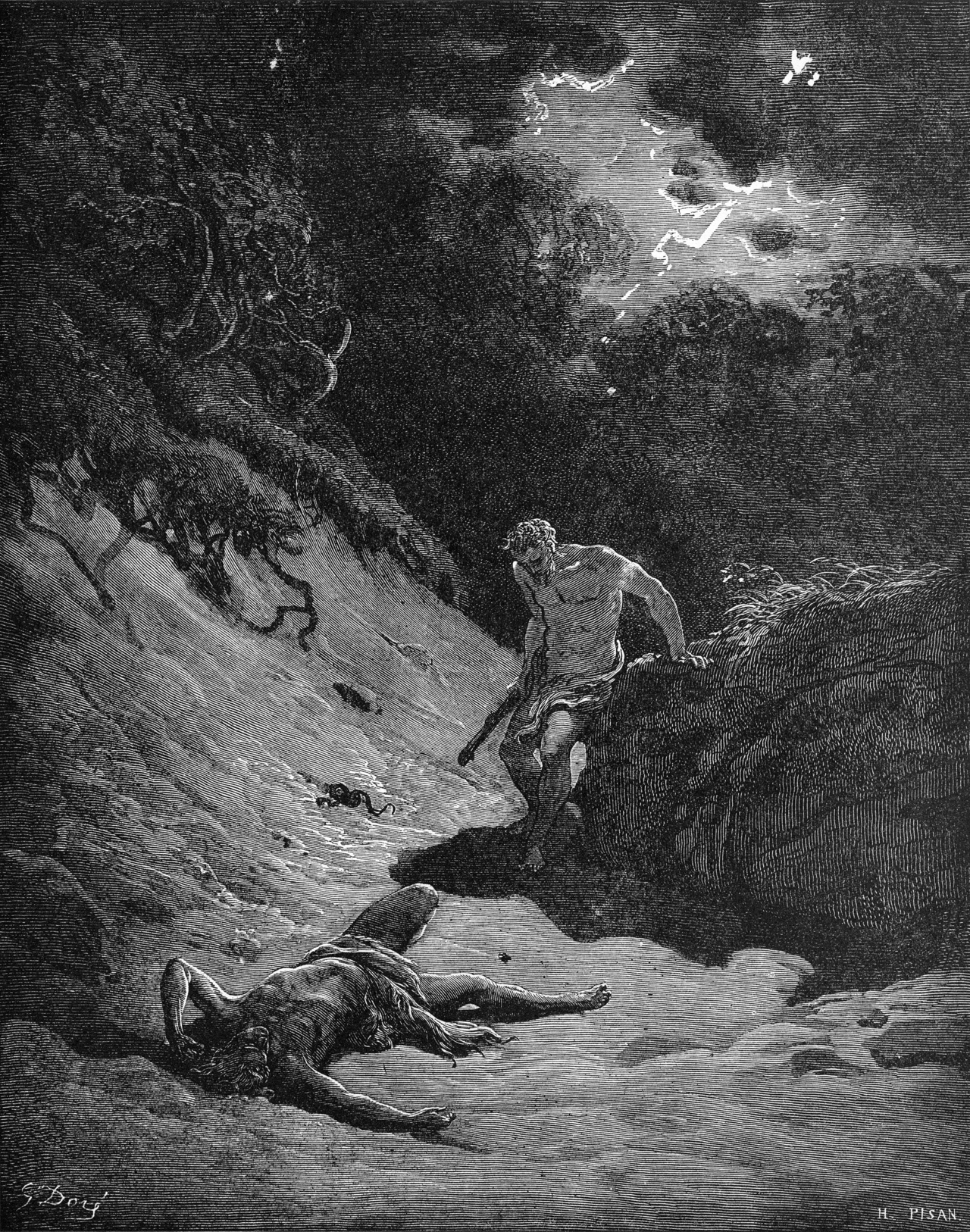
Cain, the firstborn son of Adam and Eve, murdered his brother Abel and was cursed by God to be a wanderer.
Cain was the firstborn son of Adam and Eve, and he is known for killing his brother Abel (Gen. 4; Heb. 11:4; 1Jn 3:12; Jud 1:11). Cain was a farmer, while Abel was a shepherd. When both brothers brought offerings to God, the Lord accepted Abel's offering but rejected Cain's, which led to Cain's anger and jealousy. Despite God's warning to master his sinful desires, Cain lured Abel into the field and murdered him. As a result, God cursed Cain to be a restless wanderer on the earth and banished him from His presence. Cain's descendants, known as the Cainites, are mentioned in the genealogy of Genesis 4, which highlights the spread of sin and the development of civilization apart from God. The New Testament references to Cain portray him as an example of unbelief, wickedness, and rebellion against God (Heb. Jud 11:4; 1Jn 3:12; Jud 1:11). Cain's story serves as a warning about the consequences of sin, jealousy, and disobedience to God.
The first-born son of Adam and Eve (Gen. 4). He became a tiller of the ground, as his brother Abel followed the pursuits of pastoral life. He was “a sullen, self-willed, haughty, vindictive man; wanting the religious element in his character, and defiant even in his attitude towards God.” It came to pass “in process of time” (marg. “at the end of days”), i.e., probably on the Sabbath, that the two brothers presented their offerings to the Lord. Abel’s offering was of the “firstlings of his flock and of the fat,” while Cain’s was “of the fruit of the ground.” Abel’s sacrifice was “more excellent” (Heb. 11:4) than Cain’s, and was accepted by God. On this account Cain was “very wroth,” and cherished feelings of murderous hatred against his brother, and was at length guilty of the desperate outrage of putting him to death (1 John 3:12). For this crime he was expelled from Eden, and henceforth led the life of an exile, bearing upon him some mark which God had set upon him in answer to his own cry for mercy, so that thereby he might be protected from the wrath of his fellow-men; or it may be that God only gave him some sign to assure him that he would not be slain (Gen. 4:15). Doomed to be a wanderer and a fugitive in the earth, he went forth into the “land of Nod”, i.e., the land of “exile”, which is said to have been in the “east of Eden,” and there he built a city, the first we read of, and called it after his son’s name, Enoch. His descendants are enumerated to the sixth generation. They gradually degenerated in their moral and spiritual condition till they became wholly corrupt before God. This corruption prevailed, and at length the Deluge was sent by God to prevent the final triumph of evil.
Sources: BibleData (CC BY 4.0, Cain_1) · STEPBible TIPNR (CC BY 4.0, Cain@Gen.4.1-Jud) · Theographic Bible Metadata (CC BY-SA 4.0, cain_533)