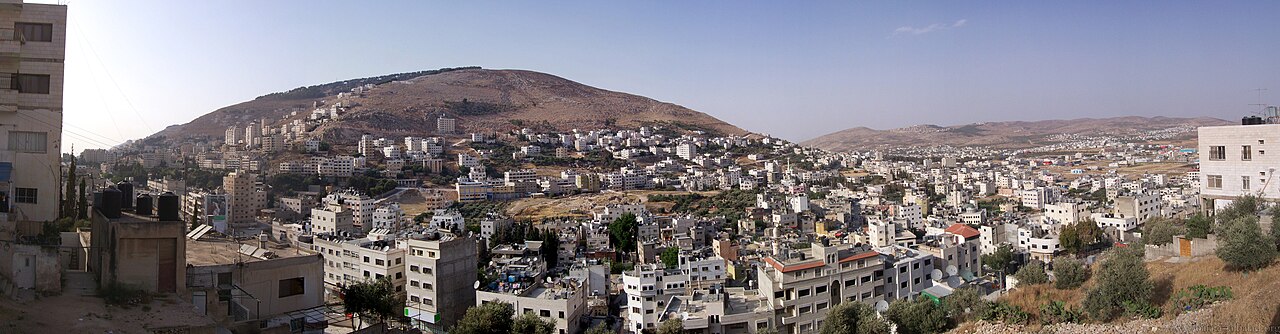
Mount Ebal
Mount Ebal is the mountain on which Israel was to put the curse, as mount Gerizim bore the blessing: “thou shalt put the blessing upon mount Gerizim, and the curse upon mount Ebal”. KJV calls it a mount; BG1940 calls it a hill and begins the name with a consonant that KJV lacks: “на хълма Гевал”. Deut 11:29.
It is also the place of the written law and the altar. When they have gone over the Jordan, Israel is to set up great stones in mount Ebal, plaister them with plaister (BG1940: “измажи ги с вар”, with lime) and write on them all the words of the law very plainly, and to build there an altar to the LORD of whole stones, on which no iron tool is lifted up. On the same day Moses names the tribes that shall stand upon mount Ebal to curse: “Reuben, Gad, and Asher, and Zebulun, Dan, and Naphtali”. Deut 27:4-8; Deut 27:13.
Joshua carries out the command: he builds an altar to the LORD God of Israel in mount Ebal, of whole stones, as it is written in the book of the law of Moses, offers burnt offerings and peace offerings on it, and writes there upon the stones a copy of the law; then half of the people stand over against mount Ebal and half over against mount Gerizim while the law is read. This is the event in which Joshua reads the law at Ebal and Gerizim. Josh 8:30-33.
Ellen G. White, in Patriarchs and Prophets, chapter 46, writes that a monument of great stones, previously prepared by a covering of plaster, was erected upon Mount Ebal and that the law was inscribed on it, with an altar of unhewn stone beside it; she calls it significant that the altar was set up on the mountain upon which the curse was put, denoting that Israel had justly incurred God’s wrath, which would at once have been visited but for the atonement of Christ, represented by the altar of sacrifice. The tribes on Ebal, she adds, gave their assent to the curses as with the voice of one man. The Sabbath School lesson “Written on Stones” (12 November 2025) notes that Mount Ebal is mentioned only in Deuteronomy and Joshua, that it was to be the site of the curses, and that the sacrifices brought there pointed to Jesus, who took upon Himself all the curses of the covenant. Deut 27:4; Josh 8:30; Josh 8:33.
Easton renders the name “stony” and gives the mountain 3,076 feet above the sea and 1,200 feet above the valley, with the city of Shechem below it; he adds that after this the name of Ebal does not again occur in Jewish history. Smith, under Mount Ebal, places Ebal on the north and Gerizim on the south of the fertile valley in which Nablus, the ancient Shechem, lies, and gives its modern name as Sitti Salamiyah; Hitchcock renders the name “ancient heaps”. Deut 11:29; Deut 27:13.