Joshua
Joshua son of Nun, an Ephraimite, was Moses’ assistant and his successor as leader of Israel. His career joins the wilderness period to the entry into Canaan, military campaigns, distribution of tribal inheritances and a final covenant assembly. The account distinguishes his military leadership from the priestly office of Eleazar; both participated in the allocation of land. Num 13:1-16; Num 27:15-23; Josh 14:1-15.
The transfer of leadership preserved the authority of the law entrusted to Moses. Courage was connected with observing that law, rather than with personal invulnerability or unrestricted conquest. The assurance of divine presence accompanied a demanding public responsibility: Joshua was to lead Israel while continuing to listen and obey. Josh 1:1-18. A New Moses, 28 September 2025.
Joshua’s earlier responsibilities included command in the battle against Amalek at Rephidim. While he fought, Aaron and Hur supported Moses’ raised hands. He also accompanied Moses toward Sinai, heard the noise of the camp during the golden-calf crisis and served at the tent of meeting outside the camp. His objection when Eldad and Medad prophesied in the camp elicited Moses’ wish that all the Lord’s people might receive the prophetic gift. These notices place him in military, administrative and religious service before his succession. Exod 17:8-16; Exod 24:12-18; Exod 32:15-20; Exod 33:7-11; Num 11:24-30.
As the Ephraimite representative among the twelve scouts, he appears first as Hoshea; Moses called him Jehoshua. His colleagues were Shammua, Shaphat, Caleb, Igal, Palti, Gaddiel, Gaddi, Ammiel, Sethur, Nahbi and Geuel. Joshua and Caleb opposed the demand to abandon the promised land and return to Egypt. They were preserved from the plague that killed the other ten scouts and were promised entry into the land. Their dissent concerned trust in the Lord’s promise, not a denial that the inhabitants were formidable. Num 13:1-16; Num 14:1-10; Num 14:26-38.
The commission to succeed Moses was public: Moses laid hands on Joshua before Eleazar and the congregation. The instructions retained a role for priestly inquiry, so succession did not make Joshua the sole religious authority. Further charges required him to lead the people across the Jordan and assured him of divine help. After Moses’ death, the people obeyed Joshua as their appointed leader. Num 27:15-23; Deut 31:1-8; Deut 31:14-23; Deut 34:9; Josh 1:1-18.
Preparations for entry included the mission of two unnamed spies from Shittim to Jericho. Rahab’s protection of the spies led to an undertaking to preserve her household, marked by a scarlet cord at her window. The subsequent crossing of the Jordan was associated with the priests carrying the covenant ark. Twelve stones taken from the river became a memorial at Gilgal; the account also mentions stones Joshua set up where the priests had stood. At Gilgal, circumcision of the wilderness-born men and the Passover marked the community’s covenant identity; manna ceased after they ate the land’s produce. Josh 2:1-24; Josh 3:1-17; Josh 4:1-24; Josh 5:1-15.
Near Jericho, Joshua encountered a figure with a drawn sword who identified himself as commander of the Lord’s host. Joshua bowed and was instructed to remove his shoe because the ground was holy. The figure is not personally named in the passage. The understanding of this encounter as an appearance of Christ before His incarnation is a theological interpretation of the worship and divine authority in the scene. Josh 5:13-15. Commander of the Army of the Lord, 19 October 2025.
The fall of Jericho followed the prescribed processions with the ark and priestly trumpets. Joshua enforced the restriction on taking the city’s devoted goods; precious metals were assigned to the Lord’s treasury. Rahab and her relatives were brought out, while the account records the killing of the city’s inhabitants and animals and the burning of the city. Joshua’s curse concerned whoever subsequently rebuilt its foundations and gates. The narrative treats the campaign as a particular divine judgment and preserves the rescue undertaking within that judgment. Josh 6:1-27.
The initial defeat at Ai exposed a violation of those restrictions. Achan, son of Carmi, in the line of Zabdi and Zerah, admitted taking a garment, silver and gold and concealing them in his tent. Joshua’s inquiry moved from the community to the identified offender; the goods, his household and possessions were brought to the place of judgment. The account records Achan’s stoning and the removal of divine anger. A subsequent campaign used an ambush, captured Ai and ended with the execution of its unnamed king. These two episodes distinguish military defeat through covenant breach from the later victory. Josh 7:1-26; Josh 8:1-35.
Military activity was accompanied by a public reaffirmation of the law. Joshua built an altar of unhewn stones on Mount Ebal, made a written copy of the law and read the blessings and curses before the gathered community facing Ebal and Gerizim. Women, children and resident foreigners were included. This assembly gives the population, rather than only its commanders, an explicit place in the obligations governing settlement. Josh 8:30-35.
Relations with neighbouring communities were not uniformly military. Representatives of Gibeon obtained a treaty by presenting themselves as travellers from a distant country. Joshua and the leaders accepted their evidence without seeking the Lord’s counsel. Discovery that they belonged to Gibeon, Chephirah, Beeroth and Kirjath-jearim did not cancel the sworn undertaking to let them live. They were assigned work cutting wood and drawing water for the congregation and the altar. Josh 9:1-27.
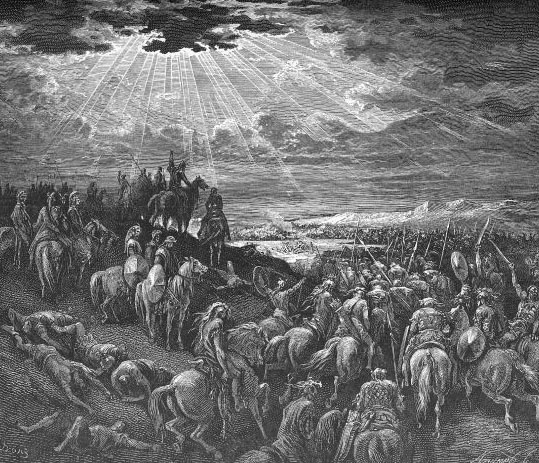
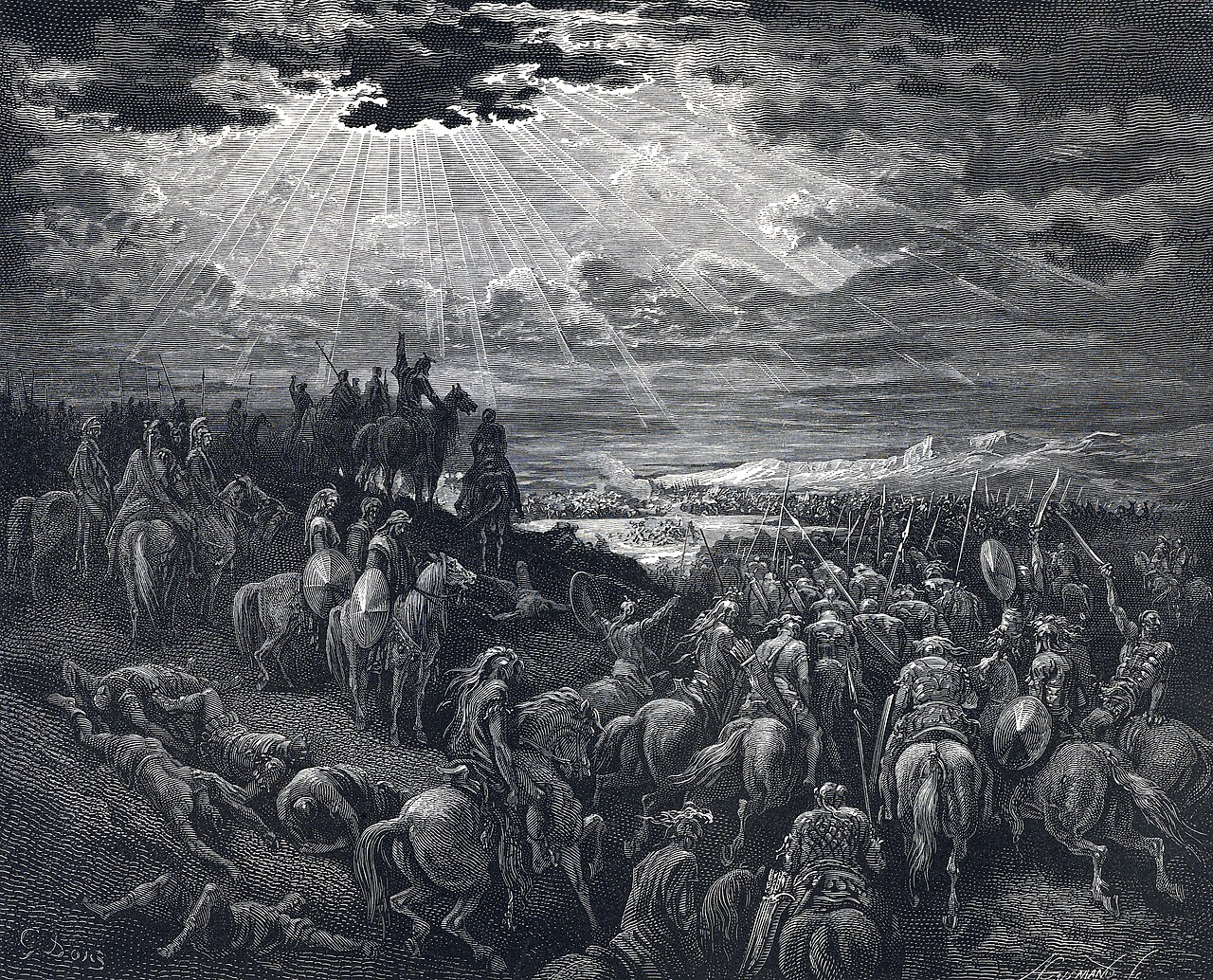
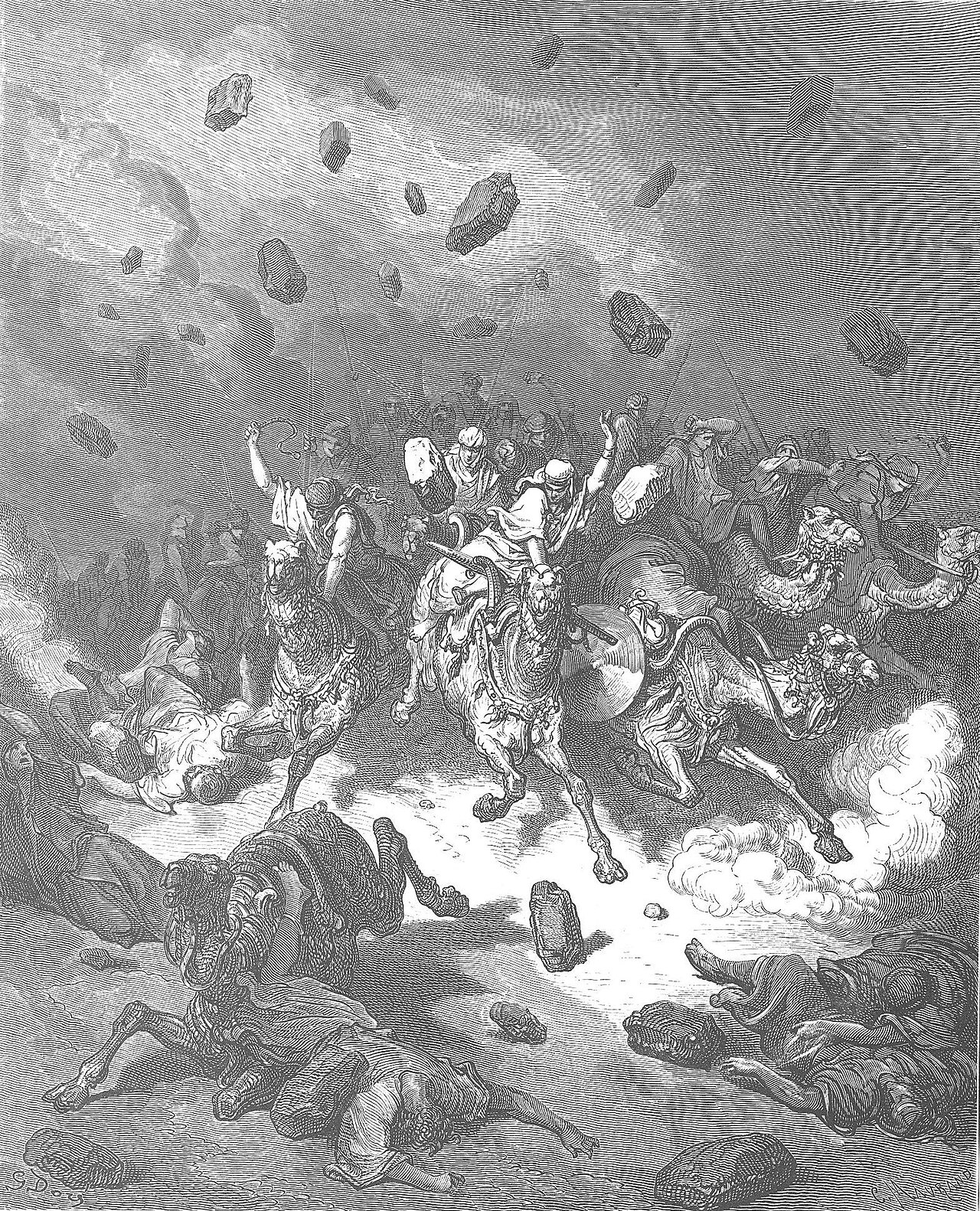
The treaty then drew Joshua into the defence of Gibeon against five Amorite kings: Adoni-zedek of Jerusalem, Hoham of Hebron, Piram of Jarmuth, Japhia of Lachish and Debir of Eglon. The battle included a destructive hailstorm and the extraordinary prolongation of the day associated with Joshua’s appeal concerning the sun over Gibeon and the moon over the valley of Ajalon. The five kings were subsequently killed at Makkedah. The passage attributes the victory to the Lord without explaining an astronomical mechanism. Josh 10:1-27.
A northern coalition assembled under Jabin of Hazor with Jobab of Madon and other kings. Joshua attacked them at the waters of Merom, disabled their horses, burned their chariots and destroyed Hazor. The wider campaign is described as prolonged. Its account of victory stands alongside the later statement that substantial territory remained to be possessed; completion of major campaigns and complete occupation were therefore distinct matters. Josh 11:1-23; Josh 13:1-7.
In the distribution of the land, Joshua worked with Eleazar and the tribal heads. Caleb, son of Jephunneh, recalled the promise made during the scouting mission and received Hebron. When seven tribes still lacked their portions, Joshua commissioned a written survey and cast lots at Shiloh, where the tent of meeting had been established. His own inheritance was Timnath-serah, which he built and inhabited. The division was thus both a territorial settlement and a public process conducted before the Lord. Josh 14:1-15; Josh 18:1-10; Josh 19:49-51.
The settlement also provided cities of refuge for people who killed unintentionally, with access for resident foreigners and a hearing before the congregation. The Levites received towns and pasturelands rather than a separate tribal territory. These arrangements qualify a description of Joshua’s work as conquest alone: the new society required procedures for justice, residence and priestly service. The summary of fulfilled promises and rest belongs to this stage of settlement. Josh 14:1-15; Josh 20:1-9; Josh 21:1-8; Josh 21:43-45.
Joshua released the fighting men of Reuben, Gad and the eastern half of Manasseh to their homes. Their construction of a large altar by the Jordan provoked the eastern tribes’ altar dispute. Phinehas, son of Eleazar, and ten leaders investigated. The eastern tribes explained that the structure was a witness to their shared relationship with the Lord, rather than a competing place of sacrifice. That explanation prevented the threatened war. Joshua’s admonition before their departure had tied their return home to continued observance of the law. Josh 22:1-34.
In old age Joshua addressed the leaders about the people’s continuing obligations, then assembled the tribes at Shechem. The covenant there combined remembrance of divine deliverance, rejection of foreign gods and a declared choice to serve the Lord. Joshua recorded its words and erected a stone as a witness. Sincerity and truth in this setting mean sustained loyalty expressed in action, rather than a ceremonial declaration detached from obedience. Josh 23:1-16; Josh 24:1-28. In Sincerity and Truth, 22 December 2025.
Joshua’s death at 110 and burial in Timnath-serah close his personal career. The final notices also record the burial of Joseph’s bones at Shechem and the death of Eleazar, son of Aaron. The generation that knew the Lord’s works continued faithful service, whereas the succeeding generation is described as losing that knowledge. The later argument about rest in Heb 4:1-11 distinguishes the settlement under Joshua from the enduring divine promise: the KJV’s name “Jesus” in that passage refers to Joshua, as BG1940 makes explicit. Josh 24:1-33; Judg 2:7-10.