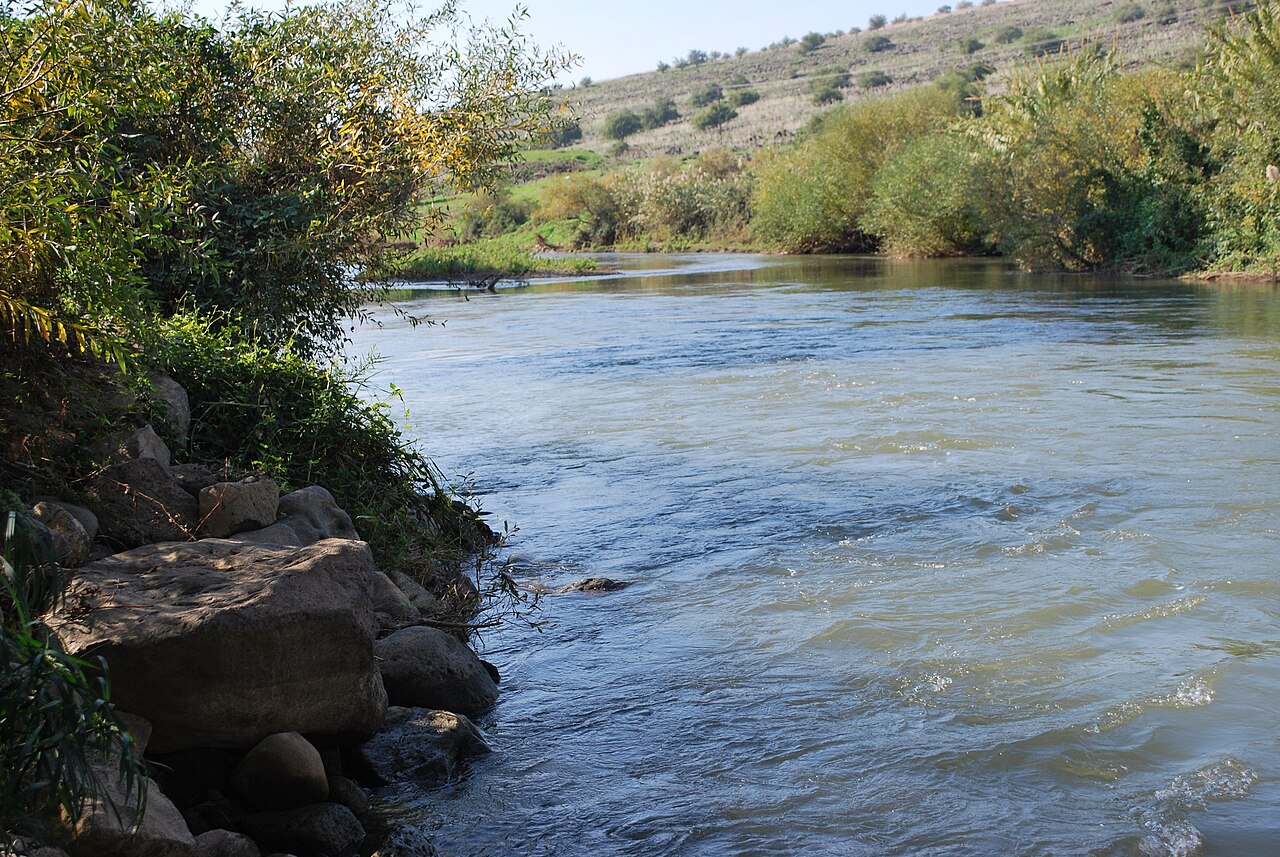
Jordan
The Jordan is both a river and a recurring boundary in the biblical geography. The lower watercourse runs toward the Salt Sea; the land description follows the river to that sea as part of the eastern border of Canaan. The accounts distinguish the river itself, its surrounding plain, its fords and particular crossings. Those settings explain its importance for settlement, military movement and baptism without requiring one modern location for every recorded encounter. Num 34:12 Josh 3:1-17
The crossing into the land joins movement with covenant worship. The priests carrying the ark go before the people, and Joshua calls for preparation before the announced wonders. The account places his leadership in continuity with Moses and attributes the dry passage to the Lord. The ark’s role makes the crossing a public expression of that relationship, rather than simply a successful ford crossing. Crossing the Jordan, 12 October 2025 Josh 3:1-17
The stones taken from the river make the passage a subject for later instruction. Twelve representatives, one from each tribe, carry stones to the lodging place; Joshua sets them at Gilgal. Their stated purpose is to prompt children’s questions and preserve testimony to the crossing. The memorial links a visible object with an explanation of God’s action, rather than assigning the event to an undated surviving modern monument. Remember, 14 October 2025 Josh 4:1-24
The earlier ancestral notices describe the surrounding plain and personal journeys. Lot chooses the well-watered plain after separating from Abram; the description reaches toward Zoar and explicitly precedes the destruction of Sodom and Gomorrah. Abram remains in Canaan, while Lot settles among the plain’s towns. Later, Jacob’s prayer to the God of Abraham and Isaac recalls crossing with only his staff and contrasts that beginning with his present household. His concern is the approach of Esau; the passage does not locate his remembered crossing at a particular modern ford. Gen 13:8-13 Gen 32:9-12
The tribal allotment uses the river as an organizing line. The grant to the Reubenites and Gadites names Gilead, the Arnon and Jabbok, the latter marking the Ammonite border. The Jordan boundary runs from Chinnereth to the Salt Sea beneath the eastern slopes of Pisgah. These descriptions are territorial evidence; riverbank language alone does not prove that all land on either side belonged to one tribe in every period. Deut 3:16-17
The crossing account gives its own more precise setting. The people leave Shittim and pass opposite Jericho while the river is overflowing at harvest. The stopped waters are related to the city of Adam, near Zaretan, distinct from the ancestral person of the same name. Armed Reubenites, Gadites and the half-tribe of Manasseh accompany the movement, while the priests remain in the river until the passage is complete. The twelve memorial stones at Gilgal are distinguished from the twelve stones that Joshua sets in the river. Josh 3:1-17 Josh 4:1-24
Control of the fords also matters in the judges’ military accounts. Ehud’s deliverance includes taking the crossings toward Moab, cutting off escape. During Gideon’s campaign, the men of Ephraim seize the waters at Beth-barah and capture the Midianite leaders Oreb and Zeeb. In the later conflict involving Jephthah, the Gileadite force holds the crossings against fleeing Ephraimites, using the pronunciation of Shibboleth as an identifying test. These are distinct operations, demonstrating the strategic function of crossing places rather than one continuous battle. Judg 3:26-30 Judg 7:24-25 Judg 12:1-6
Two prophetic accounts give the river a different role. Elijah and Elisha travel from Gilgal, through Bethel and Jericho, before crossing on dry ground after Elijah strikes the waters with his mantle. After Elijah’s taking into heaven, Elisha repeats the action on his return, and the watching prophetic community recognizes the succession. Separately, Naaman, the Syrian commander, washes seven times following Elisha’s instruction. An unnamed girl captured from Israel and serving his wife had directed the household toward the prophet in Samaria. His comparison with the Abana and Pharpar at Damascus belongs to his objection; the narrative credits the recovery to obedience to the prophetic word, not to a general medicinal property of the river. 2 Kgs 2:1-15 2 Kgs 5:1-14
In the Gospel setting, John the Baptist draws people from Jerusalem, Judea and the surrounding region to baptism with confession of sins. His address to Pharisees and Sadducees challenges reliance on descent from Abraham without the fruits of repentance. Jesus comes from Galilee and is baptized by John; the account records the descent of the Spirit and the heavenly declaration of sonship. The testimony about John names Bethabara beyond the Jordan, quotes Isaiah and distinguishes him from Elijah and Christ. That naming is not a reason to merge the Gospel locality with Gideon’s Beth-barah. Matt 3:1-17 John 1:19-34
A later commemorative landscape survives at Al-Maghtas, on the east bank north of the Salt Sea. Churches, baptismal pools, monastic remains and hermits’ caves testify to worship and pilgrimage from the fourth to fifteenth centuries CE. The location is traditionally associated with John’s baptism of Jesus; the surviving structures belong to that later commemoration, not to buildings described at the Gospel baptism.