Ai
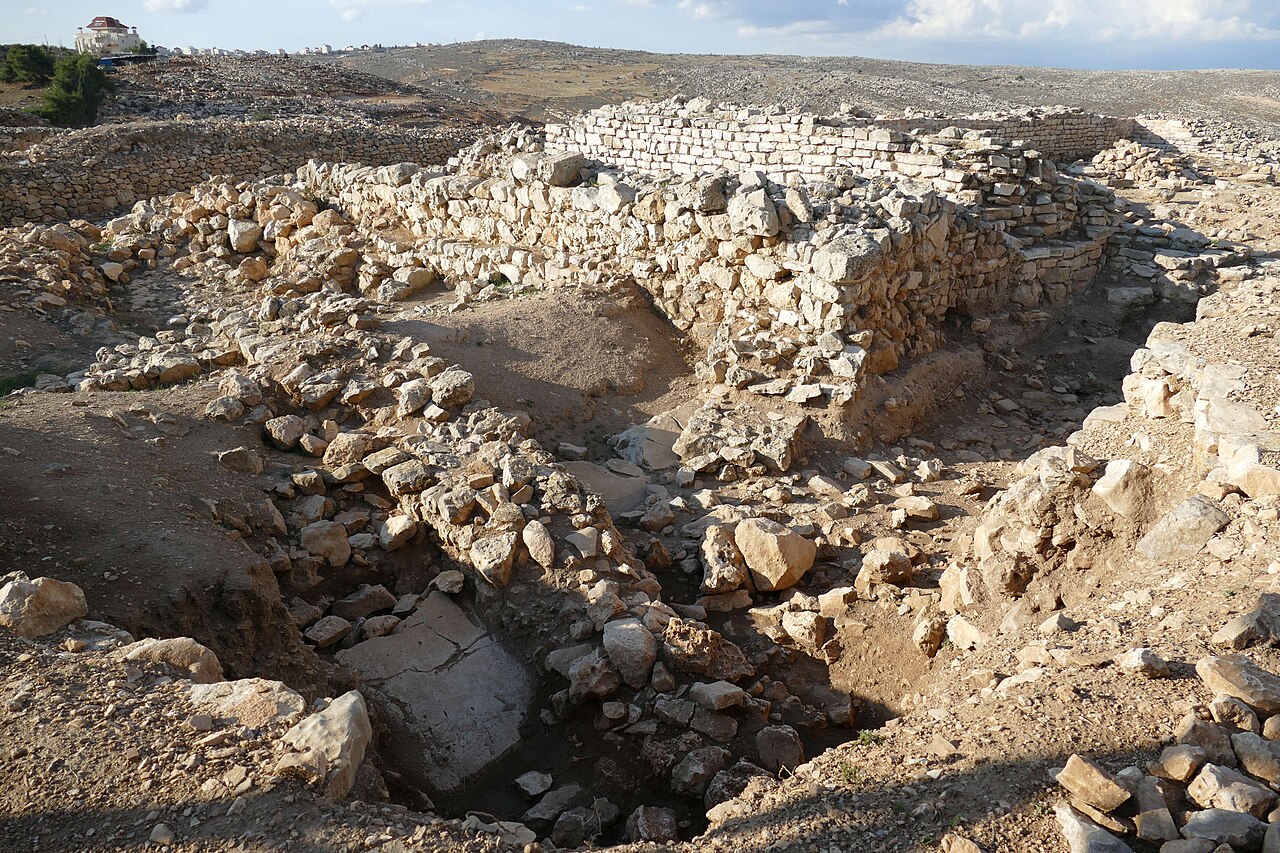
Ai, spelled Hai in Genesis (BG1940: Гай throughout), first appears as a landmark of Abram's journeys: he pitches his tent on a mountain east of Beth-el, with Beth-el on the west and Hai on the east, builds an altar there to the LORD, and later returns to the place between Beth-el and Hai where his tent had been at the beginning. Gen 12:8; Gen 13:3.
After the fall of Jericho, Joshua sends men to view Ai, “which is beside Beth-aven, on the east side of Beth-el” (Beth-aven); they report that the people are few and that two or three thousand men are enough. About three thousand go up, flee before the men of Ai, and about thirty-six are smitten as they are chased from the gate to Shebarim. Ellen G. White, Patriarchs and Prophets, chapter 45, calls Ai a small town among the ravines a few miles west of the Jordan valley and says that even Joshua laid his plans for its conquest without seeking counsel from God. The lesson “Breach of the Covenant”, 2 November 2025, names two causes of this defeat: Achan's sin and Israel's overconfidence, which led them to neglect consulting the LORD and to underestimate the enemy. Josh 7:2-5.
After Achan's judgment the LORD tells Joshua not to fear and to go up with all the people of war, for He has given into his hand “the king of Ai, and his people, and his city, and his land”; Ai and its king are to be treated as Jericho and its king, except that the spoil and the cattle may be taken, and an ambush is to be laid behind the city. Joshua chooses thirty thousand mighty men and sends them by night; the ambush lies between Beth-el and Ai on the west side, and the text later speaks of about five thousand men set there, while the main force camps on the north with a valley between it and Ai. The king of Ai hastens out with all his people; Israel feigns flight, and the men of Ai and Beth-el all pursue, leaving the city open. Ellen G. White, Patriarchs and Prophets, chapter 46, says that after the execution of the sentence on Achan the power of God was with His people and they were soon in possession of the city. Josh 8:1-3; Josh 8:9-12; Josh 8:14-17.
At the LORD's word Joshua stretches out the spear in his hand toward Ai; the ambush takes the city and sets it on fire, and the men of Ai, seeing the smoke, are caught between the two forces. All who fall that day, men and women, are twelve thousand, “even all the men of Ai”, for Joshua does not draw back the hand with the spear until all the inhabitants are utterly destroyed. He burns Ai and makes it “an heap for ever, even a desolation unto this day”; the king is hanged on a tree until evening and a great heap of stones is raised over him at the entrance of the gate. The lesson “The Door of Hope”, 5 November 2025, reads the account of how Ai is taken by an ambush as the LORD turning the earlier defeat into a door of hope, takes Joshua's weapon to be a sickle sword that signalled the attack and expressed God's sovereignty, and compares his outstretched hand with Moses at the Red Sea and in the war against Amalek. Josh 8:18; Josh 8:20-26; Josh 8:28-29.
The fall of Ai is heard of in the land: the kings on this side Jordan gather against Israel, the inhabitants of Gibeon hear what Joshua has done to Jericho and to Ai and seek a league, and Adoni-zedek king of Jerusalem fears because Gibeon, which has made peace with Israel, is a great city, greater than Ai. In the list of the kings whom Joshua smote, “the king of Ai, which is beside Beth-el” is counted as one. Josh 9:1; Josh 9:3-6; Josh 10:1-2; Josh 12:9.
After the exile the men of Beth-el and Ai number two hundred twenty and three in Ezra and an hundred twenty and three in Nehemiah, and the children of Benjamin dwell at Michmash, Aija and Beth-el; in Isaiah the Assyrian advance comes “to Aiath”, passes to Migron and lays up its carriages at Michmash. BG1940 writes Гай in Ezra and Nehemiah 7, Гаия in Nehemiah 11 and Гаят in Isaiah. Nave takes Aija and Aiath as other names of Ai, and Smith calls them probably the same place or a variation of its name; Easton says Ai was rebuilt and inhabited by the Benjamites and gives Haiyan, two miles east of Beth-el, as its most probable site. Ezra 2:28; Neh 7:32; Neh 11:31; Isa 10:28.