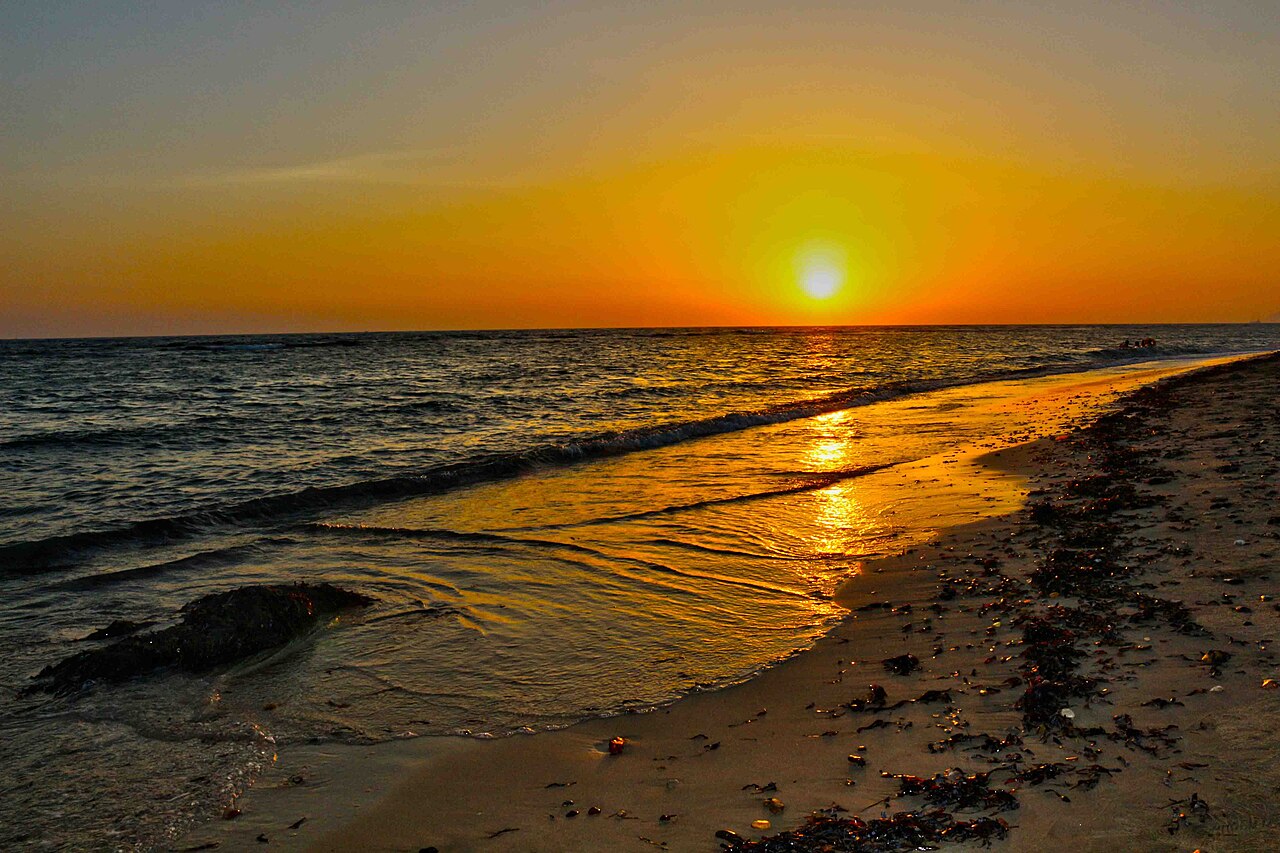
Red sea
The Red sea of KJV, "Червеното море" in BG1940, renders the Hebrew name that Easton and Smith give as Yam Suph, the sea of suph, a woolly kind of sea-weed thrown up on its shores; Smith adds that Brugsch calls it the sea of reeds or weeds and that its water is not red. Easton calls "Red Sea" the name given to it by the Greeks, of uncertain origin, and describes the sea along the west coast of Arabia, divided at Ras Mohammed into the Gulf of Akabah on the east and the Gulf of Suez on the west, with the Sinaitic Peninsula between; in the New Testament, he says, the name is given to the Gulf of Suez. Exod 10:19; Acts 7:36; Heb 11:29.
The sea first appears in the plague of locusts: the LORD turned a mighty strong west wind, which took away the locusts and cast them into the Red sea, so that not one remained in all the coasts of Egypt; Ellen White tells how the strong west wind "carried away the locusts toward the Red Sea". After the departure God led the people about, through the way of the wilderness of the Red sea (BG1940: "по околен път през пустинята към Червеното море"). Exod 10:19; Exod 13:18.
In Ellen White's account of the Exodus, the Lord turned the course of Israel southward, toward the shores of the Red Sea, instead of the direct route through the country of the Philistines, and in leading them by the way of the Red Sea "revealed Himself as a God of compassion as well as of judgment". She writes of the crossing that it was "by faith" that they passed through the Red Sea as by dry land, and that in marching down to the very water they showed that they believed the word of God as spoken by Moses. Exod 13:18; Heb 11:29.
The song after the crossing says that Pharaoh's chariots and his host were cast into the sea and his chosen captains drowned in the Red sea. Moses then brought Israel from the Red sea into the wilderness of Shur, three days without water; the list of stations in Numbers sums up the crossing in the words "passed through the midst of the sea". Exod 15:4; Exod 15:22; Num 33:8.
The same list then has Israel encamp by the Red sea after Elim and remove from it into the wilderness of Sin. Num 33:10-11.
In the promise of the land the LORD sets the bounds of Israel from the Red sea unto the sea of the Philistines, and from the desert unto the river, where BG1940 adds the name Euphrates ("Евфрат"). The Sabbath School lesson "God's Original Plan" reads the crossing of the Red Sea as the model for the conquest of the Promised Land, where God fought for His people. Exod 23:31.
In the LORD's answer to Moses' intercession after the people refuse the land, he sends them back into the wilderness by the way of the Red sea; Moses later recalls the command, and Israel compassed mount Seir many days (BG1940: "поляната Сиир"). From mount Hor they again journey by the way of the Red sea to compass the land of Edom, the stretch on which the brazen serpent is set up. Ellen White writes that, refused a passage through Edom, they were compelled to take "the long and difficult route by the Red Sea". In Jephthah's answer to the Ammonite king Israel walked through the wilderness unto the Red sea and came to Kadesh. Num 14:25; Deut 1:40; Deut 2:1; Num 21:4; Judg 11:16.
Solomon made a navy of ships in Ezion-geber, beside Eloth, on the shore of the Red sea in the land of Edom; Smith notes that Elath and Ezion-geber are the only two ports of this sea mentioned in the Bible. Ellen White counts this outlet at the head of the Red Sea among the commercial undertakings of Solomon. 1 Kgs 9:26.
Later books recall the sea as the place of deliverance. Moses reminds Israel how the LORD made the water of the Red sea overflow the army of Egypt as they pursued; Rahab tells the spies that the people of Jericho had heard how the LORD dried up the water of the Red sea, words that Ellen White quotes; at the crossing of the Jordan Joshua compares the drying of the Jordan with what the LORD did to the Red sea; at the renewal of the covenant the Egyptians pursue the fathers with chariots and horsemen unto the Red sea; and the prayer of the Levites recalls that God heard their cry by the Red sea. Deut 11:4; Josh 2:10; Josh 4:23; Josh 24:6; Neh 9:9.
The Psalms speak of the fathers who provoked God at the sea, even at the Red sea, of the LORD who rebuked the Red sea so that it was dried up, of terrible things by the Red sea, and of him who divided the Red sea into parts and overthrew Pharaoh and his host in it. Other verses of this record speak of the same sea without naming it: he turned the sea into dry land, the waters saw thee, the sea saw it and fled, and his people, remembering the days of old, ask where is he that brought them up out of the sea; in Ps 66:6 BG1940 has "реката" (the river) where KJV has "the flood". Ps 106:7; Ps 106:9; Ps 106:22; Ps 136:13; Ps 136:15; Ps 66:6; Ps 77:16; Ps 114:3; Ps 114:5; Isa 63:11.
In Jeremiah's word on Edom the cry at their fall is heard in the Red sea. In the New Testament Stephen, in his address to the council, says that Moses showed wonders and signs in Egypt, in the Red sea and in the wilderness forty years, and Hebrews says that by faith they passed through the Red sea as by dry land, which the Egyptians assaying to do were drowned. Jer 49:21; Acts 7:36; Heb 11:29.