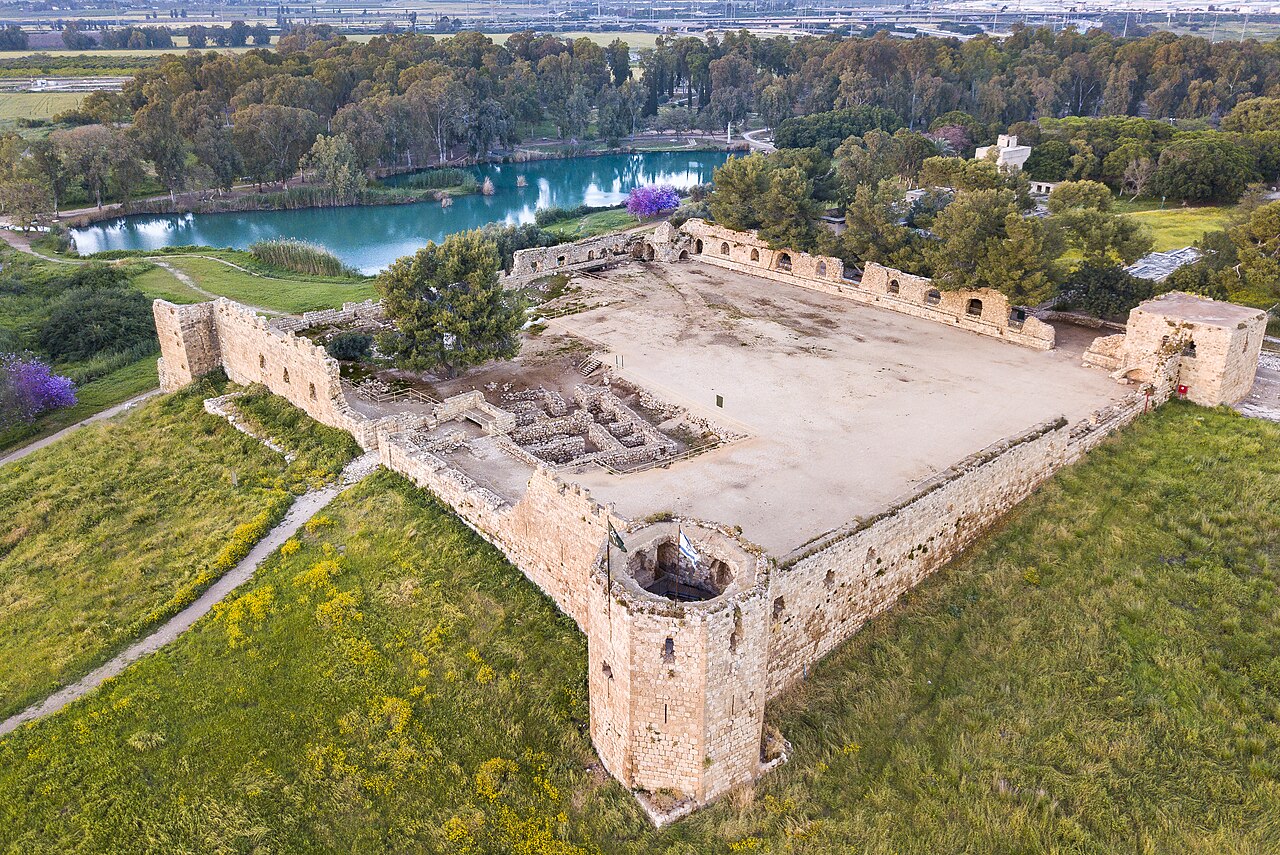
Aphek
Aphek is the city of the king of Aphek, who stands first in Josh 12:18 among the kings whom Joshua and the children of Israel smote on the west side of the Jordan (BG1940: "афекският цар"). Smith counts this royal city of the Canaanites as one of several places called Aphek and thinks it probably the same as Aphekah, a town in the mountains of Judah listed with Janum and Beth-tappuah, which this record also cites. Smith explains the name as "strength", Hitchcock as "strength; a rapid torrent". Josh 12:7; Josh 12:18; Josh 15:48; Josh 15:53.
In 1 Sam 4:1 the Philistines pitch in Aphek while Israel pitches beside Eben-ezer; in the battle that follows Israel is smitten, the ark of God is taken and the two sons of Eli are slain. Quoting the verse, Ellen G. White writes that "this expedition was undertaken by the Israelites without counsel from God, without the concurrence of high priest or prophet." Smith places this Aphek somewhere to the north-west of Jerusalem and at no great distance from it. 1 Sam 4:1-2; 1 Sam 4:10-11.
Later the Philistines gather all their armies to Aphek, and the Israelites pitch by a fountain in Jezreel; from this muster the Philistine commanders send David away, and the Philistines go up to Jezreel. Easton, under Aphik, describes "a city of the tribe of Issachar, near to Jezreel" with references to both 1 Sam 4:1 and 29:1, and gives the name the meaning "stronghold"; Smith thinks the Aphek of 1 Sam 29:1 possibly the same as that of 1 Sam 4:1, and Nave lists both under a city of Issachar which he holds probably to be the royal city of Josh 12:18. 1 Sam 29:1; 1 Sam 29:11.
The record also cites Acts 23:31, where the soldiers bring Paul by night to Antipatris; the verse does not name Aphek, and the Antipatris entries of Easton and Smith describe the town that Herod named after his father Antipater (Smith gives its ancient name as Capharsaba) without mentioning Aphek. Acts 23:31.