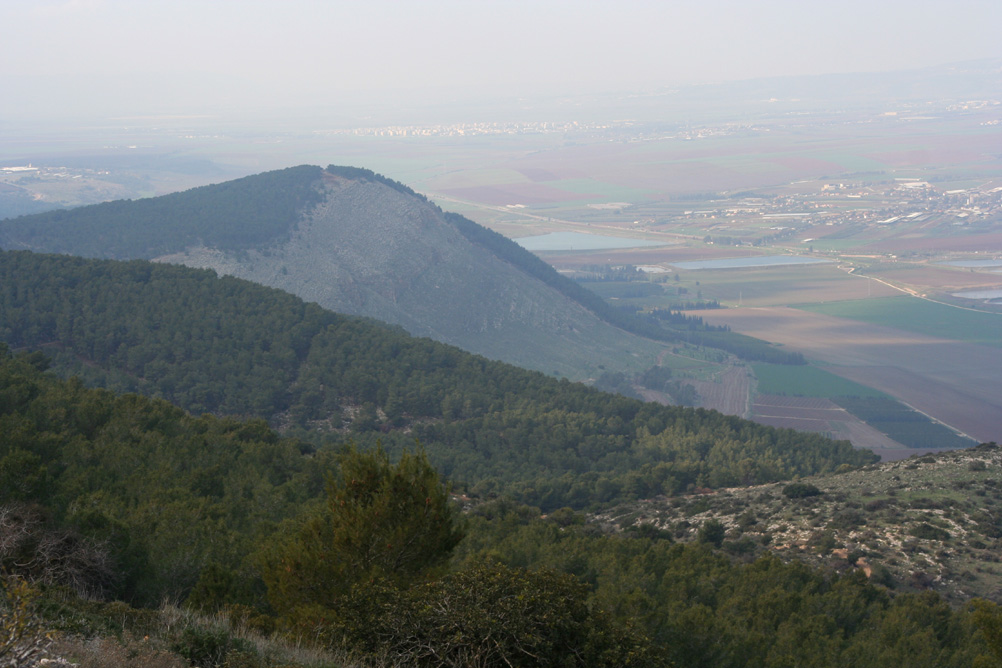
Mount Gilboa
Before the last battle of Saul the Philistines pitch in Shunem, and Saul gathers all Israel and pitches in Gilboa; the verse belongs to the account in which he consults the medium at Endor. 1 Sam 28:4.
In the battle the men of Israel flee before the Philistines and fall down slain in mount Gilboa, and on the morrow, when the Philistines come to strip the slain, they find Saul and his three sons fallen there; the sons named are Jonathan, Abinadab and Malchi-shua, and Chronicles says only “Saul and his sons”. These verses frame the death of Saul. BG1940 calls the place хълма Гелвуе (the hill of Gilboa). 1 Sam 31:1-2; 1 Sam 31:8; 1 Chr 10:1; 1 Chr 10:8.
The young man who brings David the report of Saul’s death says that he happened by chance upon mount Gilboa and saw Saul leaning upon his spear, with the chariots and horsemen following hard after him. In the lament that follows David addresses the “mountains of Gilboa”, asking that there be no dew nor rain upon them, nor fields of offerings, for there the shield of Saul was vilely cast away; BG1940 has Хълми гелвуиски (hills of Gilboa). Ellen G. White gives the lament in Patriarchs and Prophets, chapter 68. 2 Sam 1:6; 2 Sam 1:21.
When David later takes the bones of Saul and Jonathan from the men of Jabesh-gilead, the text recalls that the Philistines had hanged them in the street of Beth-shan when they had slain Saul in Gilboa; this belongs to the reburial of Saul and Jonathan. 2 Sam 21:12.
Easton describes Gilboa as a low barren range of mountains bounding the valley of Esdraelon (Jezreel) on the east, between it and the Jordan valley, and names it Jebel Fukua’; Smith places the range on the eastern side of the plain of Esdraelon, rising over the city of Jezreel, and notes that Scripture mentions it only in connection with the defeat and death of Saul and Jonathan. 1 Sam 28:4; 1 Sam 31:1.