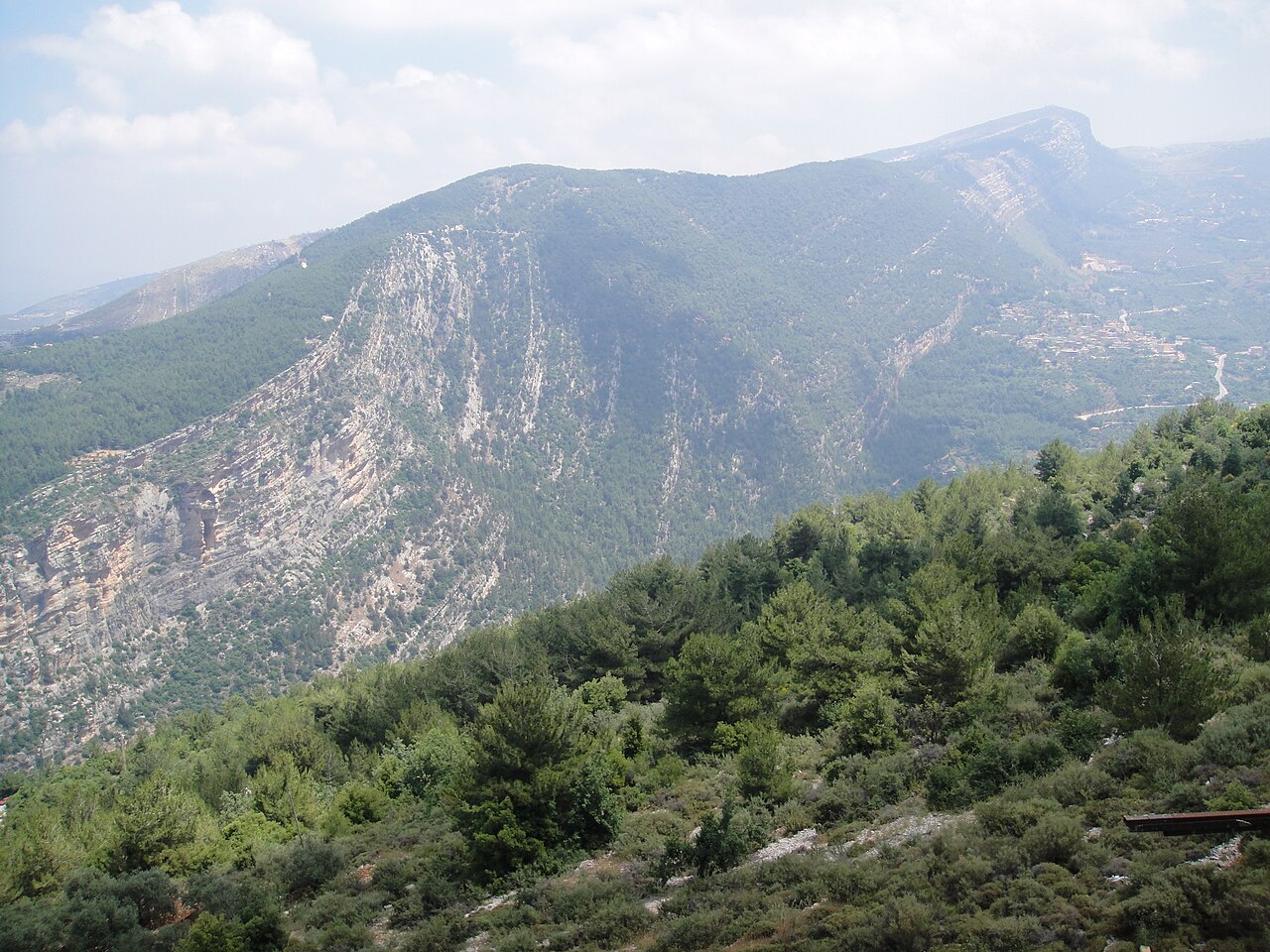
Mount Lebanon
Mount Lebanon appears in Judges among the nations that the LORD left to prove Israel, for the generations that had not known the wars of Canaan: the five lords of the Philistines, all the Canaanites, the Sidonians, “and the Hivites that dwelt in mount Lebanon, from mount Baal-hermon unto the entering in of Hamath”. The range is thus the home of the Hivites, bounded by mount Baal-hermon and the entering in of Hamath. BG1940 reads „евейци, които живеят в Ливанската планина“, the Lebanese mountain. The test was whether Israel would hearken to the commandments that the LORD had given their fathers through Moses. Judg 3:1; Judg 3:3-4.
Easton calls Lebanon “the white mountain of Syria”, a range forking into Lebanon proper in the west and Anti-Lebanon in the east; he names the Giblites and Hivites as its ancient inhabitants, citing Joshua 13:5 with this verse, and says that it was assigned to Israel but never conquered. Smith derives the name from the snow on its summit or from its white limestone cliffs, takes the western range to be the Lebanon of Scripture, and places it on the northern border of Israel. Hitchcock gives “white, incense”. In Joshua 13:5 the land still to be possessed includes “the land of the Giblites, and all Lebanon, toward the sunrising”, the Giblites being the people of Gebal. Josh 13:5; Judg 3:3.
Ellen G. White, Patriarchs and Prophets, chapter 70, paragraph 50, uses Lebanon as a limit when she sums up the renewed war of David against the Syrians: “the Syrians, from Lebanon to the Euphrates, not only gave up the war, but became tributary to Israel.” 1 Chr 19:16-19.