Capernaum
Capernaum was a lakeside settlement in Galilee and an important base for Jesus’ ministry. Matthew places his residence there after his departure from Nazareth, following the imprisonment of John the Baptist. The account connects this setting, in the territory of Zebulun and Naphtali, with Isaiah’s prophecy of light for people in darkness. The location belongs to the geographical framework of the public ministry rather than to the circumstances of his birth. Matt 4:12-17
The synagogue evidence associates Capernaum with the authority of Jesus’ teaching and his command over an unclean spirit. The passage records the listeners’ astonishment and the spread of the report through Galilee. Mark 1:16-39 (“An Unforgettable Worship Service”)
The city is also linked with named members of the earliest disciple group. Simon Peter and Andrew have a house there; James and John, sons of Zebedee, accompany Jesus into it after the synagogue gathering. The healing of Simon Peter’s mother-in-law and the arrival of many other sufferers identify a domestic setting for the ministry alongside the public synagogue. Jesus subsequently leaves for neighboring towns, so Capernaum functions as a base within a wider circuit, rather than an exclusive destination. Mark 1:16-39
Several accounts document the range of people connected with the city. In a crowded house, Jesus forgives and heals a paralytic, making his authority to forgive the central question of the dispute with the scribes. By the shore, he calls Levi, also known as Matthew, the son of Alphaeus, from the tax office; the subsequent meal involves tax collectors and the criticism of Pharisaic scribes. Luke separately records a centurion whose support for the local synagogue is attested by Jewish elders and whose servant is healed. The centurion’s personal name is not supplied. Mark 2:1-17 Luke 7:1-10
Capernaum also occurs in an account of a royal official whose son is ill in the city while Jesus is in Cana. The healing is reported across the distance between the two places. Another episode names Peter in connection with the collectors of the temple contribution and Jesus’ instruction concerning a coin in a fish. These texts preserve different aspects of household, administrative and religious life without naming every beneficiary or official. John 4:46-54 Matt 17:24-27
John locates the bread-of-life teaching in Capernaum’s synagogue. The discussion distinguishes the food associated with Moses from the life-giving bread supplied by the Father, with Jesus identifying himself as that bread. The account includes the departure of many followers and Simon Peter’s confession of confidence in the words of eternal life. Thus the city is a documented setting for disputed teaching as well as healing. John 6:24-35 John 6:59-69
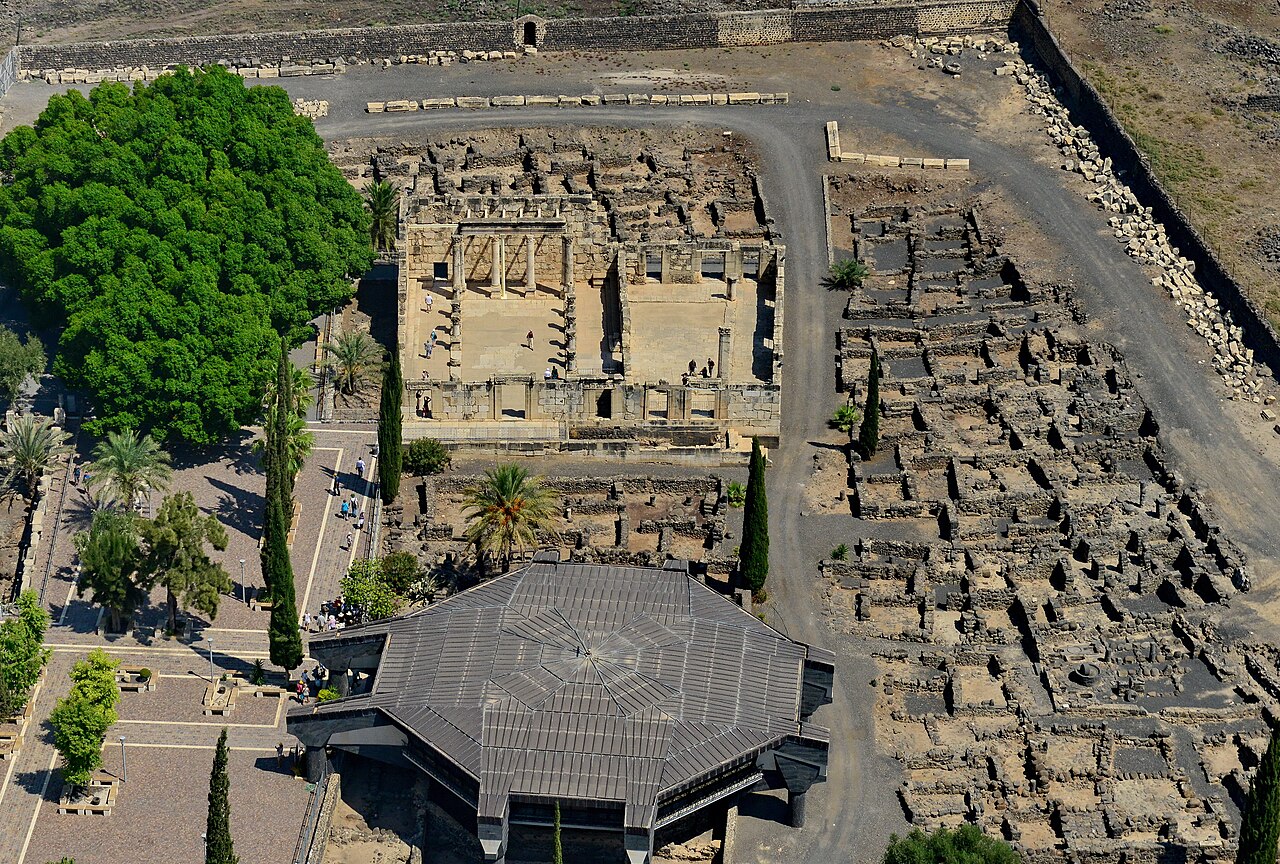
The preserved remains of ancient Capernaum lie at Tell Hum on the northern shore of the Sea of Galilee. The excavations include houses and a monumental synagogue dating to the late fifth century AD, with older remains beneath it. The visible synagogue is thus later than the synagogue of the Gospel accounts. The remains of a Byzantine octagonal church lie over a house associated with Peter; that attribution combines archaeological evidence with pilgrim tradition. Archaeological account