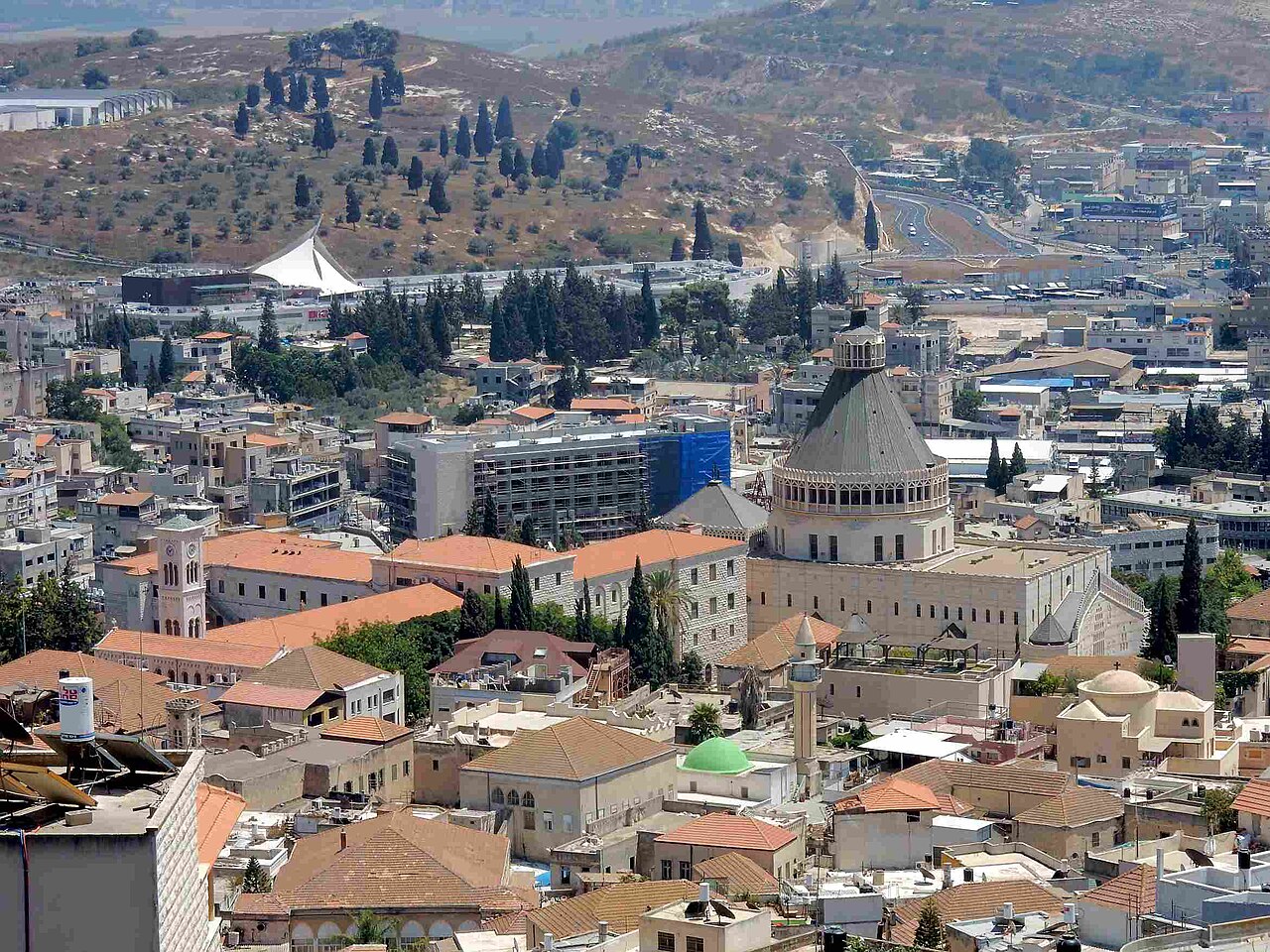
Nazareth
Nazareth is identified in the Gospels as a town of Galilee and the place where Jesus was brought up. It is connected with the household of Mary and Joseph, with the announcement of his birth and with later disputes over his authority. The sources situate the town in a landscape that includes a steep hillside. Luke 1:26-38 Luke 2:39-40 Luke 4:16-30 (Jesus Rejected at Nazareth)
Recognition of the familiar craftsman contrasts with rejection of his teaching. The Gospel evidence records both local knowledge of Jesus’ family and offense at his authority. Familiarity is part of the documented reaction; proposed additional motives should not be confused with the text’s explicit statements. Mark 6:1-6 (“Rejection and Reception”)
The announcement in Luke names Gabriel, Mary and Joseph. Joseph belongs to the house of David; the announced child will receive the throne of David and reign over the house of Jacob. Mary’s question is answered by reference to the action of the Holy Spirit, and her relative Elisabeth is cited as another recipient of divine provision. The passage supplies the family and prophetic setting of the announcement, without identifying Joseph as the source of the conception. Luke 1:26-38 (The Annuciation)
Matthew connects settlement in Nazareth with the return from Egypt after Herod’s death. Because Archelaus rules in Judea, Joseph avoids returning there and withdraws to Galilee. Luke records the family’s annual visits to Jerusalem for Passover, including the visit when Jesus is twelve and the return to Nazareth afterward. These notices establish a home connected with religious travel; they do not provide a complete itinerary for every intervening year. Matt 2:19-23 Luke 2:39-52 (Joseph and Mary return to Nazareth) (Jesus as a child in the Temple)
The local synagogue is a documented setting for Sabbath instruction. Jesus reads from Isaiah and applies the passage to his mission of good news and release. The discussion includes comparison with works reported from Capernaum, and examples involving Elijah, the widow in Sarepta, Elisha and Naaman. The account records a violent attempt to remove him from the town. Mark separately preserves the identification of him as a carpenter, the son of Mary, with brothers James, Joses, Juda and Simon, and unnamed sisters. Those family notices identify the people known locally; they do not determine the age or parentage of every sibling. Luke 4:16-30 Mark 6:1-6 (2nd Rejection at Nazareth)
Nazareth also becomes part of the identification of Jesus beyond his hometown. Philip tells Nathanael that the one described by Moses and the prophets has been found: Jesus of Nazareth, described as Joseph’s son. Nathanael’s skeptical reply documents a negative assessment by this particular speaker. It should not be expanded into a statistical claim about the town’s reputation throughout the region. John 1:45-46
In the center of modern Nazareth, a first-century house, partly cut into rock, survives beneath the remains of a later Byzantine church at the Sisters of Nazareth convent. Its association with Jesus’ childhood comes from later pilgrimage tradition; archaeology cannot establish whether Jesus occupied it. Research report