Ruth
Ruth is the Moabite woman whose marriage to Boaz places her in the family line of David and, in Matthew’s genealogy, Jesus Christ. The book locates her life in the period of the judges and connects Moab with Bethlehem through the migration of Elimelech, Naomi, Mahlon and Chilion. Ruth is identified explicitly as Mahlon’s widow. Orpah, the other Moabite daughter-in-law, belongs to the same bereaved household; the opening passage does not individually pair each woman with a named husband. Ruth 1:1-22 Ruth 4:9-22 Matt 1:1-6
Kinship gives Boaz a role in the household’s future as well as in Ruth’s immediate support. He is introduced as Elimelech’s kinsman, and Naomi recognizes him as a redeemer. The land, the dead man’s name and marriage are connected in the later gate proceedings. His relationship to the family therefore places the provision of food within the wider question of household continuity and inheritance. Ruth and Boaz study Ruth 2:1-23 Ruth 4:1-8
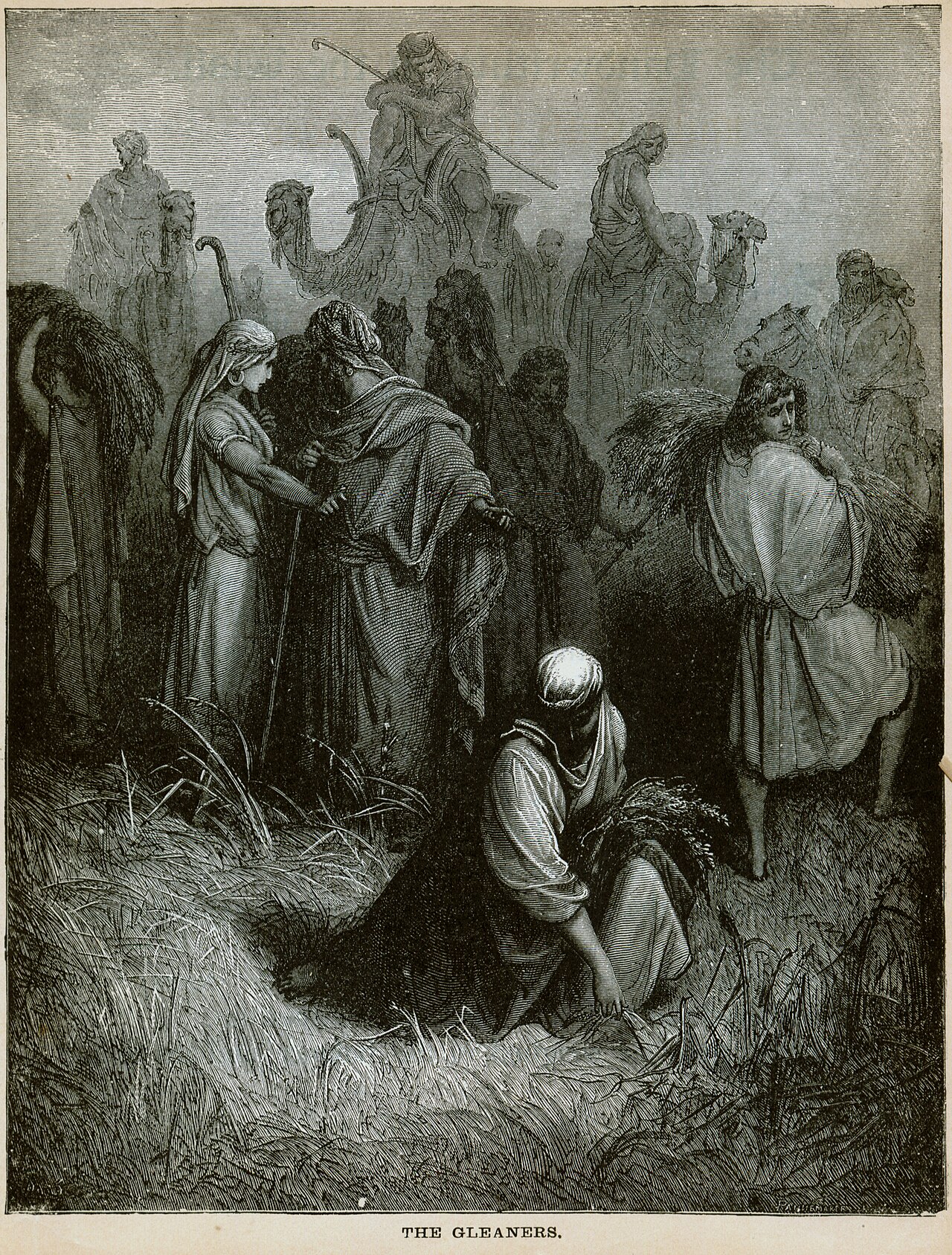
Ruth’s position combines foreign origin, widowhood and an expressed commitment to a new community. Her declaration to Naomi joins residence, people, God, death and burial in a single commitment. The text continues to call her Moabite after arrival in Bethlehem; belonging does not erase the recorded origin. The agricultural setting is equally specific: the women arrive at the beginning of barley harvest, and Ruth gleans through the barley and wheat harvests. The law’s provision of gleanings for poor people and strangers supplies the relevant institutional background. Ruth 1:1-22 Ruth 2:13-23 Lev 19:9-10
In Boaz’s field, the recorded arrangements include drinking water, a meal, grain left for Ruth and orders against molesting or rebuking her. These are concrete forms of provision and protection. At the threshing floor, Ruth herself asks Boaz to spread his covering over her because he is a near kinsman. His answer acknowledges another relative’s prior right. The passage gives her a speaking role in the proposed settlement, while distinguishing the request from the legal decision that follows. Ruth 2:1-23 Ruth 3:1-18
The transaction is witnessed by ten elders and other people at the gate. After the nearer relative declines, Boaz declares the purchase of the property associated with Elimelech, Chilion and Mahlon, together with his marriage to Ruth to preserve the deceased man’s name. The witnesses compare the household with Rachel and Leah, and with the family of Pharez, born to Tamar and Judah. These named comparisons locate the marriage within the ancestral memory of Israel. Ruth 4:1-22
Ruth and Boaz become the parents of Obed; Naomi receives him into her care. The concluding genealogy runs through Pharez, Hezron, Ram, Amminadab, Nahshon, Salmon, Boaz, Obed, Jesse and David. Matthew also names Rahab as Boaz’s mother and Ruth as Obed’s mother. The genealogical notices are the basis for Ruth’s royal and messianic connection; they do not provide a lifespan or an absolute date for her marriage. Ruth 4:9-22 Matt 1:1-6