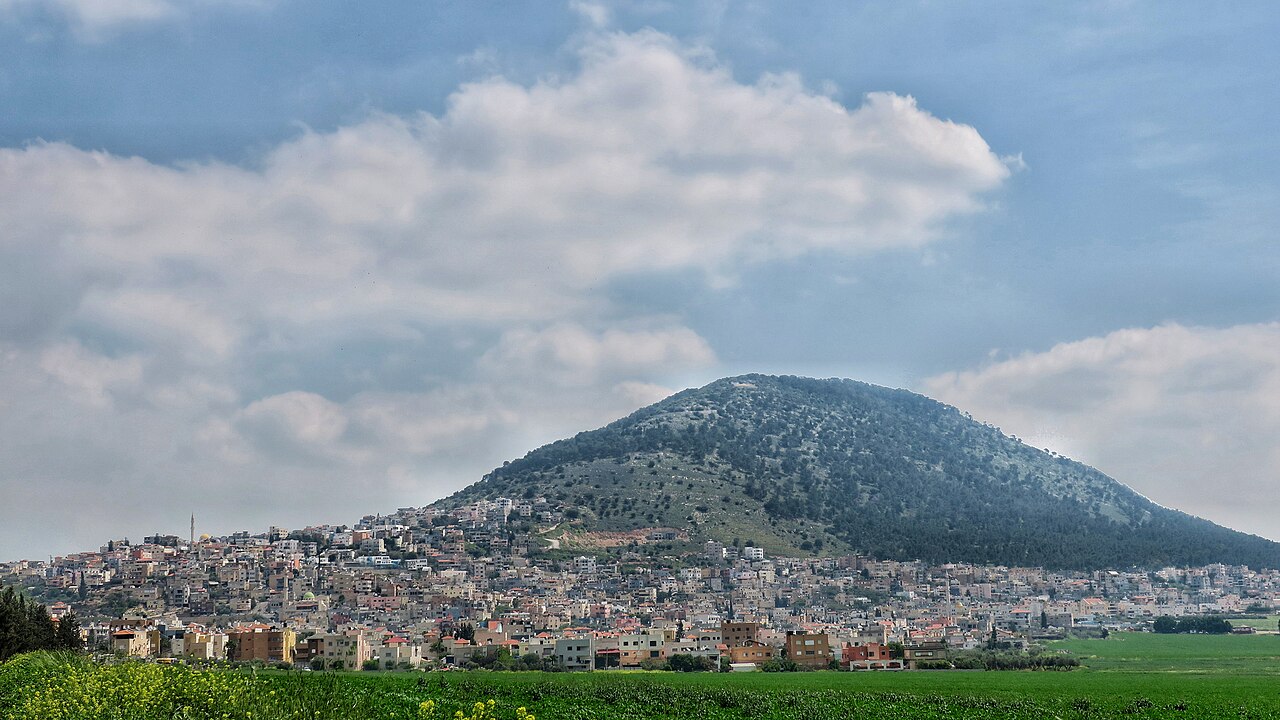
Mount Tabor
Tabor is named at the edge of the lot of Issachar: the coast reaches to Tabor, Shahazimah and Beth-shemesh, and the outgoings of the border are at Jordan. Smith reads this verse together with the Zebulun border, which passes the border of Chisloth-tabor, as making the mountain the boundary between Issachar and Zebulun. Josh 19:22; Josh 19:12.
The word that Deborah sends to Barak is to draw toward mount Tabor with ten thousand men of Naphtali and of Zebulun. Sisera is told that Barak has gone up to mount Tabor, and when Deborah says “Up”, Barak goes down from mount Tabor with ten thousand men after him, and the LORD discomfits Sisera and all his host before him in the deliverance by Barak and Deborah. In these verses BG1940 calls it хълма Тавор, the hill Tabor. Easton says that Barak encamped here before the battle; Smith, that Barak assembled his forces on Tabor and descended thence into the plain. Judg 4:6; Judg 4:12; Judg 4:14-15.
After the pursuit of the Midianites, Gideon asks Zebah and Zalmunna what manner of men they slew at Tabor; they answer that each one resembled the children of a king, and he answers that they were his brethren, the sons of his mother, before he slays the two kings. Smith places the murder of Gideon’s brothers on the mountain. Judg 8:18-19.
The poets set Tabor beside other heights: Tabor and Hermon rejoice in God’s name; the King whose name is the LORD of hosts swears that as Tabor is among the mountains and as Carmel by the sea, so shall he come; and the priests and the house of the king are charged with having been a snare on Mizpah and a net spread upon Tabor. Easton and Smith describe it as the modern Jebel et-Tur; Easton calls it a cone-like prominent mountain 11 miles west of the Sea of Galilee, about 1,843 feet high, whose singularly extensive view he finds alluded to in the Psalm and in Jeremiah, and Smith says it rises abruptly from the north-eastern arm of the plain of Esdraelon. Easton explains the name as “a height”, Smith as “a mound”, and both reject the tradition that it was the mount of the transfiguration. Ps 89:12; Jer 46:18; Hos 5:1.
Two other places of the name are kept apart: the town Tabor given with its suburbs out of Zebulun to the children of Merari, and the plain of Tabor on Saul’s homeward road, where he meets three men going up to God to Beth-el and where BG1940 reads дъба на Тавор, the oak of Tabor. Smith leaves open whether the Levitical Tabor is Chisloth-tabor abbreviated or the mountain itself. 1 Chr 6:77; 1 Sam 10:3.