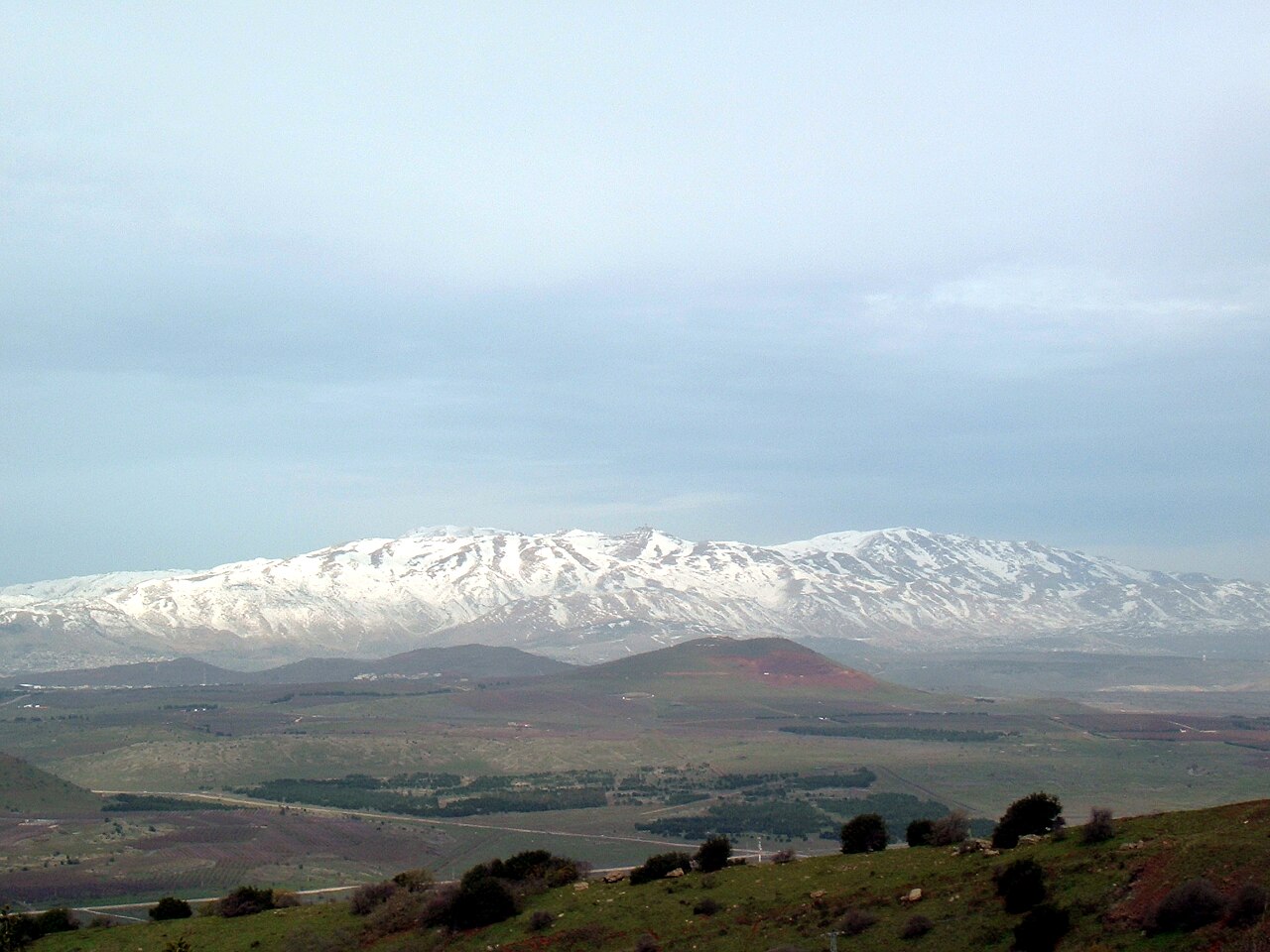
Mount Hermon
Mount Hermon is the northern limit of the land that Israel took from the two kings of the Amorites on the east side of the Jordan: “from the river of Arnon unto mount Hermon”. A parenthesis gives its other names: “Hermon the Sidonians call Sirion; and the Amorites call it Shenir” (BG1940: „Сирион“, „Санир“), and Deuteronomy 4 describes the same limit as “mount Sion, which is Hermon” (BG1940: „планината Сион (която е Ермон)“). Deut 3:8-9; Deut 4:48.
The river Arnon and Mount Hermon frame the list of the kings smitten east of Jordan. Og king of Bashan is said to have reigned in mount Hermon, in Salcah and in all Bashan; in the division of the land all mount Hermon and all Bashan unto Salcah belong to the eastern inheritance, together with Gilead and the border of the Geshurites and Maachathites. Josh 12:1; Josh 12:5; Josh 13:11.
West of Jordan the mountain marks the north of Joshua's conquests and of the land still to be possessed. The Hivites under Hermon in the land of Mizpeh are among the peoples summoned against Israel before the battle at Merom; Joshua's conquests reach unto Baal-gad in the valley of Lebanon under mount Hermon, and the land that remains includes all Lebanon toward the sunrising, from Baal-gad under mount Hermon unto the entering into Hamath. Josh 11:1-3; Josh 11:17; Josh 13:5.
Chronicles says that the children of the half tribe of Manasseh increased from Bashan unto Baal-hermon and Senir, and unto mount Hermon (BG1940: „до Ваал-ермон и Санир и планината Ермон“); here Senir stands beside Hermon in the list, as Shenir does in the Song of Solomon: the bride is bidden to look from the top of Amana, from the top of Shenir and Hermon. 1 Chr 5:23; Song 4:8.
The Psalms name it in praise: Psalm 29 makes “Lebanon and Sirion” skip “like a young unicorn” (BG1940: „като див вол в младостта си“); the psalmist remembers God “from the land of Jordan, and of the Hermonites, from the hill Mizar” (BG1940: „И на планините Ермон“; Mizar); Tabor and Hermon shall rejoice in his name; and Psalm 133 speaks of “the dew of Hermon, and as the dew that descended upon the mountains of Zion”. Ps 29:6; Ps 42:6; Ps 89:12; Ps 133:3.
Ellen G. White, Patriarchs and Prophets, chapter 43, names it in the view from Nebo before the death of Moses: “in the north, Mount Hermon stood out against the sky”. Deut 34:1.
Easton calls Hermon the eastern prolongation of the Anti-Lebanon range, the north boundary of Palestine, about 40 miles north of the Sea of Galilee; he explains “the Hermonites” by its more than one summit and counts one of its three summits as the probable scene of the transfiguration. Smith calls it the culminating point of the anti-Libanus range, towering above Dan and the fountains of the Jordan, the great landmark of the Israelites on their northern border, with three summits and the modern names Jebel esh-Sheikh and Jebel eth-Thelj, “snowy mountain”. Hitchcock gives “anathema; devoted to destruction”. Deut 3:8; Ps 42:6.