Geshur
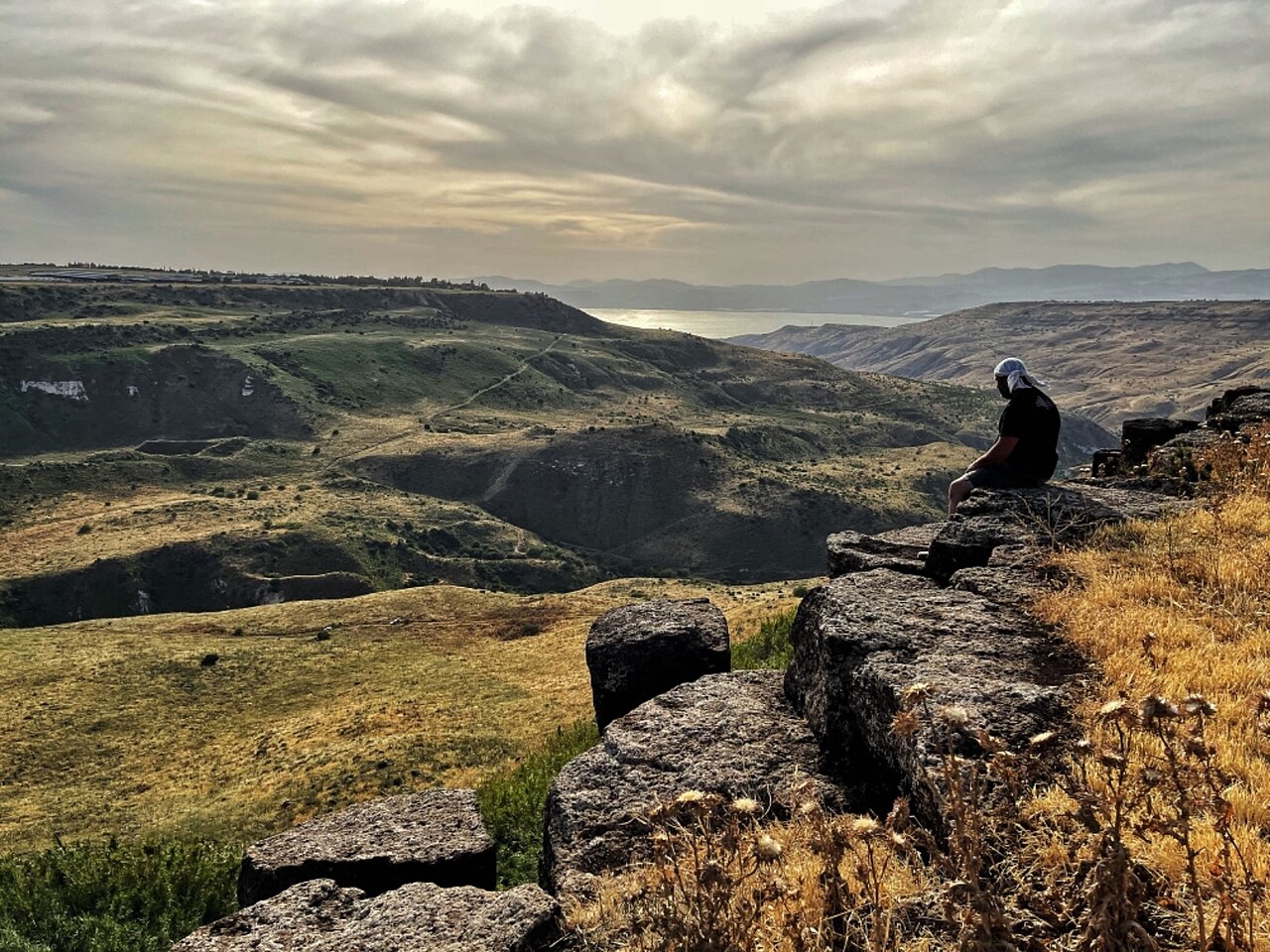
Geshur and its people, the Geshurites, mark the northern edge of the land east of the Jordan. Jair the son of Manasseh takes all the country of Argob “unto the coasts of Geshuri and Maachathi” and calls it Bashan-havoth-jair; Og reigns in mount Hermon, in Salcah and in all Bashan unto the border of the Geshurites and the Maachathites; and the eastern inheritance includes Gilead “and the border of the Geshurites and Maachathites”. Israel does not expel them, and “the Geshurites and the Maachathites dwell among the Israelites until this day”. Easton calls Geshur a district or principality of Syria near Gilead, between Mount Hermon and the Lake of Tiberias, and thinks the Geshurites probably held the rocky fastness of Argob, the modern Lejah; Smith calls it a little principality of Syria north-east of Bashan, probably a section of el-Lejah. Deut 3:14; Josh 12:5; Josh 13:11; Josh 13:13.
The land that yet remains to be possessed when Joshua is old begins with “all the borders of the Philistines, and all Geshuri” (Philistines); BG1940 reads “цялата Гесурска” with “земя” (land) supplied. David, while he dwells with Achish, invades “the Geshurites, and the Gezrites, and the Amalekites”, inhabitants of old of the land toward Shur and Egypt (Amalekites; David receives Ziklag from Achish). Easton, under Geshurites, takes the Geshuri of Joshua 13:2 to be this south-western people of 1 Samuel 27:8, not the Geshurites of verses 11 and 13; Nave keeps 1 Samuel 27:8 under Geshur, as the people of one of its villages. Josh 13:1-2; 1 Sam 27:8.
Geshur is a kingdom in David’s time: his third son Absalom is the son of Maacah the daughter of Talmai king of Geshur. After Amnon is slain, Absalom flees to Talmai the son of Ammihud, king of Geshur, and stays there three years (Absalom orders Amnon’s death; Absalom fled to Geshur). Ellen G. White, Patriarchs and Prophets, chapter 72, writes that Absalom fled to Talmai, “his mother’s father”, and that after he fled to Geshur, David, feeling that the crime of his son demanded some punishment, refused him permission to return; she places there the beginning of Absalom’s alienation from his father. 2 Sam 3:3; 1 Chr 3:2; 2 Sam 13:37-38.
Joab goes to Geshur and brings Absalom to Jerusalem, and Absalom later sends to ask “Wherefore am I come from Geshur?”, saying it had been good for him to be there still, and asks to see the king’s face (Absalom burns Joab’s barley field). He speaks of a vow made “while I abode at Geshur in Syria”, which he asks to pay in Hebron; the same chapter of Patriarchs and Prophets quotes this vow as the religious cloak of his revolt. 2 Sam 14:23; 2 Sam 14:32; 2 Sam 15:7-8.
Chronicles, in the line of Segub and Jair, reads in KJV “And he took Geshur, and Aram, with the towns of Jair, from them”, sixty cities belonging to the sons of Machir the father of Gilead; BG1940 makes Geshur and Aram the takers: “Гесур и Арам превзеха от тях Яировите паланки”. Easton cites the verse for the place of Geshur. 1 Chr 2:21-23.