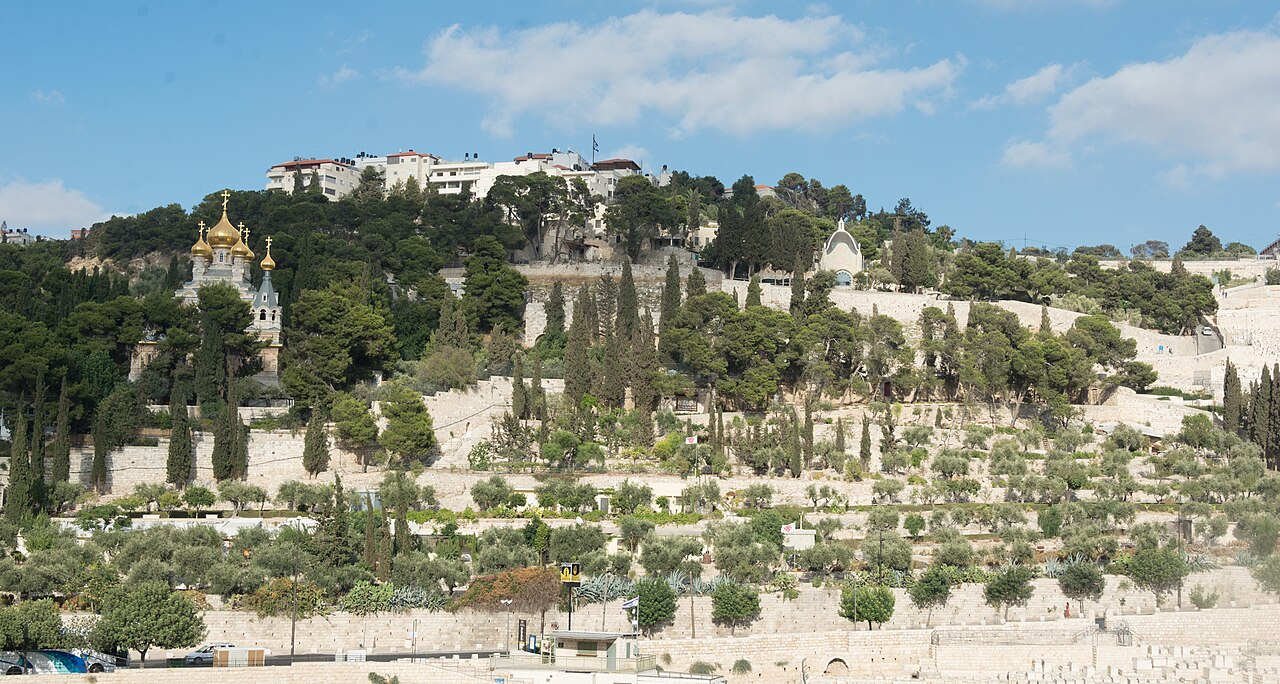
Mount of Olives
The Mount of Olives is the ridge east of Jerusalem, separated from the city by the valley of Kidron. Its name refers to olive trees; KJV also calls it “Olivet.” The biblical references place it opposite the city and within a Sabbath day’s journey of it. These descriptions identify the ridge without fixing every later commemorative site upon it. (Zechariah 14:4; Acts 1:12; Smith’s Bible Dictionary)
The hill was a recurring place of retreat during the ministry of Jesus. He taught in the temple by day and spent the nights on the mountain; his going there with the disciples is described as customary. The Sabbath School study for April 26, 2015 connects this habitual going to the hill with worship and prayer. This setting belongs to his regular activity around Jerusalem, as well as to the events immediately preceding his death. (Luke 21:37; Luke 22:39–46; Sabbath School, “As His Custom Was”)
In the earlier royal history, David crossed the hill while withdrawing from Jerusalem before Absalom. He ascended barefoot, with his head covered, weeping along with his followers. Hushai met him at the summit, and a little beyond it Ziba, the servant of Mephibosheth, brought provisions. These encounters locate the ridge along the route of the king’s departure, without making the entire ridge a single meeting spot. (2 Samuel 15:13–14; 2 Samuel 15:30–32; 2 Samuel 16:1)
The slopes opposite Jerusalem also became a setting for royal foreign worship. Solomon built high places for Chemosh and Molech on the hill facing the city. The later account of Josiah’s removal of foreign worship mentions shrines attributed to Solomon for Ashtoreth, Chemosh and Milcom, beside the “mount of corruption.” BG1940 explicitly identifies that hill with the Mount of Olives in its explanatory note. The different divine names in these passages are preserved rather than silently combined. (1 Kings 11:5–8; 2 Kings 23:13–14)
The mountain also appears as a prophetic setting, with the Lord standing on it, east of Jerusalem, and the ridge splitting to form a great valley. The splitting of the ridge belongs to the prophetic scene, distinct from the earlier historical accounts. (Zechariah 14:3–4)
In the Gospel accounts, the approach to the triumphal entry passes through the mountain’s setting near Bethphage and Bethany. Jesus sends two disciples ahead as he approaches Jerusalem; the rejoicing of the larger company is located at the mountain’s descent. The ridge thus forms part of the route into the city. (Matthew 21:1; Mark 11:1; Luke 19:29; Luke 19:37)
Opposite the temple, Jesus also delivered the Olivet discourse. The disciples’ questions concern the temple’s destruction and, in the parallel account, his coming and the end of the age. KJV names Peter, James, John and Andrew as the private questioners; BG1940 names Peter, James and Andrew, omitting John in that verse. The location is the hillside facing the temple, not the temple precinct itself. (Matthew 24:3; Mark 13:1–4)
After the last supper, Jesus and the disciples went out to the mountain after singing a hymn. The subsequent prayer took place at Gethsemane. The accounts connect this night with his submission to the Father’s will and his instruction that the disciples pray against temptation. (Matthew 26:26–36; Mark 14:26; Luke 22:39–46)
Finally, the ascension accounts connect the mountain with the departure of the risen Jesus. The Gospel places his blessing near Bethany; Acts records the disciples returning from Olivet to Jerusalem after he is taken from their sight. Ellen G. White connects the chosen place of departure with the mountain’s earlier associations with his rest, prayer and ministry. The texts support the mountain’s association with the event without identifying a particular surviving building as its exact site. (Luke 24:50–53; Acts 1:9–12; The Desire of Ages, chapter 87, paragraph 4)