Mahanaim
When the angels of God meet Jacob on his way, he says, “This is God’s host,” and calls the name of that place Mahanaim; BG1940 adds the note Т.е., Войнства (that is, hosts). Ellen G. White writes in Patriarchs and Prophets, chapter 18, that as he traveled southward “two hosts of heavenly angels seemed to encompass him behind and before, advancing with his company, as if for their protection,” and she renders the name “two hosts, or, camps.” Easton places it near the Jabbok, beyond Jordan. Gen 32:1-2.
In the division of the land east of the Jordan the border of Gad runs from Mahanaim to the border of Debir, and the possession of the half tribe of Manasseh in the inheritance Moses gives there reaches from Mahanaim over all Bashan. Out of the tribe of Gad, Mahanaim with her suburbs goes to the families of the children of Merari, the rest of the Levites, and Chronicles repeats the grant. Easton calls the town the southern boundary of Bashan; Smith reasons from its being in Gad that it lay on the south side of the Jabbok. Josh 13:26; Josh 13:29-30; Josh 21:34; Josh 21:38; 1 Chr 6:80.
After the death of Saul, Abner brings Ish-bosheth over to Mahanaim and makes him king there; from Mahanaim Abner and the servants of Ish-bosheth go out to Gibeon for the fight with Joab’s men, and after it Abner’s men return there by way of Bithron. In Patriarchs and Prophets, chapter 69, Ellen G. White says that Mahanaim, “on the farther side of Jordan, was chosen as the royal residence, since it offered the greatest security against attack, either from David or from the Philistines,” and that the coronation of Ishbosheth took place there. 2 Sam 2:8-10; 2 Sam 2:12; 2 Sam 2:29.
Years later David comes to Mahanaim while Absalom passes over Jordan, and there Shobi the son of Nahash of Rabbah, Machir the son of Ammiel of Lo-debar and Barzillai the Gileadite of Rogelim bring beds, vessels and food for the hungry and weary people; this belongs to the account in which David’s company crosses the Jordan. BG1940 spells the town Механаим in the first of these verses. Barzillai, fourscore years old, had provided the king of sustenance while he lay at Mahanaim. 2 Sam 17:24; 2 Sam 17:27-29; 2 Sam 19:32.
Ellen G. White describes the place in Patriarchs and Prophets, chapter 72: Mahanaim “had been the royal seat of Ishbosheth. This was a strongly fortified city, surrounded by a mountainous district favorable for retreat in case of war,” and there wealthy tribesmen brought abundant gifts of provision. In his last charge to Solomon David recalls that Shimei the son of Gera of Bahurim cursed him in the day when he went to Mahanaim. 2 Sam 17:24; 1 Kgs 2:8.
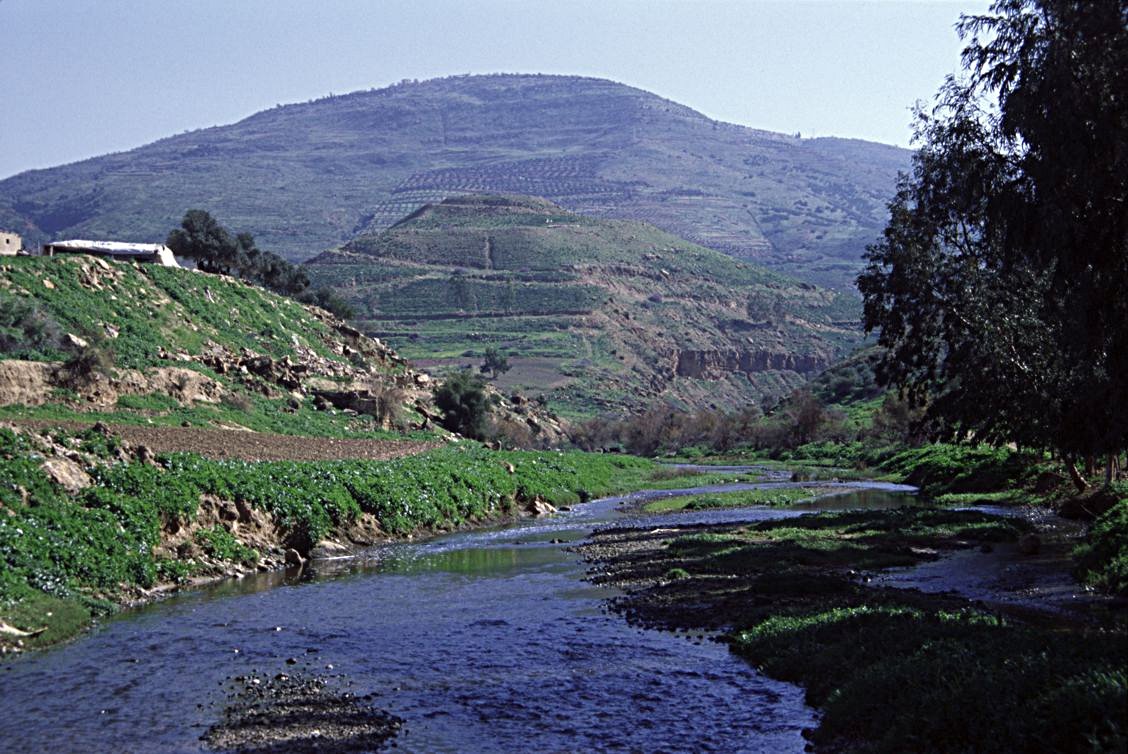
Under Solomon Mahanaim is the charge of Ahinadab the son of Iddo, one of the twelve officers who provide victuals for the king. Smith sees an allusion to the town in the Song, where KJV reads “the company of two armies” and BG1940 борба между две дружини (a struggle between two companies). Easton identifies Mahanaim with the ruin Mukhumah near Penuel, south of the Jabbok; Smith says that its exact position is not certain. 1 Kgs 4:7; 1 Kgs 4:14; Song 6:13.