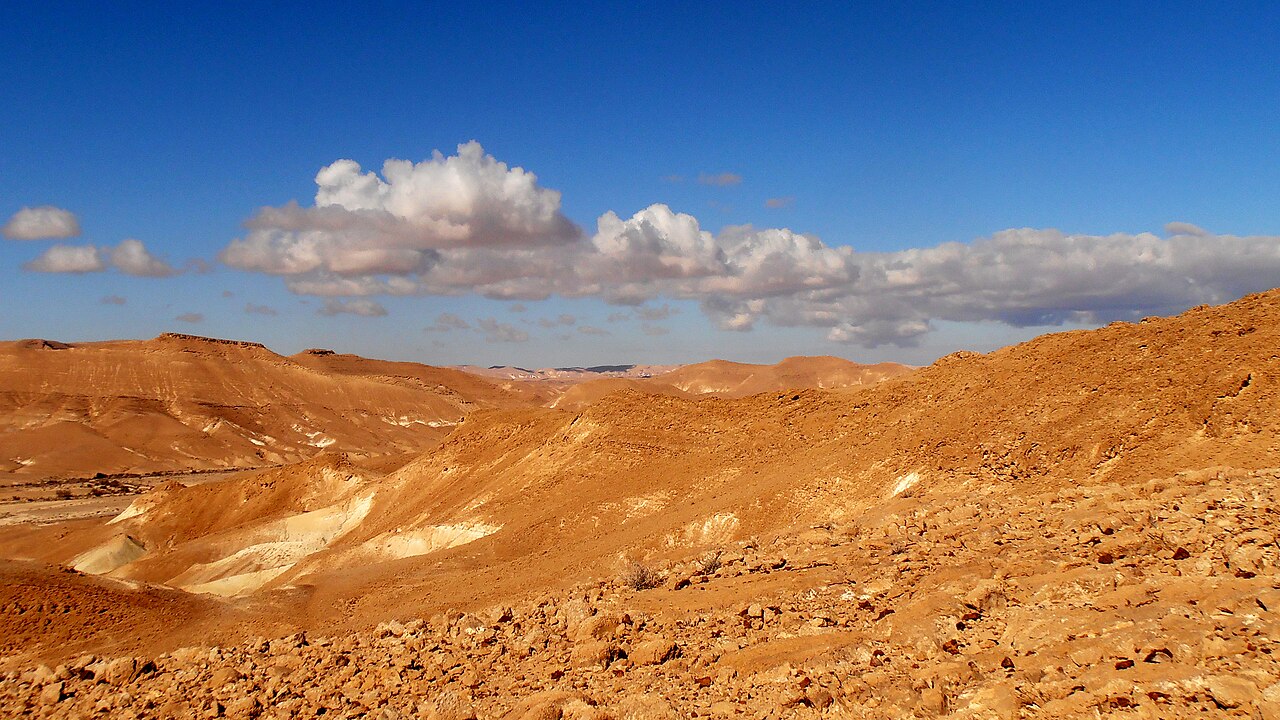
Paran
Paran is the wilderness south of the land of promise. Easton describes it as a desert tract forming the north-eastern division of the peninsula of Sinai, between the Arabah on the east and the wilderness of Shur on the west, bearing the modern name Badiet et-Tih, “the desert of the wanderings”; Smith bounds it by Palestine on the north, the Arabah on the east, the desert of Sinai on the south and the wilderness of Etham on the west. Easton renders the name “abounding in foliage, or abounding in caverns”, Smith “peace of caverns” and Hitchcock “beauty; glory; ornament”. Gen 21:21; Num 10:12.
Ishmael dwells in the wilderness of Paran (BG1940: „Фаранската пустиня“), and his mother Hagar takes him a wife out of the land of Egypt (Hagar and Ishmael leave Abraham’s household). Gen 21:21.
When the children of Israel set out from the wilderness of Sinai, the cloud rests in the wilderness of Paran, and after Hazeroth the people pitch there. Easton puts the district three days' march from Sinai. Num 10:12; Num 10:33; Num 12:16.
From the wilderness of Paran Moses, at the commandment of the LORD, sends the twelve men to search the land of Canaan, all of them “heads of the children of Israel”, and they come back to the congregation “unto the wilderness of Paran, to Kadesh” with the fruit of the land. Ellen G. White, Patriarchs and Prophets, chapter 34, places the camp eleven days after leaving Mount Horeb “at Kadesh, in the wilderness of Paran, which was not far from the borders of the Promised Land”, and writes that the people proposed sending the spies. Num 13:3; Num 13:26.
Deuteronomy opens with the words Moses spoke to all Israel “between Paran, and Tophel, and Laban, and Hazeroth, and Dizahab” (Tophel, Laban, Hazeroth, Dizahab). Where KJV reads “in the plain over against the Red sea”, with “sea” supplied in italics, BG1940 names the place „Суф“, Suph. Deut 1:1.
After the death of Samuel, David goes down to the wilderness of Paran (BG1940: „пустинята Фаран“); Easton speaks of it as a refuge for him. Hadad the Edomite and his men come from Midian to Paran and take men with them out of Paran on the way to Egypt, where Pharaoh king of Egypt gives him a house, victuals and land (Hadad seeks permission to leave Egypt). 1 Sam 25:1; 1 Kings 11:17-18.
Easton keeps the Mount Paran of two poetic passages apart, as probably the hilly region on the north of the desert (BG1940: „планината Фаран“, „хълма Фаран“), and Smith treats El-paran (BG1940: „Елфаран“), the limit of the invasion of the kings, under the same heading as Paran. Deut 33:2; Hab 3:3; Gen 14:6.