Hagar
Hagar is an Egyptian, the handmaid of Sarai, Abram’s wife, named at the point where Sarai has borne him no children. Easton and Smith call her Sarah’s handmaid (Smith: handmaid or slave), and Nave counts her a servant of Abraham. Gen 16:1.
After Abram has dwelt ten years in the land of Canaan, Sarai, saying that the LORD has restrained her from bearing, takes Hagar her maid the Egyptian and gives her to her husband Abram to be his wife; Easton and Smith term her a secondary wife or concubine. He goes in to Hagar and she conceives, and when she sees that she has conceived, her mistress is despised in her eyes. Sarai lays the wrong upon Abram, he answers that the maid is in her hand, and when Sarai deals hardly with her, Hagar flees from her face. Ellen G. White, Patriarchs and Prophets, chapter 13, says that Sarah suggested the plan, that Hagar, flattered with her new position and hoping to be the mother of the great nation promised to Abraham, became proud and treated her mistress with contempt, that Abraham’s marriage with Hagar resulted in evil to his household and to future generations, and that the marriage, like the concealing of Sarah being his wife, showed distrust of God. “Abraham’s Doubts”, 9 May 2022, reads Sarai’s appointing of Hagar as a surrogate as a common practice of the ancient Near East, notes that God is absent from the whole course of action, and hears in Abram’s hearkening to the voice of Sarai an echo of Adam and Eve. Gen 16:2-6.
The angel of the LORD finds her by a fountain of water in the wilderness, by the fountain in the way to Shur, and addresses her as “Hagar, Sarai’s maid”; she answers that she flees from the face of her mistress Sarai. Easton takes her to have been intending to return to her relatives in Egypt through the desert of Shur. The angel bids her return to her mistress and submit herself under her hands, promises to multiply her seed exceedingly, and tells her that she will bear a son and call his name Ishmael, because the LORD has heard her affliction; Ishmael will be a wild man (BG1940: като див осел, like a wild ass), his hand against every man. Hagar calls the name of the LORD that spoke to her “Thou God seest me”, and the well is called Beer-lahai-roi, between Kadesh and Bered; BG1940 names Агар in the verse where KJV has only “she”. Patriarchs and Prophets, chapter 13, says the angel addressed her as Sarai’s maid to remind her of her position and her duty, and that with the reproof were mingled words of comfort; “Abraham’s Doubts” observes that God appears to Hagar only after she has left Abram’s house, this time taking the initiative, and that the story’s close on hearing, in the name Ishmael, echoes Abram’s heeding of Sarai at its start. Gen 16:7-14.
Hagar bears Abram a son, and Abram calls his son’s name, which Hagar bore, Ishmael; Abram is fourscore and six years old when Hagar bears Ishmael to him. Gen 16:15-16.
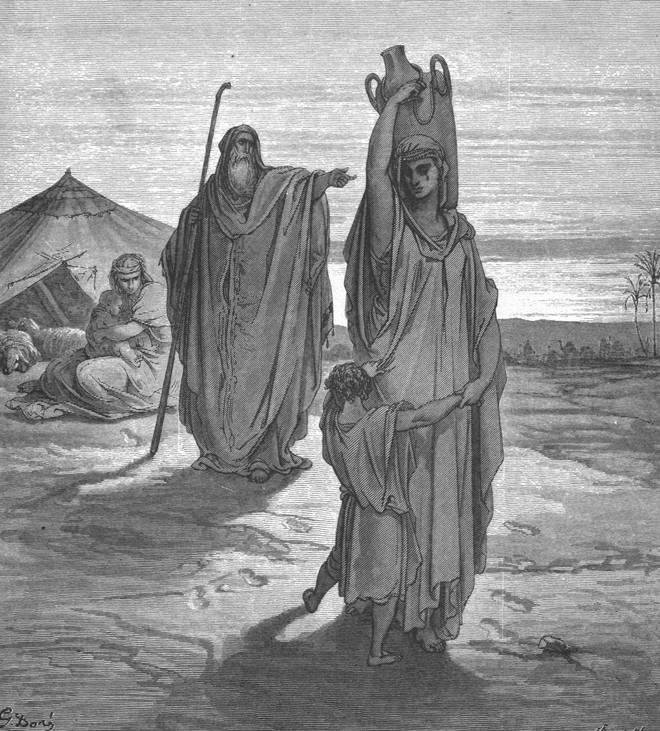
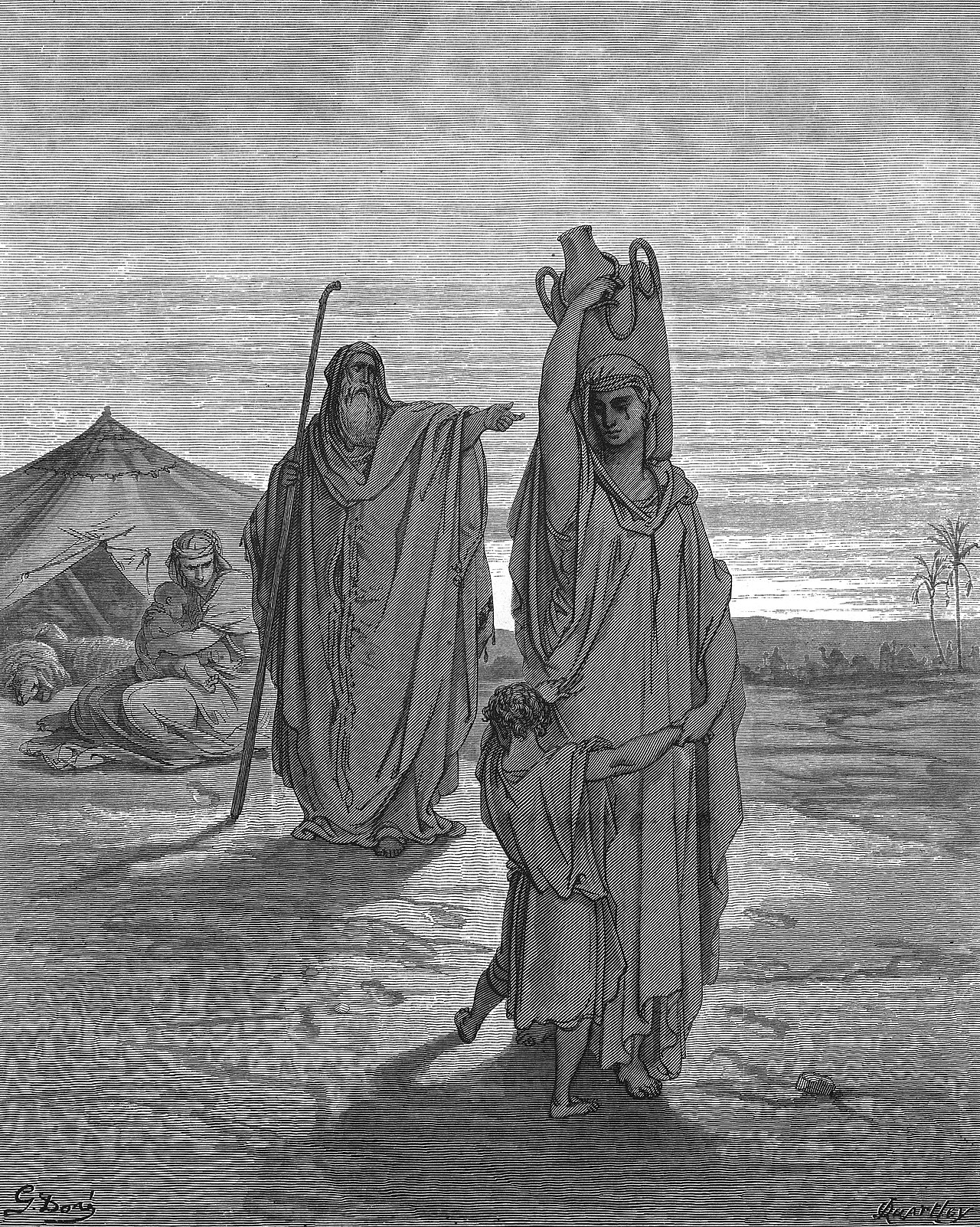
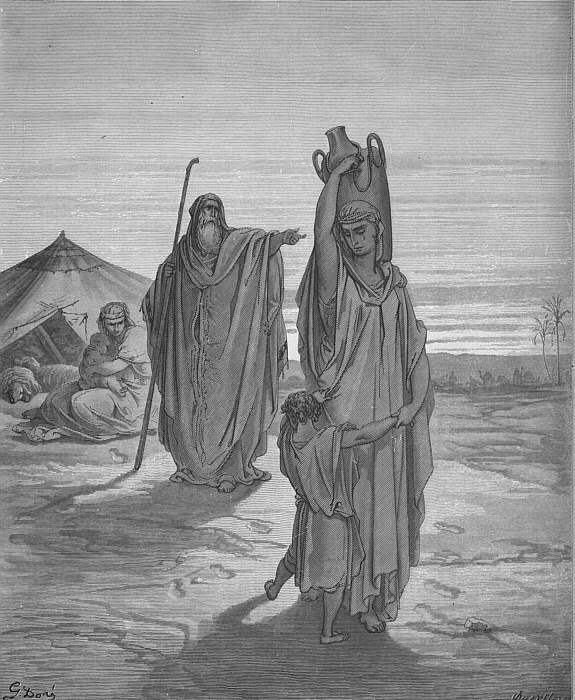
When Sarah sees the son of Hagar the Egyptian, whom she had borne to Abraham, mocking, she tells Abraham to cast out this bondwoman and her son, for the son of the bondwoman shall not be heir with Isaac; God tells Abraham to hearken to Sarah’s voice, for in Isaac shall his seed be called, and promises to make a nation of the bondwoman’s son also. Abraham rises early, gives Hagar bread and a bottle of water and the child, and sends her away; she wanders in the wilderness of Beer-sheba. When the water is spent she casts the child under a shrub and sits a bowshot off, weeping; God hears the voice of the lad, and the angel of God calls to Hagar out of heaven, “What aileth thee, Hagar? fear not”; God opens her eyes and she sees a well of water. The lad grows up in the wilderness of Paran, and his mother takes him a wife out of the land of Egypt. Patriarchs and Prophets, chapter 13, says that the birth of Isaac was to Hagar the overthrow of her cherished ambitions, that mother and son hated the child of Sarah, and that Abraham, directed through a holy angel to grant Sarah’s desire, sent away Hagar and his son with keen suffering; it adds that Sarah was the only true wife of Abraham and that the Lord did not reprove her for requiring the banishment of her rival. Ellen G. White, Spiritual Gifts, volume 3, quoted in the supplementary notes of “The Death of Sarah”, 17 May 2022, likewise says that Sarah was jealous lest Abraham’s affections be divided with Hagar and that God did not rebuke her, while Abraham was reproved by the angels for distrusting God’s power, which had led him to take Hagar as his wife; “The Covenant With Abraham”, 7 May 2022, counts Hagar, with Abram and Sarah, among those who are afraid in this part of the account, and names her among those toward whom Abram is caring. Gen 21:9-10; Gen 21:12-21.
The generations of Ishmael are introduced as those of Abraham’s son, whom Hagar the Egyptian, Sarah’s handmaid, bore to Abraham; his descendants dwell from Havilah to Shur. Nave and Smith connect with her name the Hagarites, with whom the Reubenites made war in the days of Saul, and the Hagarenes of the Psalm (BG1940: агаряните in both places). Ellen G. White, Patriarchs and Prophets, chapter 15, reckons the consequences of Abraham’s marriage with Hagar among what he had before him when he sought a wife for Isaac, and says that the jealousy of Hagar and of the wives she chose for Ishmael surrounded Ishmael’s family with a barrier Abraham tried in vain to overcome. “A Wife for Abraham”, 19 May 2022, records the suggestion of some that Keturah could be Hagar, since the chronicler groups Keturah’s sons with Hagar’s and Abraham deals with both alike, and notes that Keturah’s status, like Hagar’s, may have been that of a concubine. Gen 25:12; Gen 25:18; 1 Chr 5:10; Ps 83:6.
Paul makes the two women an allegory of the two covenants: the one from mount Sinai, which gendereth to bondage, is Agar, and this Agar is mount Sinai in Arabia and answereth to Jerusalem which now is, in bondage with her children. KJV spells her name Agar in Galatians, BG1940 keeps Агар; Nave records the name. “Abraham’s Doubts” notes that Paul refers to the story of Genesis 16 to make his point about works versus grace. Gal 4:24-25.