Full Bible Tree

Person

Dathan

Name meaning: “laws or rites”

Dictionary

The name is explained as “belonging to a fountain”; Easton also gives “welled”. Easton and Smith.

Dathan

Dathan is a son of Eliab, named with his brother Abiram among the sons of Reuben who join the Levite Korah (the rebellion of Korah, Dathan and Abiram); Smith calls him a Reubenite chieftain. Ellen G. White, Patriarchs and Prophets, chapter 35, describes Dathan and Abiram as two princes of the tribe of Reuben whose tents stood near Korah's, on the south side of the tabernacle, and says that, being descendants of the eldest son of Jacob, they claimed the civil authority and meant to divide with Korah the honours of the priesthood. Num 16:1; Num 26:9.

Summoned by Moses, the brothers refuse to come. Moses then rises and goes to Dathan and Abiram, and the elders of Israel follow him; the congregation is told to depart from the tents “of these wicked men” and touch nothing of theirs, and Dathan and Abiram come out and stand in the door of their tents with their wives, their sons and their little children (BG1940 names only the wives and little children). The same chapter of Patriarchs and Prophets adds that Korah had withdrawn to join them and that the chief rebels stood with their families “as if in defiance of the divine warning”. The ground cleaves under them, and they and all that appertained to them go down alive into the pit, as Moses had said they would (BG1940: в ада; its note at Num 16:30 explains the word as Hebrew sheol). Num 16:12; Num 16:24-27; Num 16:30-33.

Deuteronomy recalls that the earth swallowed Dathan and Abiram “in the midst of all Israel” with their households, their tents and all the substance in their possession (BG1940: всичко живо, all that lived), and the psalm names Dathan first: “The earth opened and swallowed up Dathan” (BG1940: погълна Датана), followed by a fire kindled in their company. Easton sums up that he joined Korah in his conspiracy and with his accomplices was swallowed up by an earthquake. Deut 11:6; Ps 106:17-18.
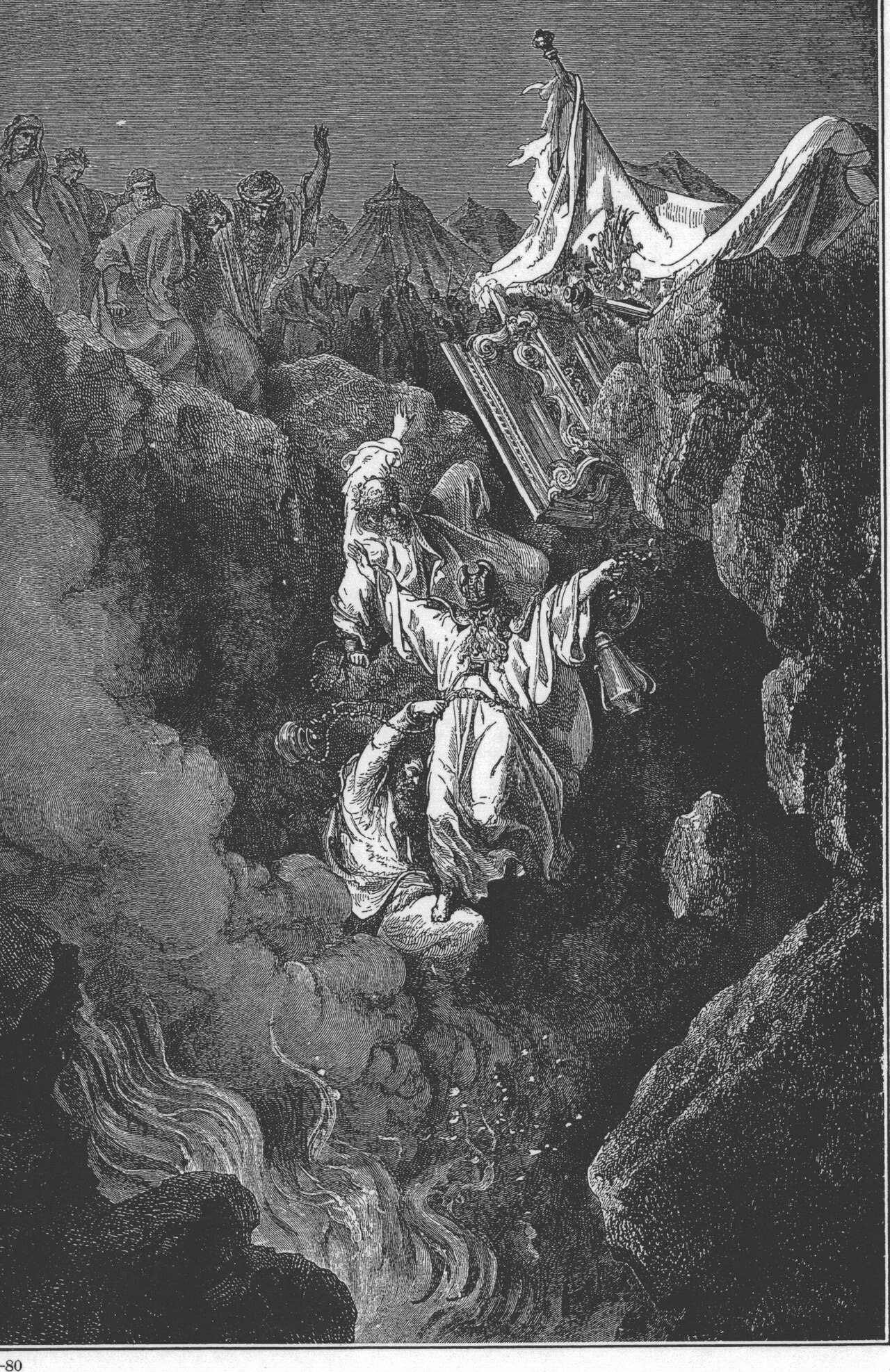
Art and maps 1

Korah, Dathan and Abiram — Numbers 16.
Korah, Dathan and Abiram — Numbers 16. · Gustave Doré · Public domain · Official source · AI-assisted caption

Connections

Conditional birth estimate

Conditional birth bounds under generation assumptions; not attested parental ages, biological limits or a lifespan.

The anchors give incompatible conditional intervals. This calculation establishes no birth year.

Below are relatives with a selected birth year, the generations separating them, and the interval allowed by each anchor. Each relative’s page shows available dates and sources. The overall estimate uses the intersection of the allowed intervals.

Relative / anchor yearGenerationsConditional interval
Reuben · 1757 BC
Ancestor
3
20–45 years per generation
c. 1697 BC – 1622 BC
Jacob · 1835 BC
Ancestor
4
20–45 years per generation
c. 1755 BC – 1655 BC
Isaac · 1895 BC
Ancestor
5
20–45 years per generation
c. 1795 BC – 1670 BC
Rebekah · 1876 BC
Ancestor
5
20–45 years per generation
c. 1776 BC – 1651 BC
Abraham · 1995 BC
Ancestor
6
20–45 years per generation
c. 1875 BC – 1725 BC
Sarah · 1985 BC
Ancestor
6
20–45 years per generation
c. 1865 BC – 1715 BC
Terah · 2125 BC
Ancestor
7
25–130 years per generation
c. 1950 BC – 1215 BC
Nahor · 2156 BC
Ancestor
8
25–130 years per generation
c. 1956 BC – 1116 BC
Haran · 2056 BC
Ancestor
8
25–130 years per generation
c. 1856 BC – 1016 BC
Serug · 2186 BC
Ancestor
9
25–130 years per generation
c. 1961 BC – 1016 BC
Reu · 2218 BC
Ancestor
10
25–130 years per generation
c. 1968 BC – 918 BC
Peleg · 2248 BC
Ancestor
11
25–130 years per generation
c. 1973 BC – 818 BC
Eber · 2282 BC
Ancestor
12
25–130 years per generation
c. 1982 BC – 722 BC
Salah · 2312 BC
Ancestor
13
25–130 years per generation
c. 1987 BC – 622 BC
Arphaxad · 2347 BC
Ancestor
15
25–130 years per generation
c. 1972 BC – 397 BC
Shem · 2447 BC
Ancestor
16
25–130 years per generation
c. 2047 BC – 367 BC
Noah · 2948 BC
Ancestor
17
25–130 years per generation
c. 2523 BC – 738 BC
Lamech · 3130 BC
Ancestor
18
25–130 years per generation
c. 2680 BC – 790 BC
Methuselah · 3317 BC
Ancestor
19
25–130 years per generation
c. 2842 BC – 847 BC
Enoch · 3382 BC
Ancestor
20
25–130 years per generation
c. 2882 BC – 782 BC
Jared · 3544 BC
Ancestor
21
25–130 years per generation
c. 3019 BC – 814 BC
Mahalaleel · 3609 BC
Ancestor
22
25–130 years per generation
c. 3059 BC – 749 BC
Cainan · 3679 BC
Ancestor
23
25–130 years per generation
c. 3104 BC – 689 BC
Cain · 4004 BC
Ancestor
23
25–130 years per generation
c. 3429 BC – 1014 BC
Enos · 3769 BC
Ancestor
24
25–130 years per generation
c. 3169 BC – 649 BC
Adam · 4004 BC
Ancestor
24
25–130 years per generation
c. 3404 BC – 884 BC
Eve · 4005 BC
Ancestor
24
25–130 years per generation
c. 3405 BC – 885 BC
Seth · 3874 BC
Ancestor
25
25–130 years per generation
c. 3249 BC – 624 BC

Family

Family of origin

Lineage

From Adam to Dathan · 27 generations. Each person is the parent of the next.

  1. LORD
  2. Adam
  3. Seth
  4. Enos
  5. Cainan
  6. Mahalaleel
  7. Jared
  8. Enoch
  9. Methuselah
  10. Lamech
  11. Noah
  12. Shem
  13. Arphaxad
  14. Cainan
  15. Salah
  16. Eber
  17. Peleg
  18. Reu
  19. Serug
  20. Nahor
  21. Terah
  22. Abraham
  23. Isaac
  24. Jacob
  25. Reuben
  26. Pallu
  27. Eliab
  28. Dathan

In the Bible

Names

  • en Dathan KJVWEBBSB laws or rites
  • bg Датан BG1940
  • en Dathan Also called · H1885 none · NUM 16:1 strong
  • he דָּתָן datan H1885 · NUM 16:1 strong
  • he דָּתָן H1885
  • el Δαθαν Dathan none · NUM 16:1
SDA Books

Awaiting permission to publish

Linked through an explicitly cited Bible passage

Loading book references…

Report an inaccuracy

Make a suggestion