Rebekah
Rebekah is the daughter of Bethuel, granddaughter of Nahor and Milcah, and sister of Laban. Her marriage to Isaac connects this family from Paddan-aram with the household from which the later patriarchal line develops. As the mother of Esau and Jacob, she has a direct part in the family’s conflict over the blessing and succession. Gen 22:20 Gen 22:23 Gen 25:19-26
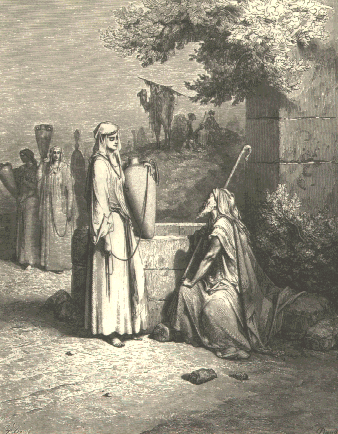
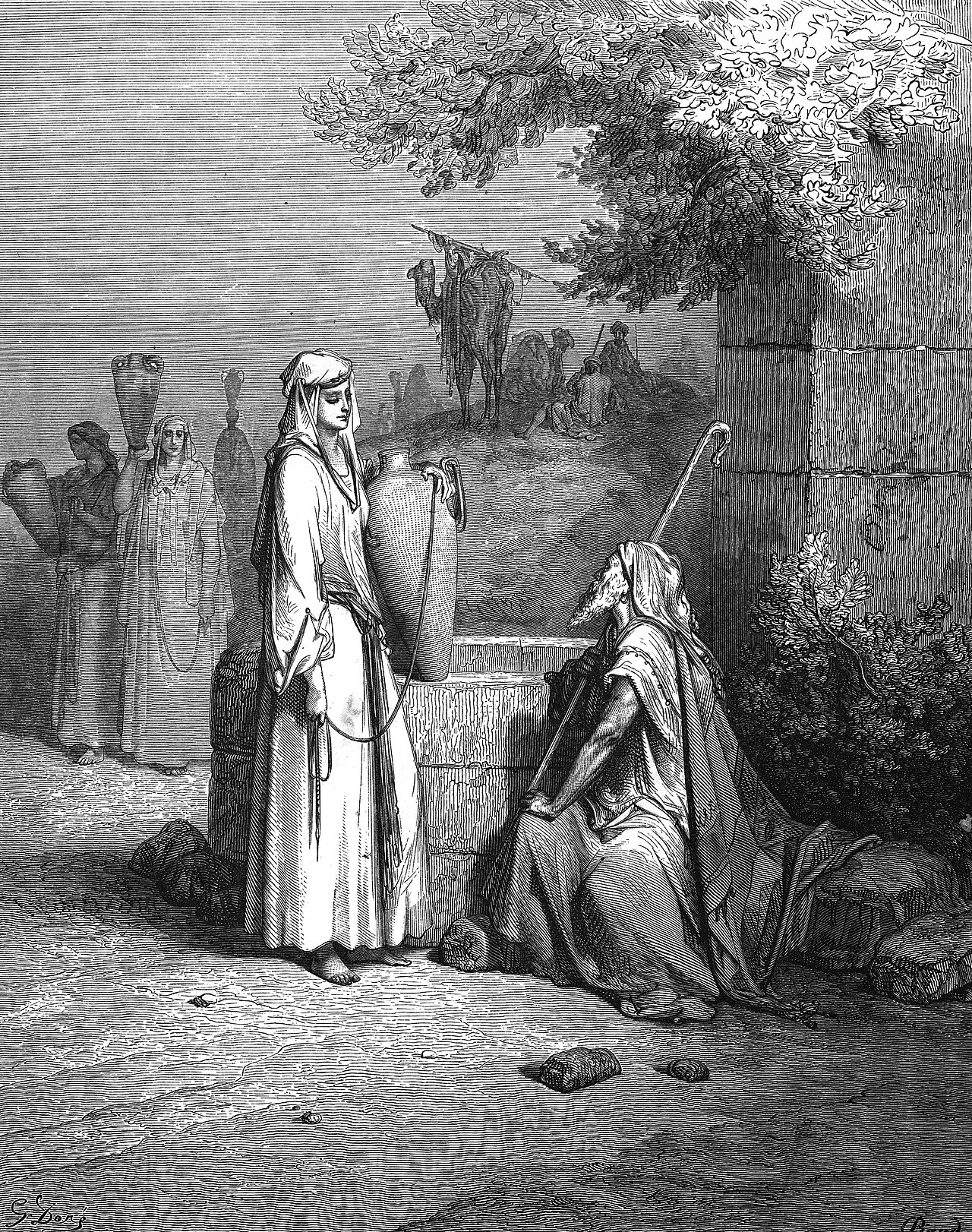
Her introduction at the well combines practical hospitality with a decisive personal response. She gives the visiting servant water and offers to draw for his camels, then tells him about her family and the lodging available at home. Later Laban and Bethuel acknowledge the Lord’s direction in the proposed match with Isaac. When her family would delay the departure, she herself is asked whether she will go and answers that she will. She leaves with her nurse and attendants. The account makes her consent an expressed part of the marriage arrangement. Gen 24:15-28 Gen 24:50-61 Hospitality and the bride’s consent
The arrangement begins with Abraham’s instructions to his senior household servant: a wife for Isaac is to be sought among his relatives, rather than among the Canaanites of the land where he resides. The servant travels to Mesopotamia with camels and gifts, prays for guidance and explains his errand in the household of Laban and Bethuel. Rebekah’s kinship with Nahor and Milcah is central to that explanation. Genesis leaves the servant unnamed; the account in Patriarchs and Prophets identifies him as Eliezer. The selection is presented within a household obligation and a prayer to the Lord, followed by the family’s and the bride’s responses. Gen 24:1-14 Gen 24:29-49 The marriage account in Patriarchs and Prophets
At the end of the journey she meets Isaac, who has come from the region of Beer-lahai-roi. She descends from the camel and veils herself after learning who he is. Isaac receives her into the tent associated with his mother Sarah; their marriage is followed by the notice that he loves her and is comforted after his mother’s death. The age given for Isaac at this marriage is forty. Her departure from Paddan-aram therefore has a lasting place in the formation of the new household. Gen 24:62-67 Gen 25:20
The birth of the twins follows a period of childlessness and Isaac’s prayer for his wife. During the pregnancy, the struggle of the children leads Rebekah to inquire of the Lord. The answer speaks of two peoples coming from her and of the elder serving the younger. The subsequent birth of the twins names Esau first and Jacob second, holding his brother’s heel; Isaac is then sixty. Their different occupations and the parents’ different preferences become part of the family’s later history: the father favours Esau, while Rebekah loves Jacob. Gen 25:21-28
The household also faces danger during its stay at Gerar. In a famine, Isaac goes to Abimelech; the Lord directs him to remain in the land rather than go down to Egypt. Fearing that the local men might kill him because of his wife, Isaac calls Rebekah his sister. Abimelech sees behaviour that reveals the marriage, rebukes the husband and warns the people against touching either of them. Rebekah’s actual status as wife is thus the issue behind both the concealment and the royal protection. Gen 26:1-11
Marriage choices in the next generation deepen the household strain. Esau takes Judith, daughter of Beeri, and Bashemath, daughter of Elon, from the Hittites; they become a grief to Isaac and Rebekah. When the future of Jacob is discussed, Rebekah expresses her weariness over the local women and her objection to a similar marriage for her younger son. These statements give a specific family setting to the proposed departure, alongside the conflict between the brothers. Gen 26:34-35 Gen 27:46
Rebekah is an active organiser of the deception over the blessing. After hearing Isaac ask Esau for game and a meal, she tells Jacob to bring two young goats and prepares the food his father likes. Jacob fears that his smooth skin will reveal the substitution and bring a curse; she accepts the risk in her reply. She supplies his brother’s clothing and covers his hands and neck with skins before sending him to the aged father. Jacob receives the blessing while claiming to be Esau. The mother’s preference has now become direct intervention in the father’s intended act. Gen 27:1-29
The success of the plan does not bring domestic peace. Esau returns, Isaac recognises what has happened, and the dispossessed son’s grief turns to a plan to kill Jacob. Rebekah learns of the threat and tells her younger son to stay with her brother Laban in Haran until the anger subsides. Her appeal about a suitable wife is followed by Isaac’s charge to seek a wife from the family of Bethuel. Jacob’s departure for Paddan-aram removes him from the immediate danger, but also separates him from his mother. Gen 27:30-46 Gen 28:1-5
The separation is the principal personal cost attached to Rebekah’s intervention. Her hope in the narrative is to send for Jacob once Esau’s anger has passed. Patriarchs and Prophets goes further, describing her repentance for the wrong counsel and stating that she never again saw her son. That account contrasts the Lord’s earlier promise with the deceit chosen to obtain its fulfilment. The family’s recorded conflict and the later account of her regret place the consequences within the household itself. Gen 27:41-45 The separation and its consequences
Later notices preserve her place in the extended household. When Jacob meets Rachel, he identifies himself through his relationship to Laban and as Rebekah’s son. The death of Deborah, explicitly called Rebekah’s nurse, is recorded below Bethel: she is buried beneath an oak named Allon-bachuth, the oak of weeping. These notices retain both the maternal connection and the memory of the woman who served in her household. Gen 29:10-12 Gen 35:8
Her burial place is identified in Jacob’s later instructions: Isaac and Rebekah are buried in the cave of Machpelah, where Abraham and Sarah were buried, and where he has buried Leah. The property is identified with Ephron, son of Zohar, among the Hittites, opposite Mamre, in the land of Canaan. In Romans, Rebekah’s pregnancy and the word concerning Esau and Jacob are recalled in an argument about divine calling before the children’s birth and deeds. Her place in the lineage is thus remembered both through the family burial notice and through the earlier promise concerning her sons. Gen 49:29-32 Gen 25:9 Rom 9:10-13