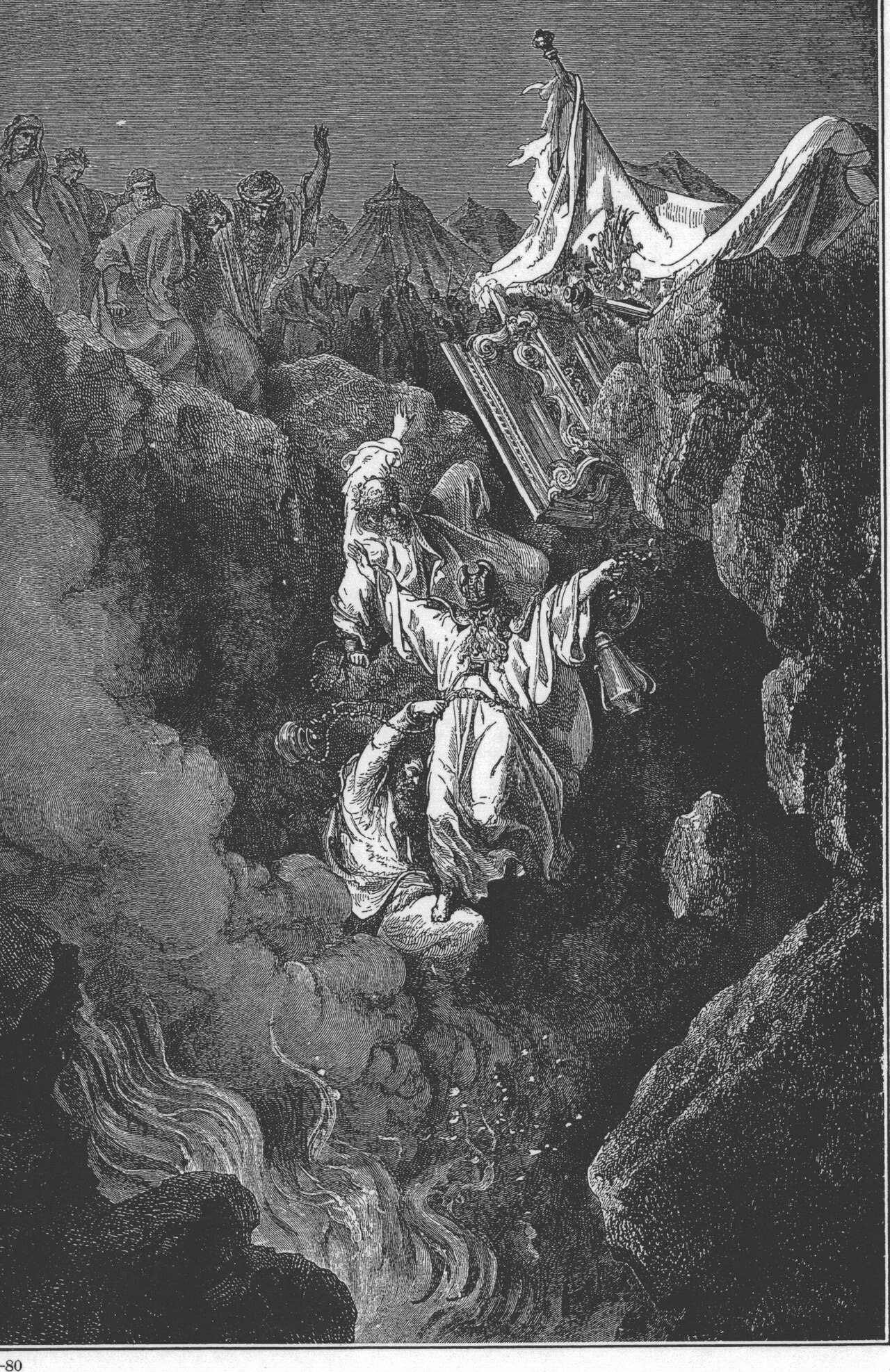
Korah
Korah is a Levite, the son of Izhar the son of Kohath the son of Levi; his brothers are Nepheg and Zichri (BG1940 spells him Коре in this verse). Since Izhar is a brother of Amram, the father of Aaron and Moses, Korah is their cousin, as Smith notes. His sons are Assir, Elkanah and Abiasaph, “the families of the Korhites”. Ellen G. White, Patriarchs and Prophets, chapter 35, describes him as a Levite of the family of Kohath and a cousin of Moses, “a man of ability and influence”. Easton explains the name as “ice, hail” and Smith as “baldness”; Hitchcock gives “baldness; ice; frost”. Exod 6:18; Exod 6:20-21; Exod 6:24; Num 16:1.
In the wilderness Korah, with Dathan and Abiram the sons of Eliab and On the son of Peleth, rises up against Moses with two hundred and fifty princes of the assembly and says to Moses and Aaron, “[Ye take] too much upon you, seeing all the congregation [are] holy” (the rebellion of Korah, Dathan and Abiram). Moses answers Korah and all his company that “to morrow the LORD will shew who [are] his”, bids them take censers, and asks the sons of Levi, “seek ye the priesthood also?” Easton sees the cause in the institution of the Aaronic priesthood, which passed over the old priesthood of the heads of families; the same chapter of Patriarchs and Prophets says that Korah, though appointed to the service of the tabernacle, “aspired to the dignity of the priesthood”, and that the tents of Dathan and Abiram stood near his. Num 16:1-10.
On the morrow Korah gathers all the congregation against Moses and Aaron at the door of the tabernacle, and the glory of the LORD appears; Patriarchs and Prophets remarks that it was the rebels, not Moses, who had called the people together to witness their victory. The congregation is told to get up from about the tabernacle of Korah, Dathan and Abiram (BG1940: жилищата, the dwellings); the earth swallows “all the men that [appertained] unto Korah, and all [their] goods”, and fire from the LORD consumes the two hundred and fifty men that offered incense. The brasen censers become plates for the altar, a memorial that no stranger offer incense, “that he be not as Korah, and as his company”, and the plague that follows kills fourteen thousand and seven hundred “beside them that died about the matter of Korah”. Num 16:16-19; Num 16:24-35; Num 16:38-40; Num 16:49.
Later texts look back to the event. The census list of Numbers 26 recalls that the earth swallowed Dathan and Abiram “together with Korah, when that company died”, and adds, “Notwithstanding the children of Korah died not”; the family of the Korathites remains among the families of the Levites. The daughters of Zelophehad plead that their father “was not in the company of them that gathered themselves together against the LORD in the company of Korah” (their request for an inheritance). Jude names him Core and sets him beside Cain and Balaam: they “perished in the gainsaying of Core” (BG1940: Кореевото упорство). Patriarchs and Prophets sees in the rebellion of Korah, “upon a narrower stage”, the same spirit that led to the rebellion of Satan in heaven. Num 26:9-11; Num 26:58; Num 27:3; Jude 1:11.
His line continues among the Levites. Chronicles lists “Korah his son, Assir his son” under the sons of Kohath, where the father is called Amminadab (a BG1940 note refers to Izhar in verses 2, 18 and 38), and traces the singer Heman back through Ebiasaph to “the son of Korah”. Shallum the son of Kore the son of Ebiasaph the son of Korah and his brethren, the Korahites, keep the gates of the tabernacle (BG1940 writes Korah here as Коревия, the possessive of Коре); Mattithiah, the firstborn of Shallum the Korahite (BG1940: Серум), has charge of the things made in the pans; Korhites such as Elkanah, Jesiah, Azareel, Joezer and Jashobeam are among those who come to David at Ziklag; Meshelemiah is of the Korhites among the porters; and under Jehoshaphat the children of the Korhites stand up to praise the LORD “with a loud voice on high” (Jehoshaphat's prayer and Judah's deliverance). 1 Chr 6:22; 1 Chr 6:33; 1 Chr 6:37; 1 Chr 9:19; 1 Chr 9:31; 1 Chr 12:1; 1 Chr 12:6; 1 Chr 26:1; 1 Chr 26:19; 2 Chr 20:19.
Eleven psalms carry the heading “for the sons of Korah”: Psalms 42, 44–49, 84, 85, 87 and 88, the last also “Maschil of Heman the Ezrahite”, naming Heman the Ezrahite (BG1940: за Кореевите синове, or Кореевите потомци from Psalm 84 on). “Meet the Psalmists”, 1 January 2024, names Psalms 42, 44–47, 49, 84, 85 and 87–88 as composed by the sons of Korah, among the temple musicians who were also Levites (the Bulgarian edition leaves out Psalm 87); “Longing for God in Zion”, 9 March 2024, notes that the sons of Korah had firsthand experience of the blessedness of the Lord's house as temple musicians and keepers of the temple gates. Ps 42:1; Ps 44:1; Ps 45:1; Ps 46:1; Ps 47:1; Ps 48:1; Ps 49:1; Ps 84:1; Ps 85:1; Ps 87:1; Ps 88:1.